
Last updated on August 17th, 2026 at 03:38 pm
Creating valuable content takes time. But publishing a blog post, guide, video, or case study is only the beginning. Even excellent content can struggle to generate traffic if the right people never discover it.
That is where content promotion comes in.
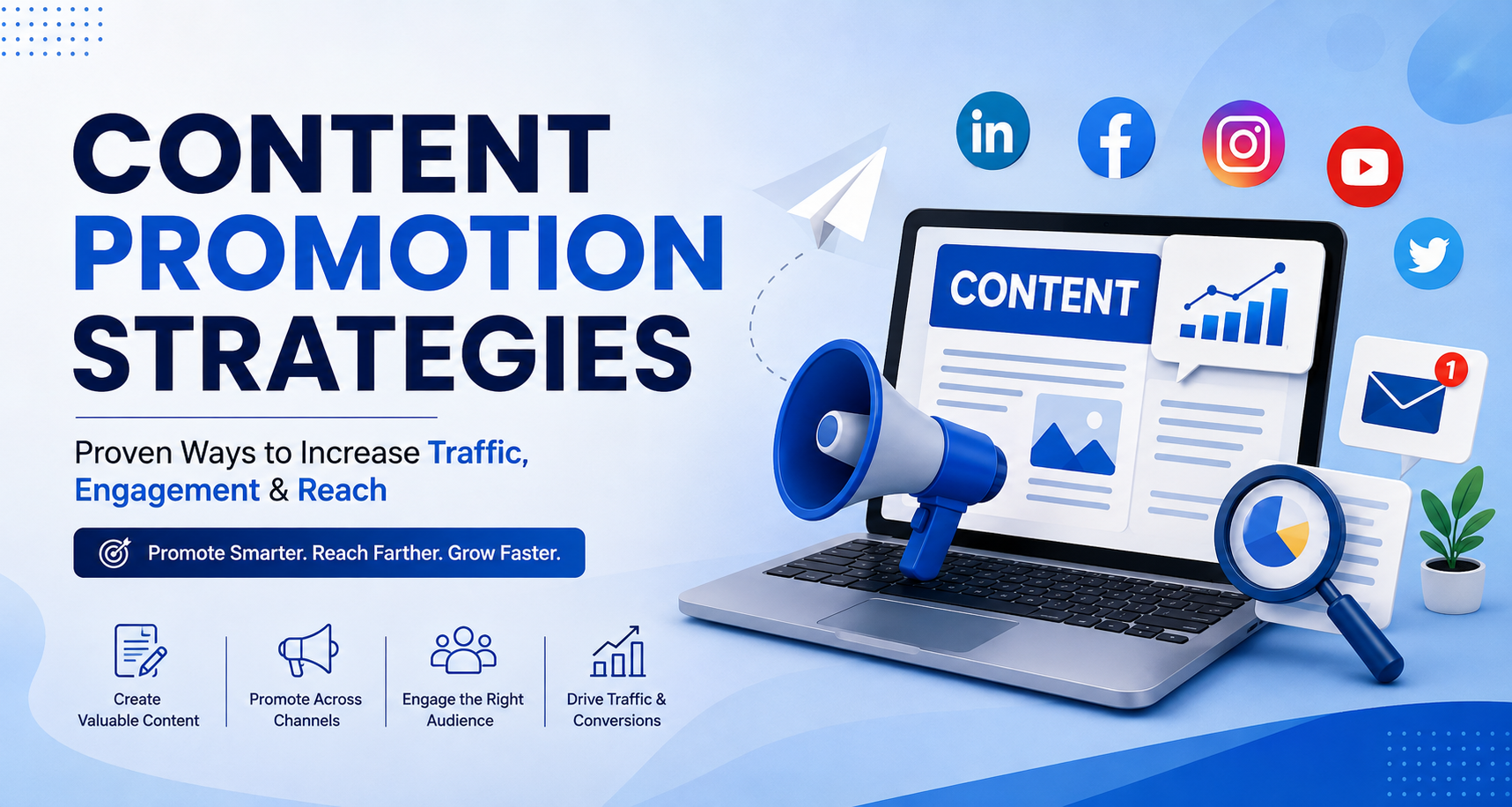
Content promotion is the process of distributing your published content across channels such as search engines, social media, email, online communities, partnerships, outreach, and paid advertising. The goal is not simply to get more views. Effective promotion should help you attract the right audience, generate engagement, earn backlinks, build brand awareness, and ultimately support business growth.
A strong content promotion strategy combines organic and paid channels instead of depending on a single source of traffic.
In this guide, we’ll cover 15 practical content promotion strategies, explain how to build a repeatable promotion workflow, and show you which metrics to track to determine whether your efforts are actually working.
What Is Content Promotion?
Content promotion is the strategic distribution of content after it has been created and published.
For example, publishing a detailed blog post does not mean your promotional work is finished. That article can also become:
- LinkedIn posts
- Instagram content
- Short-form videos
- An email newsletter
- A downloadable checklist
- A presentation
- An infographic
- A discussion topic for relevant communities
- Outreach material for industry websites
- Supporting content for paid advertising
Think of your original article as the core asset and your promotion channels as the distribution network around it.
The objective is simple: put useful content in front of people who are most likely to find it relevant and valuable.
Why Content Promotion Matters
Search engines can bring long-term organic traffic, but ranking takes time and competition can be high. Social algorithms are also constantly changing, while email lists and professional communities provide opportunities to reach audiences more directly.
A strong promotion strategy can help you:
- Increase website traffic
- Improve content visibility
- Generate qualified leads
- Build backlinks
- Strengthen brand authority
- Increase social engagement
- Reach new audiences
- Extend the lifespan of existing content
- Support SEO performance
- Generate conversions from existing content assets
The important point is that content creation and content promotion should work together.
A useful piece of content with no distribution may remain invisible. A well-promoted piece of content has more opportunities to attract readers, shares, mentions, links, and conversions.
15 Content Promotion Strategies
1. Share Content on Social Media
Social media is one of the easiest places to start promoting newly published content.
However, avoid copying the same blog link and caption across every platform. Each channel has different user behavior and content formats.
For example:
- Turn the article’s key points into a LinkedIn post.
- Create a carousel summarizing the main lessons.
- Convert an important section into a short video.
- Use an interesting statistic or insight as a standalone social post.
- Ask a question related to the article to encourage discussion.
The goal should not always be to push people directly to the website. First create something useful on the platform, then give users a reason to explore the full article.
2. Repurpose One Article Into Multiple Content Formats
One of the most efficient promotion strategies is content repurposing.
Instead of creating ten completely new pieces of content, take one strong article and turn it into multiple assets.
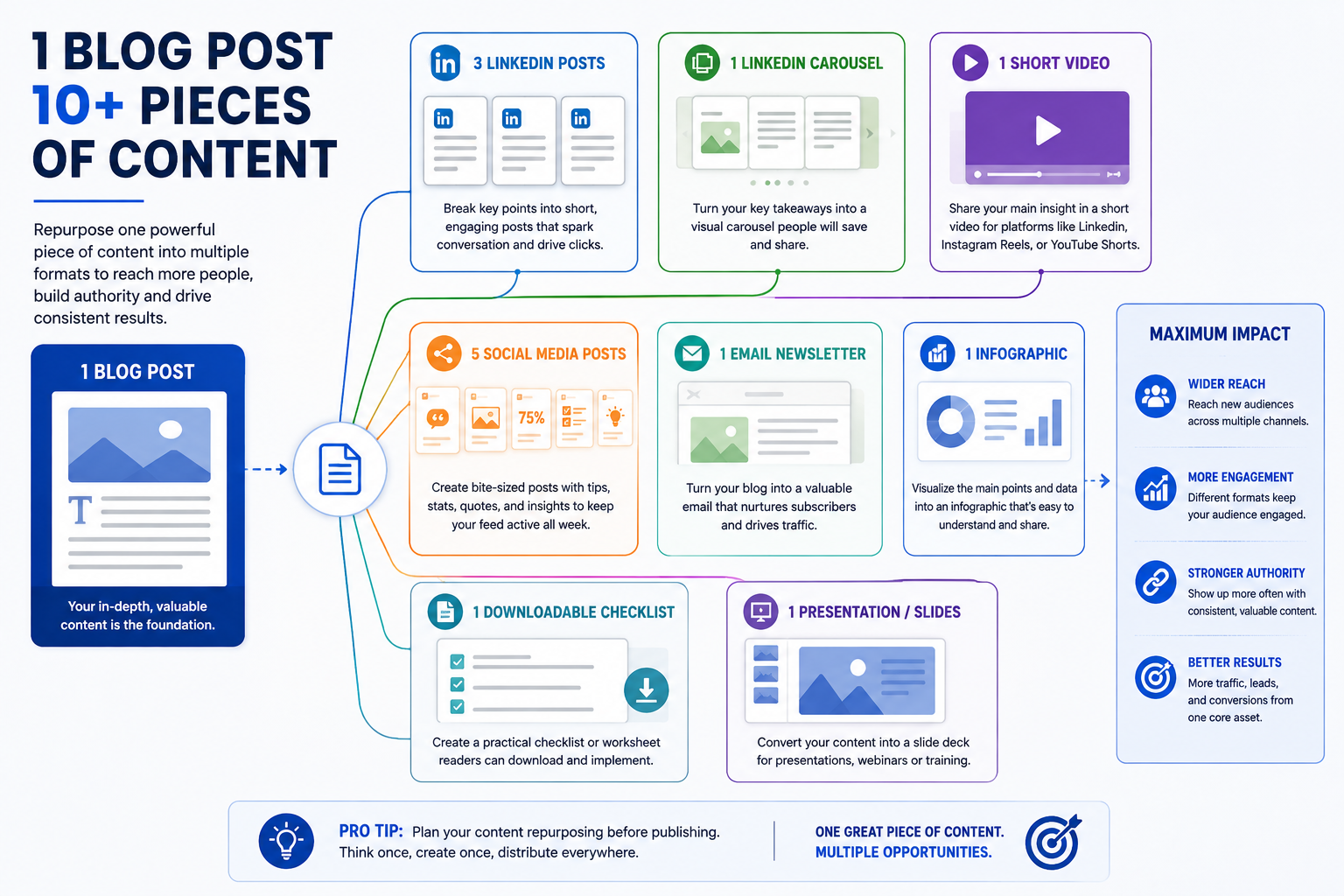
For example:
1 blog post → 1 LinkedIn carousel → 3 LinkedIn posts → 1 short video → 5 social posts → 1 email → 1 infographic
This increases your content’s reach while reducing the amount of time required to create new material.
The key is to adapt the content instead of simply copying and pasting it.
3. Build an Email Distribution Strategy
Your email subscribers are already familiar with your brand, making email one of the most valuable channels for content promotion.
When publishing a new article, don’t simply send:
“New blog post: Read now.”
Instead, give subscribers a useful reason to click.
For example:
Most businesses spend hours creating content but very little time promoting it. Here are five distribution tactics that can help you get more value from every article you publish.
Then link to the full guide.
You can also segment your email list based on interests, industry, previous engagement, or customer stage so that your content is more relevant to each audience.
4. Promote Content Through LinkedIn
For B2B companies, LinkedIn can be particularly useful for content distribution.
Rather than publishing only the article URL, extract one strong insight and build a native LinkedIn post around it.
A simple structure is:
Problem → Insight → Practical recommendation → Example → CTA
You can then publish additional posts based on different sections of the same article.
This gives one piece of content multiple opportunities to reach your audience.
5. Use Relevant Online Communities
Communities can generate highly targeted traffic when used correctly.
Look for communities where your target audience is already discussing the problem your content addresses.
The important rule is do not spam links.
Participate in the conversation first. Answer questions, provide useful information, and share your article only when it genuinely adds value.
Relevant professional communities, industry groups, discussion platforms, and niche forums can be useful distribution channels when approached naturally.
6. Partner With Industry Influencers and Experts
Influencer marketing doesn’t always mean working with celebrities or large creators.
For B2B and specialist industries, a respected industry expert with a smaller but highly relevant audience may be more valuable.
You can:
- Interview experts for an article.
- Include expert quotes.
- Create a collaborative guide.
- Invite professionals to contribute insights.
- Create an expert roundup.
- Share the finished article with contributors.
When people are genuinely involved in creating a piece of content, they are more likely to engage with or share it.
7. Build Backlinks Through Outreach
Content promotion and link building can work together.
After publishing a valuable resource, identify websites that already discuss the same subject.
Then create a personalized outreach campaign explaining why your resource could add value to their existing content.
Focus on relevance rather than sending hundreds of generic emails.
A strong backlink prospect usually has:
- Relevant subject matter
- A genuine audience
- Useful existing content
- Editorial standards
- A reason to reference your resource
The objective isn’t simply to collect links. It is to earn relevant editorial mentions that can contribute to authority, referral traffic, and discoverability.
8. Use Guest Posting
Guest posting can extend your reach beyond your own website.
Instead of writing generic articles for unrelated websites, identify publications that already reach your target audience.
Choose topics that naturally connect to your expertise and provide genuine value to the host publication.
You can then reference your own resources where they are contextually useful.
Quality matters more than quantity. A small number of relevant publications can be more valuable than dozens of low-quality placements.
9. Leverage Digital PR
If your content contains original research, useful data, expert insights, industry trends, or unique findings, consider promoting it through digital PR.
For example, a company could publish:
“2026 Digital Marketing Performance Report”
The data can then become the basis for:
- Press outreach
- Industry commentary
- Expert quotes
- News coverage
- Publisher mentions
- Social content
- Sales material
Original information gives journalists, publishers, and industry professionals a stronger reason to reference your content.
10. Promote High-Value Content With Paid Advertising
Organic promotion isn’t the only option.
Paid advertising can accelerate the distribution of valuable content, particularly when the content supports a larger marketing objective.
Potential channels include:
However, don’t promote every blog post simply because it exists.
Paid promotion is generally better suited to content that:
- Targets a valuable audience
- Supports a commercial topic
- Generates leads
- Builds remarketing audiences
- Demonstrates expertise
- Supports a larger campaign
Start with a clear objective and track the result rather than optimizing only for clicks.
11. Use Retargeting to Re-Engage Visitors
Someone who reads one article may not be ready to become a customer immediately.
Retargeting allows you to reconnect with visitors who have already interacted with your website.
For example:
Blog visitor → Retargeting ad → Service page → Lead form
This approach can be particularly useful when informational content sits at the top of your marketing funnel.
The important thing is to maintain relevance. A visitor who read an SEO guide should receive an offer related to SEO rather than an unrelated service.
12. Collaborate With Complementary Brands
Look for businesses that serve a similar audience without directly competing with you.
For example, a web development company and a CRM consultant could collaborate on:
“The Complete Guide to Building a Lead-Generating Website and CRM Funnel.”
Both businesses can contribute expertise and promote the finished resource to their respective audiences.
This creates a mutually beneficial distribution opportunity while introducing each brand to a new but relevant audience.
13. Update and Republish Existing Content
Content promotion doesn’t always mean creating something new.
Sometimes your existing content already has the foundation for stronger performance.
Review older articles and look for:
- Outdated statistics
- Old screenshots
- Broken links
- Missing sections
- New industry developments
- Better examples
- New search intent
- Opportunities for internal links
After improving the article, update its publication information where appropriate and promote it again through your existing channels.
A useful article can have multiple promotional cycles throughout its lifespan.
14. Strengthen Internal Linking
Internal links are often overlooked as a content promotion method.
When you publish a new article, identify older relevant pages that can link to it.
For example, an article about content promotion could be connected to pages covering:
- SEO
- Digital marketing
- Content marketing
- Social media marketing
- Paid advertising
- Content creation
This helps readers discover related information and creates a stronger relationship between pages across your website.
Internal linking should be natural and useful. Avoid adding links simply to increase the number of links on a page.
15. Optimize Content for Search and AI-Driven Discovery
Content promotion shouldn’t stop at social media and paid advertising.
Your content should also be structured so that search engines and modern search experiences can understand it clearly.
Start with the fundamentals:
- Match the search intent.
- Use a clear heading structure.
- Answer important questions directly.
- Include relevant entities and terminology naturally.
- Add original insights and examples.
- Keep important information easy to find.
- Strengthen internal linking.
- Maintain accurate and useful information.
- Demonstrate first-hand expertise where possible.
The goal isn’t to write content for algorithms. It is to create content that is genuinely useful, well-structured, trustworthy, and easy to understand.
How to Create a Content Promotion Workflow
A repeatable workflow prevents content promotion from becoming an afterthought.
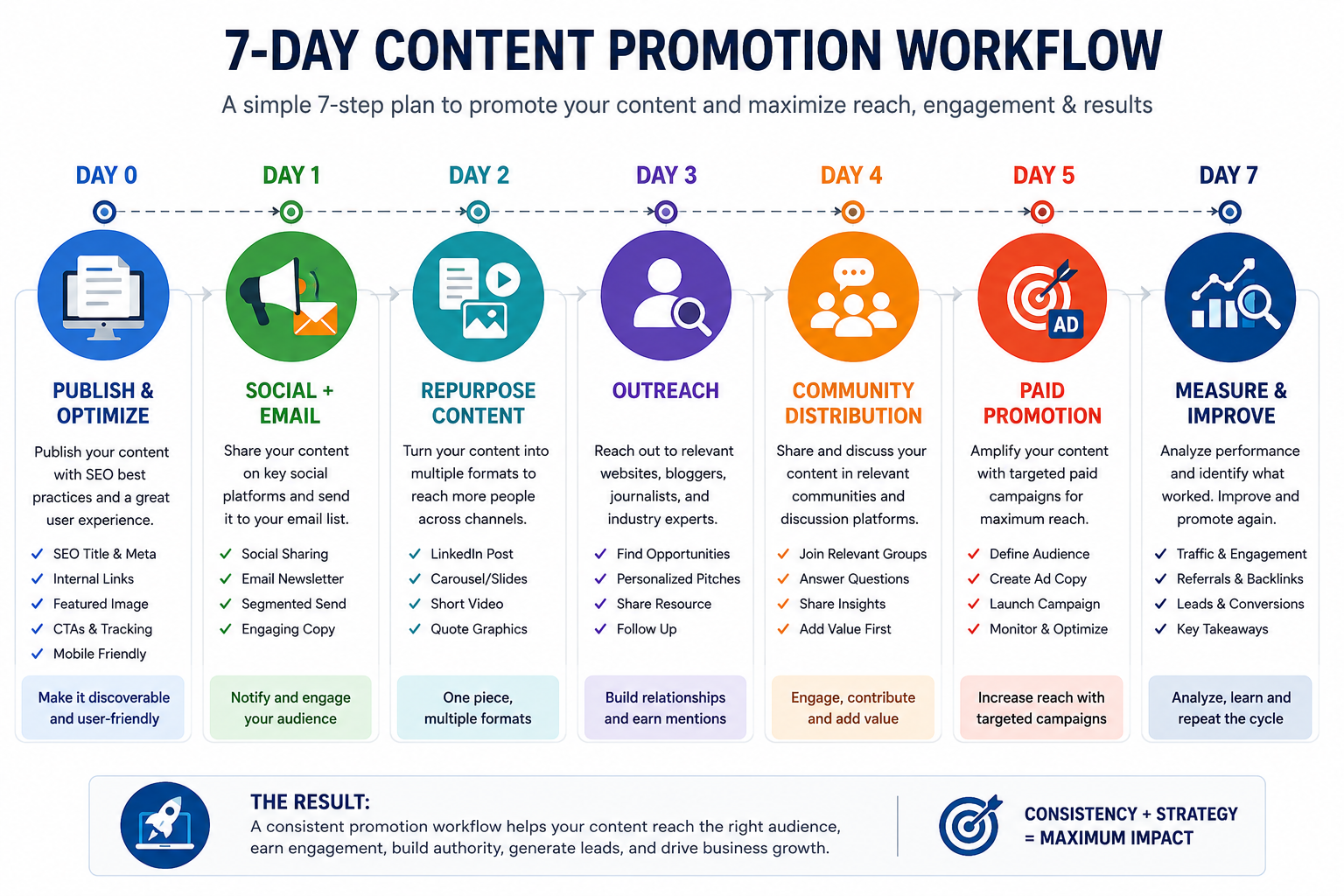
Here’s a simple seven-day framework:
Day 0 — Publish
Publish the article after checking:
- SEO title
- Meta description
- URL
- Internal links
- Images
- CTAs
- Mobile experience
- Tracking
Day 1 — Social + Email
Share the article through your main social channels and send it to the appropriate email segment.
Day 2 — Create Supporting Content
Turn the article into:
- A carousel
- Short posts
- A video
- A visual summary
Day 3 — Outreach
Identify relevant publishers, experts, websites, and communities that may benefit from the content.
Day 4 — Community Distribution
Participate in relevant discussions and contribute useful insights from the article where appropriate.
Day 5 — Paid Promotion
If the article supports a commercial objective, test paid distribution against a clearly defined audience.
Day 7 — Review Performance
Check traffic, engagement, referrals, backlinks, conversions, and search visibility.
Then decide whether to continue, improve, repurpose, or redistribute the content.
Content Promotion Metrics to Track
Getting traffic is useful, but traffic alone doesn’t tell you whether your strategy is working.
Track metrics based on your objective.
| Metric | What It Tells You |
| Organic traffic | Whether search is generating visibility |
| Referral traffic | Which external channels send visitors |
| Social engagement | Whether your content resonates |
| Click-through rate | Whether promotion generates interest |
| Backlinks | Whether other websites find the content valuable |
| Leads | Whether content contributes to business opportunities |
| Conversion rate | Whether visitors take desired actions |
| Assisted conversions | Whether content supports later conversions |
For example, a blog post with 2,000 visitors and no leads may be less commercially valuable than an article with 500 highly targeted visitors that generates 20 qualified enquiries.
Always connect content metrics to the business objective.
Common Content Promotion Mistakes
Even a strong article can underperform if its promotion strategy is weak.
Avoid these common mistakes:
Publishing Once and Forgetting About It
One social post isn’t a promotion strategy. Valuable content can be redistributed in different formats over time.
Using the Same Message Everywhere
Different platforms require different formats, hooks, and communication styles.
Buying Low-Quality Backlinks
Focus on relevance and editorial value rather than backlink volume.
Promoting Every Piece With Paid Ads
Not every article deserves an advertising budget. Prioritize content that supports measurable objectives.
Measuring Only Pageviews
Traffic is useful, but leads, conversions, engagement, and qualified referral traffic can provide more meaningful insights.
Creating Content Without a Distribution Plan
Before publishing, decide how the content will be promoted. Distribution should be part of the content strategy from the beginning.
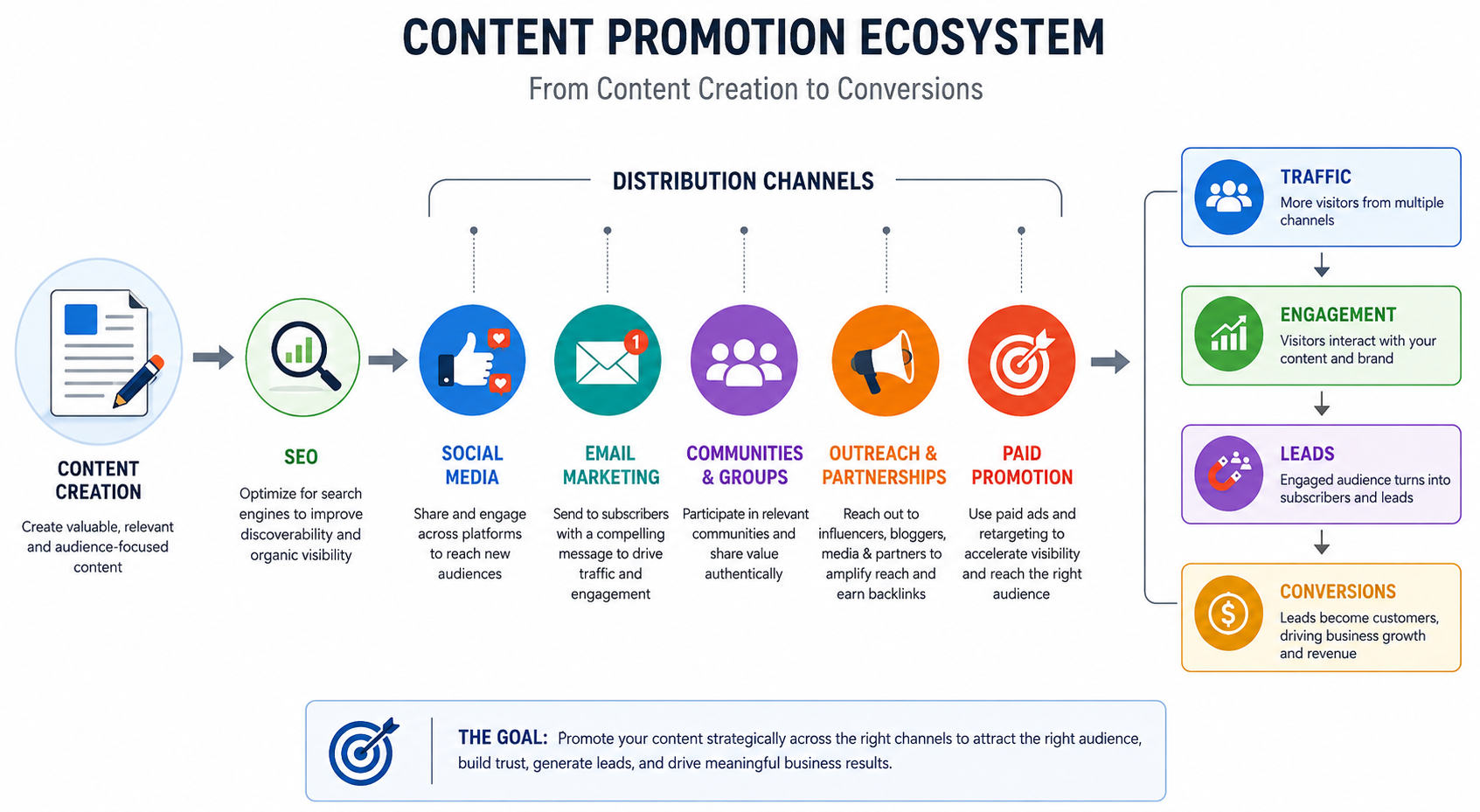
A Simple Content Promotion Ecosystem
The most effective approach combines multiple channels:
Content Asset
↓
SEO + Internal Linking
↓
Social Media + Email
↓
Communities + Partnerships
↓
Outreach + Digital PR
↓
Paid Promotion + Retargeting
↓
Traffic + Engagement
↓
Leads + Conversions
This approach turns content promotion from a collection of random marketing activities into a repeatable system.
Frequently Asked Questions
What is content promotion?
Content promotion is the process of distributing published content through channels such as search engines, social media, email, communities, partnerships, outreach, and paid advertising to increase its visibility, traffic, engagement, and business impact.
What are the best content promotion strategies?
Some of the most effective strategies include SEO, social media distribution, email marketing, content repurposing, backlink outreach, guest posting, digital PR, partnerships, paid advertising, retargeting, and community engagement.
How do I promote a blog post?
Start by sharing it with relevant audiences through social media and email. Then repurpose the article into additional formats, build relevant outreach opportunities, strengthen internal links, participate in relevant communities, and consider paid promotion when the content supports a valuable business objective.
Can I promote content without paid advertising?
Yes. SEO, social media, email marketing, internal linking, community participation, partnerships, guest posting, digital PR, and organic outreach can all generate content visibility without requiring an advertising budget.
How long should I promote a piece of content?
There is no fixed promotional period. High-quality evergreen content can be promoted repeatedly over months or even years. Review performance regularly and refresh the content when information, search intent, or industry conditions change.
What is the difference between content marketing and content promotion?
Content marketing is the broader strategy of using valuable content to attract, educate, engage, and convert an audience. Content promotion is the distribution component that helps that content reach the intended audience.
Final Takeaway
Creating great content is only half the job.
The real opportunity comes from building a system that consistently puts that content in front of the right people.
Instead of publishing an article and waiting for traffic, combine SEO, social media, email, content repurposing, communities, partnerships, outreach, digital PR, paid advertising, and retargeting based on the audience and objective.
Most importantly, measure what happens after distribution.
The goal isn’t to generate the largest possible number of views. It is to attract the right audience, create meaningful engagement, earn authority, generate qualified traffic, and turn useful content into measurable business results.
If your business is creating content but struggling to turn that content into traffic and leads, a structured content promotion strategy can help connect your content efforts with your broader SEO, digital marketing, and growth goals.
Ready to get more value from your content? ThirdEssential can help businesses combine content marketing, SEO, paid advertising, and digital marketing into a strategy designed around measurable growth.