
Last updated on August 13th, 2026 at 05:54 pm
Educational institutions are no longer using their websites only as digital brochures. Today, a school, college, university, coaching institute, or online academy may use its website to publish courses, manage admissions, communicate with students, promote events, share academic resources, collect enquiries, and deliver online learning.
That makes choosing the right website platform an important decision.
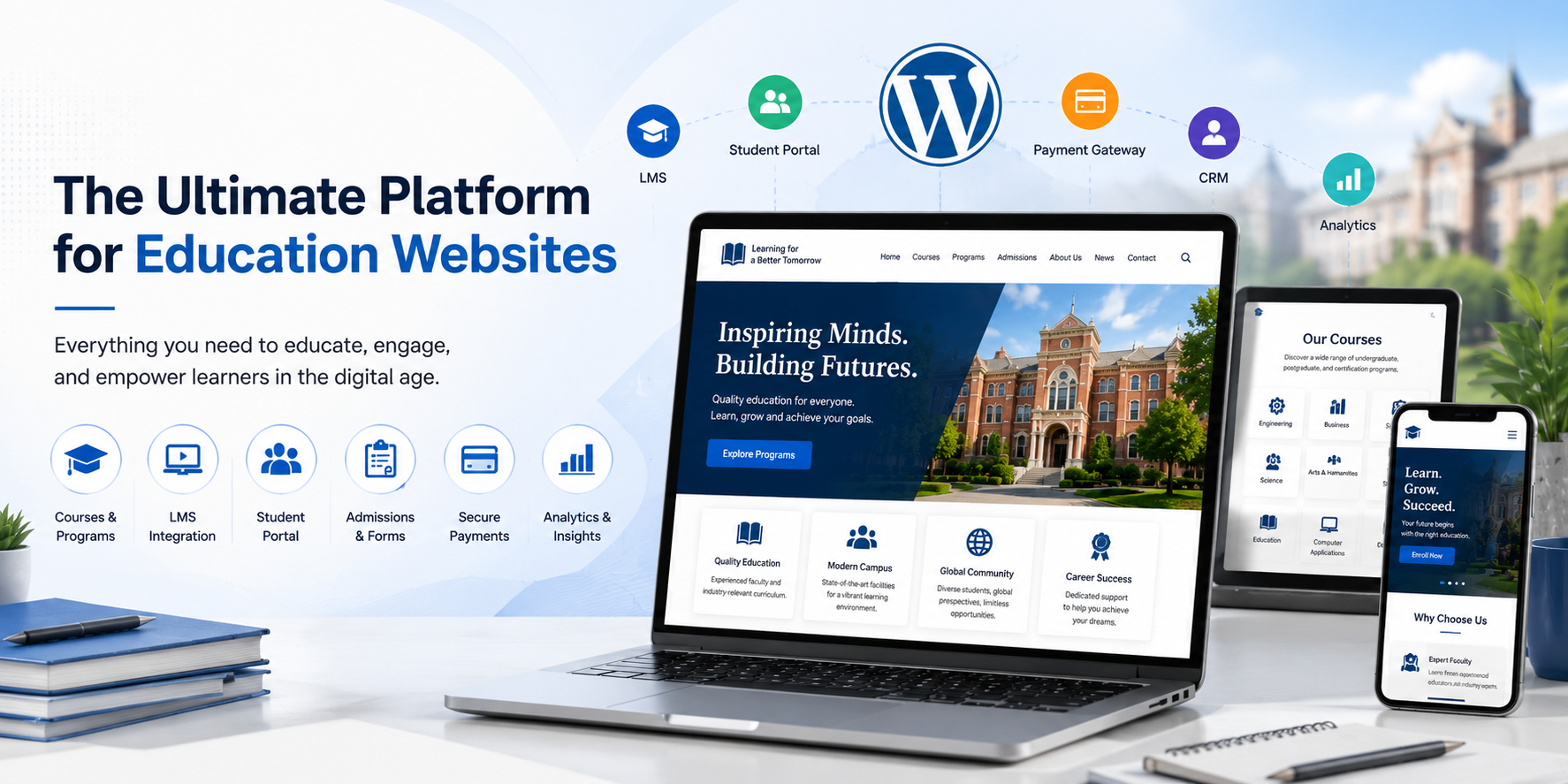
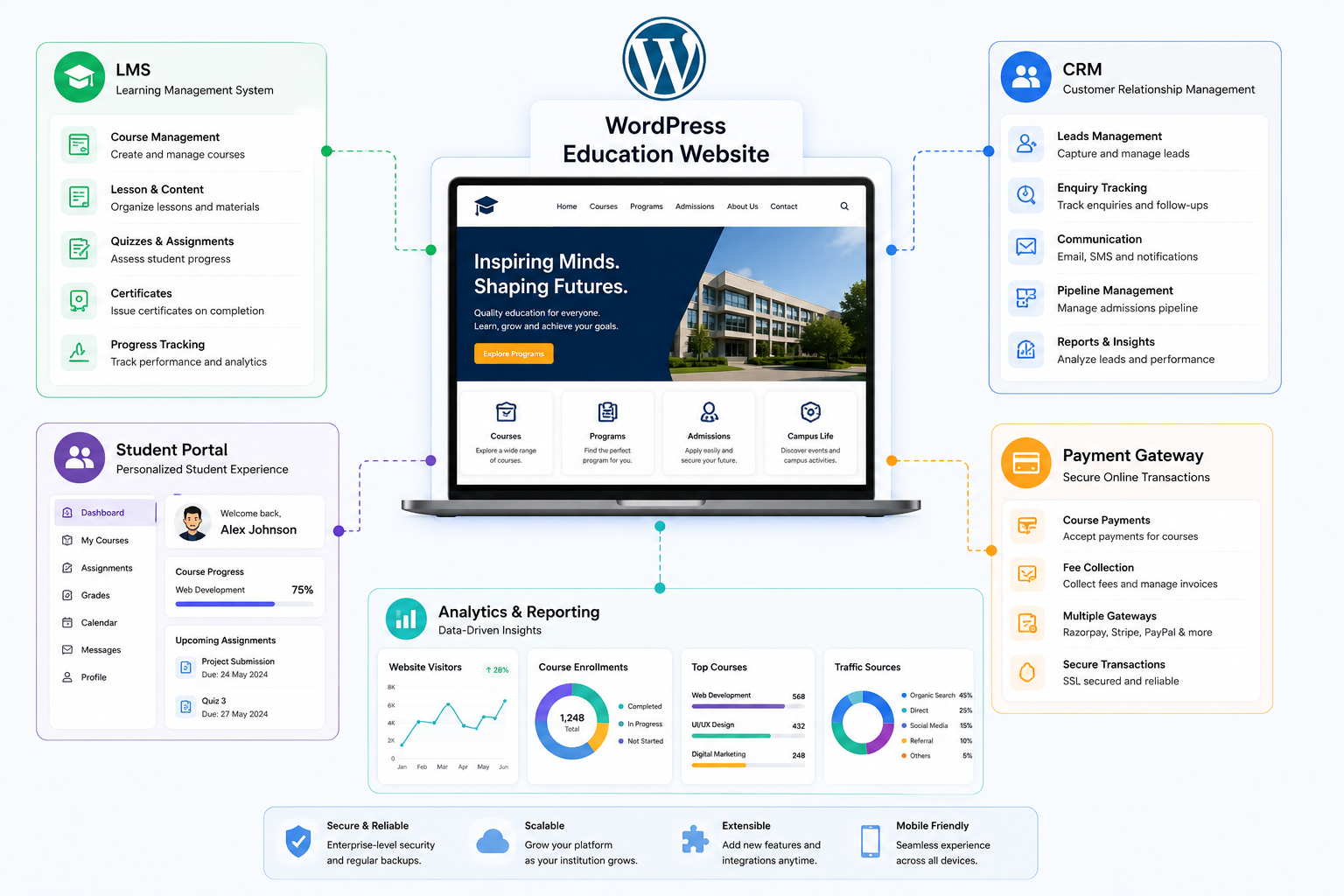
WordPress development for education websites offers a flexible approach because WordPress can support both simple informational websites and more advanced education platforms. With the right combination of themes, plugins, integrations, and custom development, an education website can be adapted to meet the specific requirements of an institution.
From course pages and faculty directories to LMS integration, student portals, online payments, CRM connections, and SEO, WordPress provides a foundation that can grow as the organization grows.
But is WordPress actually the right platform for an education website? Let’s look at what makes it suitable and what institutions should consider before starting development.
Why Do Education Websites Need a Flexible Platform?
Education websites usually contain more content and functionality than a standard business website.
A school may need pages for admissions, academics, faculty, facilities, events, notices, activities, and parent resources. A university may need separate sections for departments, programs, faculty members, research, admissions, and student services.
An online academy may have completely different requirements, including courses, lessons, quizzes, student accounts, subscriptions, payments, and progress tracking.
Because these requirements can change over time, an education website needs a platform that allows administrators to add and update content without rebuilding the entire website.
This is one of the reasons organizations consider WordPress. Its content management system makes everyday content updates relatively straightforward, while its development ecosystem provides options for adding more advanced functionality when needed.
1. Easy Content Management
One of the biggest advantages of WordPress is its content management system.
Education organizations regularly publish new information. Admission deadlines change, new courses are introduced, examination dates are announced, events are scheduled, and important notices need to be published.
With WordPress, administrators can manage pages, posts, images, documents, announcements, and other content from a centralized dashboard.
A properly structured website can also separate different types of information. For example, courses can have their own templates, while faculty profiles, events, news, and resources can be managed independently.
This becomes particularly useful for larger educational websites where multiple teams may be responsible for maintaining different sections.
For organizations with more specific requirements, custom WordPress development can be used to create custom content structures and administration workflows.
2. Flexible Design and Customization
An education website needs to communicate credibility while making information easy to find.
A university website may require a formal structure with departments and academic programs. A coaching institute may need a more conversion-focused design with course pages, enquiry forms, testimonials, and calls to action.
WordPress allows these designs to be customized according to the organization’s brand and audience.
Pre-built themes can be useful for smaller projects, but organizations with unique requirements may benefit from custom WordPress website development. Developers can create custom page templates, layouts, navigation systems, forms, and functionality instead of forcing the website into the limitations of a pre-designed theme.
Customization can also extend to the website’s backend, allowing administrators to manage different types of educational content more efficiently.
3. Responsive Websites for Students and Parents
Students and parents do not access education websites only from desktop computers. They may search for courses, check admission information, read announcements, or complete forms using smartphones and tablets.
A responsive website adapts its layout and functionality to different screen sizes.
For an education website, this is particularly important for:
- Admission forms
- Course pages
- Contact forms
- Online registrations
- Faculty profiles
- Event information
- Downloadable resources
- Student portals
Mobile optimization should be considered during the development process rather than added later.
Page speed, navigation, font sizes, images, forms, and interactive elements all need to work properly on smaller screens.
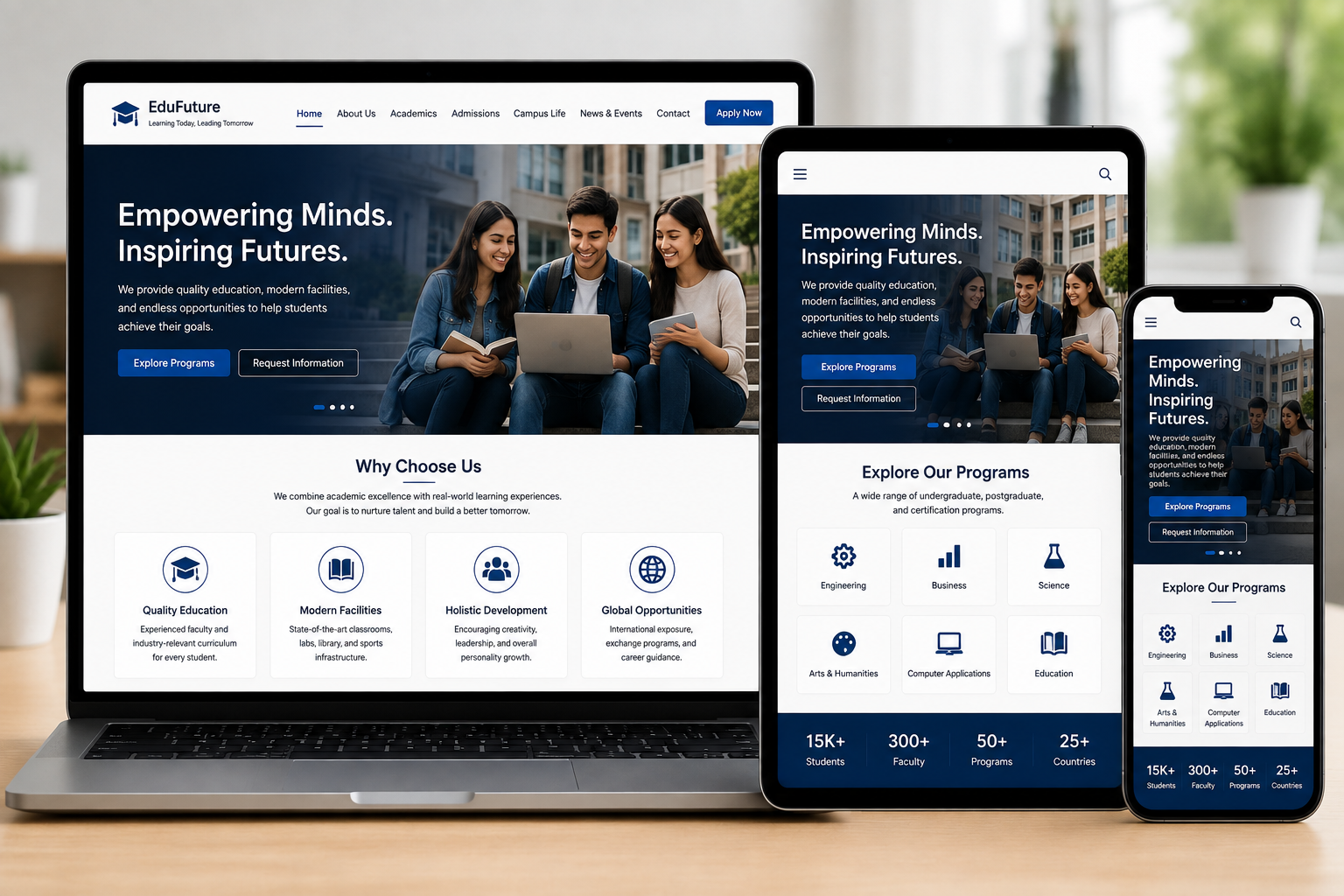
Suggested alt text: Responsive WordPress education website displayed across desktop tablet and mobile devices
4. LMS Integration for Online Learning
One of the most important considerations for modern education businesses is online learning.
Schools, universities, coaching institutes, and online academies may want to provide courses, lessons, assessments, and learning resources through their websites.
WordPress can be extended with Learning Management System functionality.
Depending on the requirements, a WordPress LMS platform can include:
- Course and lesson management
- Student registration
- Instructor profiles
- Quizzes and assessments
- Student dashboards
- Course progress tracking
- Memberships
- Paid courses
- Certificates
- Email notifications
- Learning resources
The exact LMS solution should depend on factors such as the number of students, course structure, payment requirements, content type, reporting needs, and integrations.
For organizations with specialized requirements, WordPress LMS development can involve customizing existing functionality or building additional features around the LMS.
This makes WordPress useful not only for informational education websites but also for organizations delivering online education.
5. Course and Program Management
Educational institutions often have large amounts of course-related information.
A university could have hundreds of programs across different departments. A coaching institute may offer multiple courses for different exams or skill levels.
Instead of creating every page manually, WordPress can be structured to manage courses systematically.
A course page might include:
- Course name
- Overview
- Duration
- Eligibility
- Curriculum
- Fees
- Learning outcomes
- Faculty
- FAQs
- Admission information
- Enquiry form
This structure also creates SEO opportunities because individual course and program pages can target relevant search queries.
A well-planned content architecture makes it easier for users to navigate between courses, departments, faculty members, and related resources.
6. Faculty and Staff Profiles
Faculty members are an important part of an education institution’s online presence.
A structured faculty directory can include:
- Name
- Designation
- Department
- Qualifications
- Areas of expertise
- Experience
- Publications
- Research interests
- Contact information
WordPress can be customized to create reusable faculty profile templates.
This means administrators can add new faculty members without designing a completely new page each time.
For universities and colleges, this can also improve the overall information architecture of the website by allowing visitors to browse faculty members by department or specialization.
7. Admission and Registration Forms
For many education businesses, the website is also a lead-generation and admissions channel.
Prospective students may use the website to:
- Request information
- Enquire about courses
- Register for an event
- Apply for admission
- Schedule a consultation
- Download a prospectus
- Request a callback
These forms can be connected with email systems, CRM platforms, marketing automation tools, or other business applications.
For example:
Website → Admission Form → CRM → Admissions Team
This type of workflow can reduce manual data entry and make it easier for admissions teams to respond to prospective students.
Advanced requirements may involve custom WordPress integrations using APIs, webhooks, or middleware.
8. CRM, Payment, and Third-Party Integrations
Education websites often need to work alongside other software.
An institution may already use a CRM, student management system, payment gateway, email marketing platform, analytics platform, or communication tool.
WordPress can connect with these systems through plugins and APIs.
For example, an online academy could have a workflow such as:
Course Page → Payment → Registration → Student Account → Course Access
A coaching institute might use:
Landing Page → Enquiry Form → CRM → Sales Follow-Up
These integrations can make the website part of a larger digital ecosystem rather than an isolated platform.
For more complex projects, WordPress API integration can be used to exchange data between WordPress and external applications.
9. SEO-Friendly Website Architecture
Having an education website is not enough if prospective students cannot find it.
Search engine optimization should therefore be considered during WordPress development.
A strong education website can include:
- SEO-friendly URLs
- Optimized page titles
- Meta descriptions
- Structured heading hierarchy
- Internal linking
- XML sitemaps
- Schema markup
- Optimized images
- Mobile-friendly pages
- Fast-loading content
- Proper canonicalization
- Clean site architecture
The website structure should also reflect how users search for information.
For example, a university could organize content around:
University → Department → Program → Course
A coaching institute might use:
Institute → Exam → Course → Batch
This type of structure helps users navigate the website while creating a logical relationship between related content.
A strong WordPress SEO development strategy can therefore support both usability and organic search visibility.
10. Performance and Scalability
Education websites can grow significantly over time.
A small institute might initially have 20 pages but eventually publish hundreds of course pages, blogs, faculty profiles, resources, and event pages.
Online education platforms may also experience traffic spikes during admissions, course launches, or examination periods.
Performance therefore needs to be considered from the beginning.
Important areas include:
- Quality hosting
- Caching
- Image optimization
- CDN implementation
- Database optimization
- Lightweight themes
- Careful plugin selection
- Code optimization
- Core Web Vitals
- Regular performance monitoring
Simply installing many plugins can create performance and compatibility problems.
For larger websites, experienced WordPress developers should evaluate the technical architecture before adding functionality.
11. Security and Website Maintenance
Education websites may collect information through admission forms, registrations, student accounts, and payment systems.
Security should therefore be part of the website’s ongoing management.
Common WordPress security practices include:
- Keeping WordPress updated
- Updating plugins and themes
- Using secure hosting
- Implementing SSL
- Creating regular backups
- Using strong authentication
- Monitoring vulnerabilities
- Limiting unnecessary plugins
- Securing API integrations
Maintenance is equally important.
A website that works properly when launched can develop compatibility, security, or performance issues later if it is not maintained.
Regular WordPress website maintenance can include updates, backups, security monitoring, performance checks, broken-link checks, and technical troubleshooting.
12. WordPress for Different Types of Education Websites
The flexibility of WordPress means it can be adapted to several education-related businesses and institutions.
Schools
School websites can provide information about academics, admissions, faculty, facilities, activities, events, notices, and parent resources.
Colleges and Universities
Universities often require larger information architectures covering departments, programs, faculty, research, admissions, events, student resources, and academic information.
Coaching Institutes
Coaching businesses can use WordPress for course catalogs, faculty profiles, results, testimonials, admission forms, schedules, and lead generation.
Training Institutes
Professional training organizations can publish course information, registration options, certifications, schedules, and learning resources.
Online Academies
Online academies can combine WordPress with LMS functionality to deliver courses, assessments, memberships, payments, certificates, and student dashboards.
13. WordPress Can Support Multilingual Education Websites
Educational organizations may serve students from different regions and countries.
A multilingual WordPress website can provide content in multiple languages while maintaining a centralized content management system.
This can be useful for:
- International schools
- Universities
- Language institutes
- International training organizations
- Global online academies
Multilingual implementation needs to be planned carefully because translated URLs, metadata, internal links, sitemaps, and hreflang implementation can affect SEO.
The goal should be to provide a consistent experience for users while allowing search engines to understand the relationship between different language versions.
14. WordPress vs a Basic Website Builder
A simple website builder may be sufficient for an organization that only needs a few informational pages.
However, education websites can become more complex as requirements increase.
An institution may eventually need:
- LMS functionality
- Student accounts
- Course management
- CRM integration
- Payment gateways
- Custom forms
- API integrations
- Advanced SEO
- Custom reporting
- Membership functionality
WordPress provides more flexibility for organizations that expect their website to evolve.
That does not mean WordPress is automatically the right choice for every project. The platform should be selected based on the organization’s functionality, budget, technical requirements, expected traffic, and long-term plans.
15. Best Practices for WordPress Education Website Development
Before development begins, it is useful to define the website’s requirements and information architecture.
Some important considerations include:
Understand the Audience
Identify whether the primary users are students, parents, faculty, administrators, or business customers.
Plan the Information Architecture
Organize courses, departments, resources, admissions, and other content logically.
Prioritize Mobile Experience
Make sure important pages and forms work well on mobile devices.
Keep the Website Fast
Optimize images, scripts, plugins, databases, and hosting.
Plan Integrations Early
If the website needs a CRM, LMS, payment gateway, or external application, account for it during development.
Build With SEO in Mind
Use a logical URL structure, internal linking strategy, metadata, schema, and crawlable architecture.
Consider Future Growth
Avoid building an architecture that works only for the current number of pages or users.
Common Challenges With WordPress Education Websites
WordPress is flexible, but flexibility also requires proper planning.
One common problem is relying on too many plugins. While plugins can add functionality quickly, poorly maintained or conflicting plugins can create security and performance issues.
Another challenge is choosing the wrong hosting environment for the expected traffic.
Large education platforms may also require custom development rather than relying entirely on pre-built plugins.
There can also be challenges with integrations. A CRM, LMS, payment gateway, or student management system may have different APIs and data structures that need to be connected correctly.
Working with experienced developers and planning the technical architecture before development can help reduce these problems.
Final Thoughts
WordPress has evolved beyond being a simple blogging platform. Its combination of content management, customization, integrations, and extensibility makes it a practical option for many types of education websites.
A school may need a straightforward website for admissions and announcements. A university may require a large content architecture covering departments, programs, faculty, research, and student resources. An online academy may need a complete LMS with courses, payments, assessments, and student dashboards.
WordPress can support these different requirements when the platform is planned and developed correctly.
The important factor is not simply choosing WordPress. The website needs the right architecture, content structure, integrations, performance strategy, security practices, and ongoing maintenance.
For organizations planning a new education website or upgrading an existing one, professional WordPress development services in indore can help turn those requirements into a scalable digital platform while keeping the website manageable for the internal team.
Ultimately, a successful education website should do more than present information. It should make it easier for students, parents, faculty, and administrators to find, access, and interact with the information and services they need.
Frequently Asked Questions
Is WordPress a good platform for education websites?
Yes. WordPress can support schools, colleges, universities, coaching institutes, training organizations, and online academies. It can be used for both informational websites and more advanced platforms with LMS, payment, CRM, and student-management functionality.
Can WordPress be used for an online education platform?
Yes. WordPress can be combined with LMS functionality to create online courses, lessons, quizzes, student accounts, progress tracking, memberships, payments, and certificates.
Can a WordPress education website integrate with a CRM?
Yes. WordPress can connect with CRM systems through plugins, APIs, webhooks, or custom integrations. This can help manage enquiries and admissions more efficiently.
Can WordPress handle online course payments?
Yes. Payment gateways can be integrated into WordPress websites to accept payments for courses, registrations, memberships, applications, and other educational services.
Can an education website be customized with WordPress?
Yes. WordPress themes, templates, plugins, APIs, forms, databases, and other components can be customized depending on the requirements of the project.
How much does WordPress education website development cost?
The cost depends on the website’s size, design requirements, number of pages, LMS functionality, integrations, custom features, payment systems, and ongoing maintenance requirements. A simple informational website will generally require a different development investment than a full education platform.
Does WordPress support SEO for education websites?
Yes. WordPress provides a flexible foundation for technical SEO, content optimization, structured data, internal linking, XML sitemaps, mobile optimization, and performance improvements.