

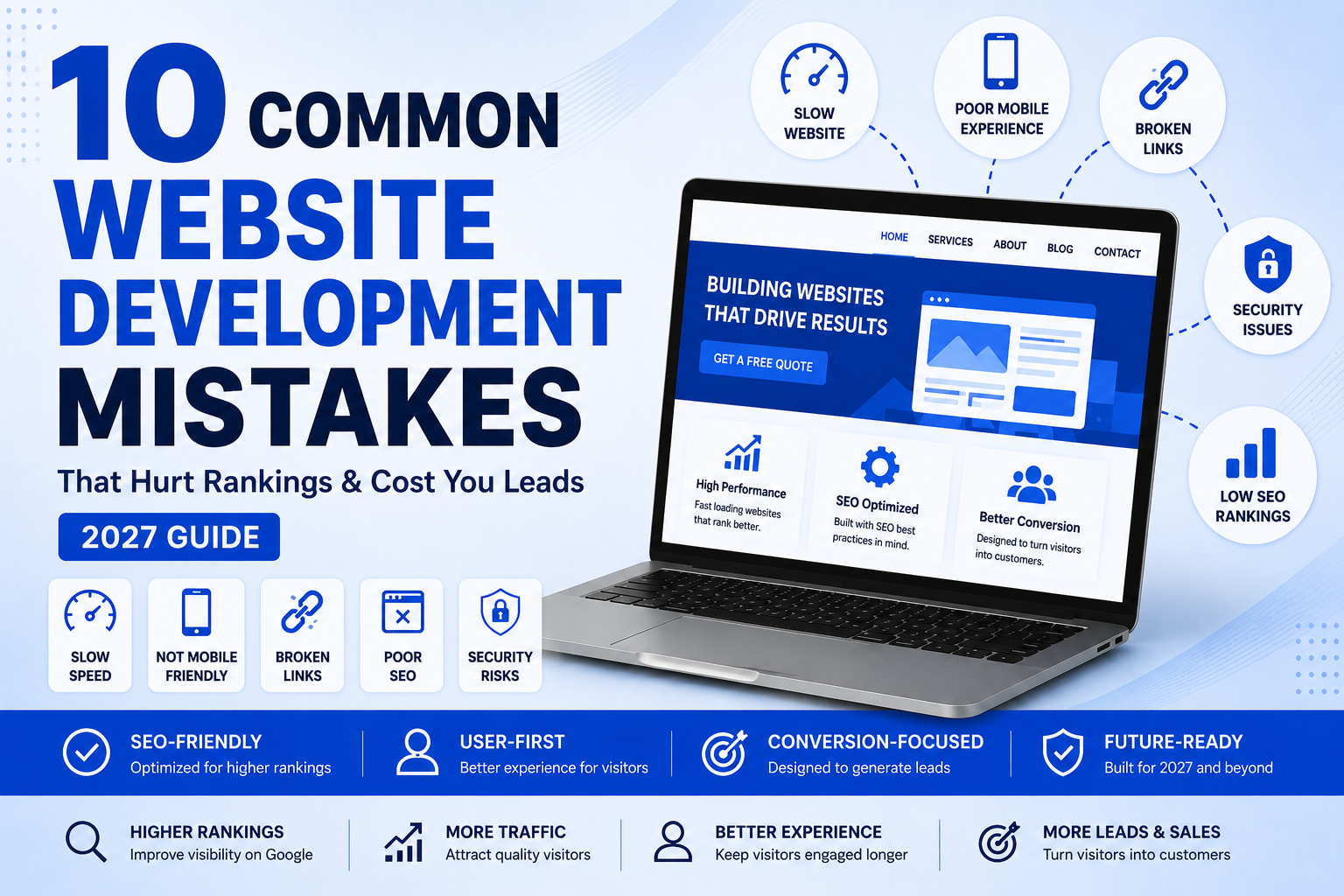
10 Common Website Development Mistakes That Cost Businesses Leads in 2027 (And How to Fix Them)

10 Common Website Development Mistakes That Cost Businesses Leads in 2027 (And How to Fix Them)

What Are the Most Common Website Development Mistakes?

Some of the most frequent website development mistakes involve slow website loading speeds, lack of mobile responsiveness, confusing website navigation, lack of implementable SEO, missing calls-to-action, outdated security protocols, poorly optimized images, broken links, poor accessibility, and failing to maintain your website.

These problems can lower your website’s rankings on Google, affect the user experience, and it can impact the conversion rate. In 2027, a successful website will be fast, mobile-friendly, secure, easy to navigate, search engine optimized and also designed to help users achieve their objectives with as much ease as possible. 

Introduction

Imagine spending thousands of dollars on a beautiful website only to realize that it isn’t bringing in customers.

Sadly, this occurs more frequently than business owners would like.

Many business owners feel that they have a website, and that is all they need. In practice, though, creating a website is the starting point. If the site is slow, difficult to navigate, not optimized for search engines or doesn’t answer visitors’ questions, potential customers will leave within a few seconds and look elsewhere.

The role of today’s websites is not just so much to display information. They will be responsible for educating visitors, building trust, generating leads, and being one seamless experience on their desktop, tablet and smartphone.

Search engines also have undergone many changes. Google now considers technical performance, helpful content, user experience, security, accessibility and trustworthiness of websites when assessing their performance. AI Search experiences also reward websites that give the users accurate, clear, and useful answers to their queries.

Any development error, even the smallest of them, can have a major effect on your online visibility and business growth.

From a new website to a redesign, steering clear of these blunders can keep you from spending money unnecessarily, time or perhaps qualified leads.

In this comprehensive guide, we will be discussing the most common mistakes businesses tend to make while creating websites for their businesses in 2027 and explaining why they are important, so you can implement them and make your website better for both users and Google. 

Why Website Development Matters More Than Ever in 2027

Your website no longer just serves as a digital brochure, but is frequently the first time potential customers interact with your business. It can often form their initial impression within seconds.

A professionally designed website can easily help visitors find your information or help them to navigate to your site quickly, which will help to build trust in your brand, and will help to lead them to take some form of action, be it requesting a quote, booking a consultation or even making a purchase.

On the other hand, a badly designed website can cause obstacles to your visitors and make it difficult for them to engage with your business.

For example:

  • Slow websites put up more “bounce rates”.
  • It can be hard for users to find important information when it is confusing to navigate.
  • Lack of mobile optimization leads to a bad user experience for smartphone users.
  • Poor technical SEO hobbles searchability.
  • The lack of security measures brings down customer trust.
  • Lack of accessibility prevents potential customers from accessing the product.
  • Several disciplines are involved with modern website development:
  • User Experience (UX)
  • User Interface (UI)
  • Technical SEO
  • Website Performance
  • Accessibility
  • Security
  • Conversion Optimization
  • Mobile Responsiveness
  • Content Structure

If all of these factors are aligned, your website becomes a valuable asset to your business that will consistently bring in leads and help the business grow over time.

Companies that make investments in professional website development will be more inclined to:

Optimize websites for search engines. Optimize websites for search engine ranking

  • Increase website traffic
  • Increase qualified leads.Tackle better leads.
  • Build customer trust
  • Reduce bounce rates
  • Improve conversion rates

Avoid being outcompeted by other businesses in their field.

From startups to local service providers and expanding enterprises, a robust website provides a solid basis for digital marketing strategies.

Looking for expert help? We create high-performance, search engine optimized websites that help businesses expand at Third Essential. Check out our Website Development Services to see how we can help produce a website that can help you achieve your long-term objectives. 

Mistake #1: Prioritizing Design Over Performance

While a website may gain attention with its visual appeal, it will lose it if it takes a long time to load or appears unresponsive.

Many businesses spend a lot of money on creating animations, high-resolution media and elaborate visual effects and fail to take into account the impact these have on performance.

Today’s users demand that websites open almost immediately. A few seconds can make all the difference, and that can result in more bounces and less conversions. 

Why This Happens

Developers often include:

  • Large images
  • Unoptimized videos
  • Excessive JavaScript
  • Multiple animation libraries
  • Heavy page builders
  • Unnecessary plugins

These characteristics can enhance looks, but can also make for a substantial drop in performance if not done properly. 

Why It Matters

Slow websites create poor user experiences.

Visitors may:

  • Leave before the page loads
  • View fewer pages
  • Spend less time on your website
  • Lose confidence in your business

Performance also affects search visibility because Google considers page experience and Core Web Vitals when evaluating websites.

How to Fix It

  • Compress images before uploading.
  • Use modern image formats like WebP.
  • Remove unnecessary plugins.
  • Enable browser caching.
  • Minify CSS and JavaScript files.
  • Use a reliable hosting provider.
  • Implement lazy loading for images.

Mistake #2: Ignoring Mobile Users

Larger number of people are using internet on smartphones than on desktop PCs.

However, numerous business sites are still built for big screens. 

This often results in:

  • Tiny text
  • Difficult navigation
  • Buttons that are too close together
  • Horizontal scrolling
  • Broken layouts

These issues frustrate users and reduce conversions.

Why It Matters

Having a mobile friendly website offers a better user experience for all visitors, no matter their device.

Responsive design also helps search engines efficiently crawl and index your content. 

Some signs that indicate your website needs improvement are as follows. 

  • It is challenging to read the text.
  • Navigation menus are perplexing.
  • Forms are difficult to fill out. 
  • Images extend beyond the screen.
  • Buttons are difficult to tap.

Best Practices

  • Use responsive layouts.
  • Optimize fonts for smaller screens.
  • Ensure buttons are easy to tap.
  • Simplify navigation.
  • Test across multiple devices.

Mistake #3: Poor Website Navigation

It is essential that visitors can not find important information.

Users who don’t find the services, pricing, contact information or FAQ within a few clicks, might abandon your website in their entirety.

Bad directionality adds unneeded friction. 

Common Navigation Mistakes

  • Too many menu items
  • Unclear page names
  • Hidden navigation
  • Broken internal links
  • No search functionality
  • Inconsistent menus

Why It Matters

Good navigation improves:

  • User experience
  • Time on site
  • Page views
  • Conversion rates
  • Search engine crawlability

Best Practices

  • Structure your navigation in an orderly fashion.
  • Use descriptive labels for menus.
  • Have a uniform website navigation.
  • Have distinct links to key pages. 

Mistake #4: Ignoring SEO During Website Development

A major error made by businesses is when they see SEO as something that can be tacked on to the completed website.

In fact, SEO should actually be integrated into the development process from the start.

Technical SEO lays the foundation for search visibility. 

SEO development mistakes that can be avoided. 

  • Missing title tags
  • Duplicate meta descriptions
  • Incorrect heading hierarchy
  • Broken URLs
  • Poor internal linking
  • Missing XML sitemap
  • No structured data
  • Slow loading pages

Why It Matters

Even great content can fail to rank if it doesn’t have the right technical SEO.

Search engines require clear signals to determine the meaning, structure and relevance of your website. 

Best Practices

  • Make descriptive page titles.
  • Use 1 H1 per page.
  • Use headings (H2 and H3).
  • Develop internal logical links.
  • Optimize URLs.
  • Provide XML sitemap.
  • Use the appropriate structured data. 

Mistake #5: Poor Core Web Vitals Performance

Core Web Vitals are metrics that capture how consumers interact with your website, including: loading performance, responsiveness, and visual stability.

If the web site is heavy, doesn’t meet the standards for its resources or has an inefficient coding system, it will not meet these benchmarks. 

The Three Key Metrics

Largest Contentful Paint (LCP) is a metric for how fast the primary content loads.

Interaction to Next Paint (INP) is the measure of responsiveness to user interaction.

Cumulative Layout Shift (CLS): This index quantifies how stable the website has been in terms of the visual changes that have occurred while loading the page. 

Why They Matter

Improving Core Web Vitals can result in: 

  • Improved user satisfaction
  • Lower bounce rates
  • Better engagement
  • Stronger search performance

How to Improve

  • Optimize server response times.
  • Compress media files.
  • Reduce render-blocking resources.
  • Minimize layout shifts.
  • Load only essential scripts.

Mistake #6: Weak Website Security

Websites are secure and safeguard your business and your customers.

Unfortunately, many small businesses neglect to think about security until there is a problem. 

If a website is compromised, it can cause data loss, loss of customer trust and downtime. 

  • No SSL certificate
  • Weak passwords
  • Outdated plugins
  • Missing backups
  • No firewall
  • Poor user permission management

Why Security Matters

Visitors expect websites to be secure.

A secure website helps:

  • Protect customer information
  • Prevent malware infections
  • Reduce hacking risks
  • Maintain business credibility
  • Improve overall trust

Security Best Practices

  • Use HTTPS.
  • Keep your CMS and plugins up to date. 
  • Enable automatic backups.
  • Use a strong password and multi-factor authentication
  • Use a Web Application Firewall (WAF). 
  • Limit administrator access.

Mistake #7: No Clear Call-to-Action (CTA)

In your mind, visualize a visitor coming to your website after performing a search for your services. They enjoy your content, then they look around a few pages, and they may think that they might want to work with you. 

If they don’t know what to do next. 

  • Should they call?
  • Fill out a form?
  • Request a quote?
  • Book a consultation?
  • Download a brochure?

Not having a clear next step guide on your site means losing out on customers every day.

A great website without a Call-to-Action (CTA) is like a salesperson who doesn’t ask for the sale. 

Why It Matters

Many businesses websites get a lot of traffic but don’t get many leads because visitors don’t take action.

Each page must have one question to address: 

“What do you want the visitors to do next?”

Without a clear CTA, users often leave the website—even if they’re interested in your services.

Common CTA Mistakes

  • There’s no CTA above the fold. There is no CTA above the fold.
  • The majority of buttons are competing for space.
  • Placeholders such as “Click Here.
  • There is a contact form at the bottom, which is hidden.
  • No phone number shown
  • Displays are not replaced during the CTA.No adjustment of displays before CTA.
  • Avoid using various CTAs within the same page 

Better CTA Examples

Instead of:

Submit

Use:

Get a Free Quote

Book a Free Consultation

Talk to Our Experts

Schedule a Website Audit

Start Your Project Today

You’re ready to begin your project right away!

These CTAs tell visitors what they’re getting. 

Real Business Example

An area service provider had more than 3,500 visitors to their website on a monthly basis, and just 12 leads per month. 

They have redesigned the website and they: 

  • Added a CTA above the hero section.
  • After each major chapter, put contact buttons.
  • Incorporated floating “Call Now” button on mobile
  • Simplified their contact form 

Inquiries jumped with no increase in advertising within 3 months.

It’s not that there was more traffic, it’s that it was more convenient for people to reach out to the business. 

Expert Tip

Each key page should have one main objective. 

Ask yourself:

“What action do I want them to take if someone visits this page on the day of posting? “

Plan around that objective. 

Mistake #8: Poor Content Structure

There is plenty of valuable information on many websites but visitors never read it.

Why not?

Because it is hard to scan.

The modern reader does not read every single word. He skims through the text.

If you have a wall of text, visitors may leave your website without even trying to find the required information.

Moreover, Google appreciates structured content because it is easier to comprehend and use for search results and AI-based summaries.

Bad Signs of Content Structure

  • Very big paragraphs
  • Lack of headings
  • bullet points
  • less images
  • Table format not proper
  • Low FAQs
  • Long sentences

Why Is It Important to Structure Your Content

Proper formatting allows visitors to:

  • Find the answer quickly
  • Spend more time on the site
  • Understand complicated material
  • Navigate your content

Structured content also helps search engines to understand hierarchy of the page.

Good Signs of Content Structure

Not:

500-word paragraph

But:

Headings

  • Clear headings
  • Short paragraphs
  • Bullet points
  • Numbered lists
  • Images
  • Infographics
  • Comparison tables
  • FAQs

This improves readability and increases the likelihood of your content being used in featured snippets and AI-generated summaries.

Real Business Example

An IT company created a 2,800-word post that wasn’t ranking despite being informative.

By optimizing the structure and making sure it had:

  • Shorter paragraphs
  • H2 and H3 tags
  • Comparison tables
  • FAQs
  • More internal links

It began to rank for several long-tail keywords and get increased organic traffic in a couple of months.

No changes in the information – just better formatting.

Expert Tip

First of all, write for skimmers.

People should understand the essence of your page if they only read:

  • Headings
  • Bullet points
  • Highlighted tips
  • Images

And if they need more information, they will read further

Mistake #9: Ignoring Website Accessibility

Accessibility does not just mean compliance.

Accessibility means that all your visitors will be able to navigate your website comfortably.

A good website must be accessible since it is important in reaching out to many more people.

Most organizations overlook accessibility when developing websites.

Common Accessibility Mistakes

  • No alternate text for images
  • Color contrast is too low
  • Very small fonts
  • No keyboard accessibility
  • No captions for videos
  • Badly labeled buttons
  • Forms lacking labels

Why Accessibility Matters

Accessible websites:

  • Make it more usable
  • Boost customers’ trust
  • Encourage accessible design
  • Help search engines comprehend the content
  • Remove hurdles from the way of user

Many things that make something more accessible can also improve SEO.

Real Business Example

A case was reported by an e-commerce company whereby their users had challenges while making purchases through the use of mobile phones since the form on which they filled was not optimized for keyboard and screen reader accessibility.

This problem was solved after optimizing the form with regards to its labels and buttons. The improvement of forms and their accessibility benefits all users.

Expert Tip

Accessibility needs to be part of a project right from the start and not bolted on at the end.

Changes made during development are easier than rebuilding entire pages later

Mistake #10: Broken Links and Poor Internal Linking

Nothing irritates visitors more quickly than following a dead link.

Dead links will ruin your visitor experience and make your website look neglected.

On the other hand, many businesses ignore internal links and fail to capitalize on their advantages.

Common Problems

  • 404 pages
  • Broken menu links
  • Redirect chains
  • Old URLs
  • Missing internal links
  • Orphan pages
  • Incorrect redirects after redesigns

Why Internal Linking Matters

Internal links help:

  • Users find related content
  • Search engines understand the layout of your website
  • Distribute page ranking on your website
  • Stay on the site for longer
  • Crawling is done efficiently

An effective internal link strategy will help in creating topic authority as well.

Real Business Example

A professional services website hosted many informative blog articles; however, they were separate with very few connections to other pages within the site.

By adding proper relationships among service pages, blogs, and resource guides, visitors ended up reading more articles per visit, and search engines found it easier to establish relations.

Expert Tip

Every new blog post should link to:

  • Service page
  • Blog posts
  • Contact page
  • About page (where applicable)

Similarly, the service pages need to have links back to educational pages that address commonly asked questions by customers.

It forms an excellent content ecosystem.

Frequently Asked Questions (FAQs)

1. What are the most common website development mistakes?

The most common website development mistakes include slow loading speed, poor mobile responsiveness, weak technical SEO, confusing navigation, missing calls-to-action (CTAs), unoptimized images, broken internal links, poor accessibility, outdated plugins, and neglecting regular website maintenance. These issues can hurt search rankings, reduce user engagement, and lower conversion rates.

2. Why is website development important for SEO?

Website development lays the technical foundation for SEO. A well-developed website improves page speed, mobile usability, Core Web Vitals, crawlability, URL structure, schema markup, and user experience all of which help search engines understand and rank your content more effectively.

3. How often should a business website be updated?

A website should be monitored regularly, with security patches and plugin updates applied as needed. Content should be reviewed periodically to ensure it remains accurate and relevant, while a full technical and SEO audit is recommended at least once a year.

4. Does website speed affect Google rankings?

Yes. Website speed influences user experience and is one of the signals Google considers when evaluating page experience. Faster websites generally provide a better browsing experience, helping reduce bounce rates and improve engagement.

5. What is mobile-first website development?

Mobile-first development means designing and optimizing a website for smartphones before adapting it for larger screens. This approach ensures a better experience for the majority of users who browse on mobile devices.

6. What are Core Web Vitals?

Core Web Vitals are performance metrics that measure how users experience your website. They evaluate loading performance, responsiveness, and visual stability to help determine whether your site provides a smooth browsing experience.

7. How can I improve my website’s conversion rate?

Focus on clear calls-to-action, simple navigation, fast page loading, trust signals such as testimonials and reviews, easy-to-use contact forms, and content that answers visitors’ questions. A website that guides users naturally toward the next step is more likely to generate leads.

Final Conclusion

In 2027, a successful website is more than just pretty pictures. It should function well, respond to user inquiries, cultivate trust and facilitate user action.

Looking back on this guide, we’ve learned about the most frequent website development errors that can hinder search visibility, make users unhappy, and stifle business expansion. These enhancements not only boost page load times but also enhance mobile-friendliness, improve security measures, enhance accessibility, and optimize technical aspects like SEO.

The best websites are designed with users in mind. If visitors can easily find what they are looking for, get around easily, and know that you trust your business, they will be more inclined to be your customer.

Search engines are increasingly favouring sites that are high quality, expert and have a good user experience. These are the basics, and they’re not just for Google to rank your website; these are for your business to thrive for years.

No matter if you’re building a new website or enhancing a current site, it’s crucial to view your site as a continuously growing business asset rather than a one-and-done venture. 

Why Choose Third Essential?

We don’t build websites at Third Essential, we build digital experiences that help businesses grow.

Our approach combines:

  • User-focused website design
  • SEO-friendly development
  • Responsive mobile experiences
  • Fast-loading, performance-optimized websites
  • Technical SEO Best Practices
  • Conversion-focused layouts
  • Continuous website maintenance and support

All of our websites are designed to be scalable, high performing and accessible to users, so they can meet your marketing objectives and your customers’ expectations.

From startups to local businesses to established companies, we work closely with you to create a website that aligns with your brand and delivers measurable results. 

Website Development in Indore

If you are based in Indore or serve customers from all over Madhya Pradesh, make sure your website is optimized for search engine results as well as local search intent.

A great local seo strategy encompasses:

  • Optimized Google Business Profile
  • Having Consistent Name, Address, and Phone Number (NAP)
  • Location-specific landing pages
  • Schema markup at the local level.
  • Customer reviews
  • Blog articles that are relevant to the local community.
  • Fast mobile performance

The internal links between the service and location pages are correct.

For businesses in Indore, a professional website development company in indore combined with local SEO can be beneficial in boosting their visibility in the vicinity where they are looking for services online. 

Ready to Improve Your Website?

If your website is currently slow, dated, hard to maintain or not bringing the amount of leads you’d like, it is time to make some changes.

We know how to design a site that is not only beautiful, fast and search engine friendly, but one that is designed to help your business grow over time, which is what we do here at Third Essential.

We can provide you with a brand new website, redesign or technical enhancements on an existing site.

Contact Third Essential today to get a consultation and learn about how a third party developed website can help your business get more visitors, leads and improve results online.

How to Increase Ecommerce Sales in 2027: AI-Powered Strategies That Actually Drive Revenue

Ecommerce is changing faster than ever.

Increasing online sales in the past was about running more Google ads, posting more on social media, sending more promotional emails, or giving discounts. Those strategies will still help to grow, but the scope of ecommerce in 2027 is significantly wider.

Buyers can now find products via search engines, social networks, marketplaces, AI assistants, chatty and engaging shopping experiences and now much more personalized.

Meanwhile, the customer expects that ecommerce sites will know what they are looking for, respond to queries promptly, give correct product details, enable an easy checkout process and make the entire buying experience easy.

So, how will you boost ecommerce sales in 2027?

It’s not just a matter of “increasing traffic.”

A more helpful way to look at it is:

In short, Ecommerce 

Revenue = Qualified Traffic x Conversion Rate x Average Order Value x Repeat Purchases.To summarise, Ecommerce Revenue = Qualified Traffic x Conversion Rate x Average Order Value x Repeat Purchases.

By leveraging AI, SEO, personalization, conversion optimization, enhanced product experiences, and customer retention, ecommerce companies can adopt effective strategies to boost sales in 2027.Overall, the synergy between AI and ecommerce strategies, along with SEO, personalization, conversion optimization, improved product experiences, and customer retention, creates an effective formula for driving sales in 2027. 

What Is Changing in Ecommerce in 2027?

What’s most different about the customer journey is that it’s now much more AI-assisted.

A consumer no longer needs to begin their search journey on Google, go to five ecommerce sites, manually browse the pages and compare prices to decide what they want to purchase.

Rather, they can consult with an AI assistant:

“Please suggest a lightweight laptop for video editing within the budget of ₹80,000 that has a long battery life.”

The AI can do the comparison of product, specification, reviews, price and availability before the customer gets to an ecommerce site.

Google is also working on commerce experiences powered by AI, such as agentic shopping and its Universal Commerce Protocol (UCP), which will enable commerce product discovery, carts, and checkout on AI surfaces.

This means that along with optimizing for the human shopper, Ecommerce businesses should optimize for the systems that are assisting shoppers with discovery and evaluation. 

15 Ways to Increase Ecommerce Sales in 2027

1. Optimize Your Ecommerce Store for AI-Powered Product Discovery

While traditional SEO continues to be significant, there are avenues for ecommerce visibility that go beyond traditional search results.

Google’s guidance says that Google’s generative AI search experiences are built using existing Search systems, and that the quality of the content and websites that are useful, unique, and technically accessible are important. Google also suggests having the correct product details and applying Google Merchant Center when applicable for ecommerce businesses. 

Your product pages should therefore provide clear, structured information such as:

  • Product name
  • Product category
  • Price
  • Availability
  • Product specifications
  • Sizes and variants
  • Materials
  • Dimensions
  • Shipping information
  • Return policy
  • Customer reviews
  • FAQs
  • High-quality product images
  • Relevant product attributes

Don’t write product descriptions only for keywords.

Write them so both customers and search systems can clearly understand the product.

Example

Instead of:

Premium Running Shoes

Use:

Lightweight men’s running shoes with breathable mesh upper, cushioned sole, and shock absorption for daily running and gym workouts.

The second description provides significantly more information about the actual product and potential use cases.

2. Make Your Product Pages Built for Conversion

Getting visitors to your website is only half the job.

The product page has to convince them to buy.

A strong ecommerce product page should answer the customer’s most important questions immediately:

What is it?

Who is it for?

Why should I choose it?

How much does it cost?

When will I receive it?

Can I return it?

Can I trust this store?

Your product pages should include:

  • Clear product photography
  • Multiple product angles
  • Product videos where useful
  • Benefits, not only features
  • Reviews and ratings
  • Size or buying guides
  • Delivery information
  • Returns information
  • FAQs
  • Stock availability
  • Clear calls to action
  • Related products
  • Relevant bundles

The goal is to remove uncertainty before the customer reaches checkout.

3. Use AI Personalization to Show More Relevant Products

One of the most important ecommerce opportunities in 2027 is personalization.

Instead of showing every visitor the same homepage and product recommendations, AI can help personalize experiences based on signals such as:

  • Previous purchases
  • Browsing behavior
  • Search activity
  • Products viewed
  • Cart contents
  • Location
  • Customer preferences
  • Purchase frequency

For example, a returning customer who previously purchased running shoes could see:

“Complete your running setup”

with recommendations for running socks, sportswear, hydration products, or accessories.

AI-powered personalization is already being used for product recommendations, search, email campaigns, and checkout cross-sells. Shopify also reports growing use of AI to personalize ecommerce experiences.

The important point is not to add AI simply because it is trending.

Use AI where it makes the shopping experience more relevant.

4. Add Conversational AI to Your Ecommerce Website

Customers often have questions before purchasing.

For example:

  • “Which size should I choose?”
  • “Is this suitable for sensitive skin?”
  • “Will this work with my existing device?”
  • “What is the difference between these two products?”
  • “When will this arrive?”
  • “Can I return it?”

Instead of forcing customers to search through multiple pages, ecommerce businesses can use conversational AI to help answer common questions.

An AI shopping assistant can potentially help customers:

  1. Understand their requirements
  2. Find suitable products
  3. Compare products
  4. Answer product questions
  5. Recommend complementary products
  6. Explain shipping and returns
  7. Guide customers toward checkout

However, AI should not replace accurate product information or human support.

The chatbot is only as useful as the data behind it.

5. Improve Ecommerce Search for Natural-Language Queries

Traditional ecommerce search often expects users to type product keywords.

But customers naturally search using questions and descriptions.

For example:

Traditional search:

Black shoes

Natural-language search:

Comfortable black shoes for office wear under ₹3,000

AI-powered ecommerce search can interpret the second query more effectively by understanding:

  • Product type
  • Color
  • Use case
  • Price
  • Customer intent
  • Preferences

Salesforce reports that consumers are increasingly using natural-language interactions to find products, reflecting the broader shift from keyword-based discovery toward intent-based shopping.

If your ecommerce store has hundreds or thousands of products, improving internal search can become a major conversion opportunity.

6. Build Product Content That AI Can Understand

In 2027, product information needs to be consistent across your website and shopping channels.

Make sure your product data is accurate across:

  • Website
  • Google Merchant Center
  • Marketplaces
  • Social commerce platforms
  • Product feeds
  • Shopping platforms
  • AI-powered shopping experiences

Google specifically highlights product information and Merchant Center as important ways ecommerce businesses can make their products available across Search and AI-powered experiences.

This creates a simple principle:

If your product data is incomplete, inconsistent, or outdated, both customers and AI systems have less reliable information to work with.

7. Reduce Checkout Friction

You can spend thousands on advertising and SEO and still lose sales at checkout.

Common checkout problems include:

  • Too many form fields
  • Forced account creation
  • Unexpected shipping charges
  • Limited payment options
  • Slow checkout pages
  • Complicated coupon fields
  • Poor mobile experience
  • Unclear delivery dates
  • Lack of trust signals

Make checkout as simple as possible.

Consider offering:

  • Guest checkout
  • Multiple payment options
  • Wallet payments
  • UPI where relevant
  • Saved customer information
  • Clear shipping costs
  • Estimated delivery dates
  • Simple returns information
  • Secure payment messaging

The closer a customer gets to purchase, the less unnecessary friction you should introduce.

8. Increase Average Order Value With Smart Bundles

Increasing sales does not always mean finding more customers.

You can also increase revenue from every existing customer.

One effective approach is product bundling.

For example:

Instead of selling:

Camera — ₹50,000

Offer:

Camera + Memory Card + Tripod + Camera Bag

The customer gets a more complete solution, while the business increases average order value.

AI can also help identify products frequently purchased together and use that information to improve recommendations.

Useful strategies include:

  • Frequently bought together
  • Buy more, save more
  • Product bundles
  • Quantity discounts
  • Cross-sells
  • Upsells
  • Free-shipping thresholds
  • Subscription options

Always make recommendations relevant rather than simply adding more products to the customer’s screen.

9. Use AI to Recover Abandoned Carts

Cart abandonment remains one of the biggest ecommerce challenges.

But simply sending the same generic:

“You forgot something!”

Email to everyone is no longer enough.

AI can help segment abandoned-cart customers based on behavior.

For example:

Customer A

Added a product and left immediately.

Possible action:

Reminder email.

Customer B

Viewed the product multiple times.

Possible action:

Product education + reviews + reminder.

Customer C

Added products but abandoned at payment.

Possible action:

Payment troubleshooting or checkout reminder.

Customer D

Existing customer with previous purchases.

Possible action:

Personalized reminder based on purchase history.

The goal is to understand why the customer stopped, rather than automatically offering a discount.

10. Build First-Party Customer Data

Privacy changes and increasingly fragmented customer journeys make first-party data more valuable.

Your ecommerce business should understand customers through information you legitimately collect with appropriate consent, such as:

  • Purchase history
  • Email engagement
  • Product preferences
  • Customer account activity
  • Website interactions
  • Loyalty activity
  • Customer support interactions

This information can help you create more relevant:

  • Email campaigns
  • Product recommendations
  • Offers
  • Retention campaigns
  • Loyalty programs
  • Reorder reminders

Instead of repeatedly paying to acquire the same customer, build a relationship that encourages them to return.

11. Focus on Retention and Repeat Purchases

A first purchase is not the end of the customer journey.

For many ecommerce businesses, the second purchase can be just as important as acquiring a new customer.

Create automated customer journeys such as:

Purchase → Delivery → Product education → Review request → Cross-sell → Reorder reminder → Loyalty offer

For consumable products, reorder reminders can be especially useful.

For example:

“It may be time to reorder your skincare essentials.”

This is more relevant than sending the same promotional email to every customer.

12. Use Reviews and Real Customer Content to Build Trust

AI can help customers discover products, but trust still matters.

Add genuine customer-generated content such as:

  • Product reviews
  • Customer photos
  • Video testimonials
  • Before-and-after examples where appropriate
  • Detailed ratings
  • Product Q&A
  • Verified purchase indicators
  • User experiences

Don’t manufacture reviews.

Instead, make it easy for real customers to share their experiences.

Strong product pages should answer both:

“Is this product right for me?”

and

“Can I trust this business?”

13. Optimize Your Ecommerce Website for Mobile

Mobile shopping is not an optional experience.

Your ecommerce website should be tested on real mobile devices for:

  • Page speed
  • Navigation
  • Product images
  • Search
  • Filters
  • Add-to-cart buttons
  • Product variants
  • Forms
  • Checkout
  • Payment
  • Popups
  • Sticky elements

A beautiful desktop website can still lose sales if the mobile checkout is difficult to use.

Prioritize the pages closest to revenue:

Product page → Cart → Checkout → Payment

These deserve regular testing and optimization.

14. Use AI for Ecommerce Marketing But Don’t Let AI Replace Strategy

AI can accelerate ecommerce marketing, but generating more content does not automatically generate more sales.

Use AI where it provides a measurable advantage.

For example:

Content

Use AI to help generate product content variations, FAQs, email drafts, and campaign ideas.

Advertising

Use AI-powered advertising platforms to test creative variations and identify audiences.

Analytics

Use AI to identify unusual changes in conversion rates, product performance, and customer behavior.

Customer Support

Use AI to answer repetitive questions and route complex issues to human agents.

Personalization

Use AI to recommend products and tailor customer experiences.

The key is:

AI should increase the effectiveness of your ecommerce system, not simply increase the amount of content you produce.

15. Prepare for Agentic Commerce

One of the most important ecommerce developments to watch heading into 2027 is agentic commerce.

Instead of simply helping customers find information, AI agents can increasingly assist with shopping tasks.

For example:

“Find me a good pair of running shoes under ₹8,000.”

An AI system could potentially:

  1. Understand the customer’s requirements
  2. Search available products
  3. Compare options
  4. Evaluate product information
  5. Add a suitable product to a cart
  6. Assist with checkout

Google’s Universal Commerce Protocol is designed to support commerce interactions across AI surfaces, including product discovery, carts, and checkout.

This means ecommerce businesses should start thinking beyond:

“How do I rank my product page?”

and also ask:

“Can an AI system clearly understand, compare, and transact with my products?”

That makes accurate product data, structured ecommerce information, reliable inventory, pricing, shipping details, and technically accessible websites increasingly important.

How AI Can Help Increase Ecommerce Sales

AI can influence multiple stages of the ecommerce funnel.

Ecommerce Area              How AI Can Help
Product discovery Understand natural-language shopping intent
Product search Deliver more relevant results
Recommendations Suggest products based on customer behavior
Personalization Customize experiences for different shoppers
Customer support Answer common questions 24/7
Cart recovery Identify and respond to abandonment patterns
Email marketing Personalize content and recommendations
Advertising Assist with creative and audience optimization
Analytics Identify performance changes and opportunities
Retention Predict relevant reorders and offers
Product content Help maintain large catalogs
Agentic commerce Prepare products for AI-assisted shopping

The biggest opportunity is not one individual AI feature.

It is connecting these systems together.

The 2027 Ecommerce Sales Funnel

A modern ecommerce growth strategy should look more like this:

1. Discover

SEO + Google Shopping + Social + AI Search + Marketplaces

↓

2. Understand

High-quality product content + Reviews + Video + FAQs

↓

3. Personalize

AI recommendations + Behavioral data + Relevant offers

↓

4. Convert

Fast website + Strong product page + Simple checkout

↓

5. Increase Order Value

Bundles + Upsells + Cross-sells + Free-shipping thresholds

↓

6. Retain

Email + SMS/WhatsApp where appropriate + Loyalty + Reorder campaigns

↓

7. Re-engage

Personalized campaigns + Product recommendations + Customer lifecycle marketing

This approach focuses on the complete customer journey rather than relying on a single marketing channel.

How to Measure Whether Your Ecommerce Strategy Is Working

Don’t measure success only by website traffic.

Track metrics that connect directly to revenue.

Traffic

  • Organic traffic
  • Paid traffic
  • AI-referred traffic where measurable
  • Direct traffic
  • Product page sessions

Conversion

  • Ecommerce conversion rate
  • Add-to-cart rate
  • Checkout initiation rate
  • Checkout completion rate
  • Cart abandonment rate

Revenue

  • Total ecommerce revenue
  • Revenue per visitor
  • Average order value
  • Revenue by channel

Retention

  • Repeat purchase rate
  • Customer lifetime value
  • Purchase frequency
  • Returning customer revenue

AI/Search Visibility

Also monitor how your products and content appear across evolving AI-powered search experiences and use available Search Console reporting to understand visibility. Google now provides a Generative AI performance report in Search Console for eligible sites.

A Practical 90-Day Ecommerce Sales Plan for 2027

Instead of implementing everything simultaneously, prioritize the changes that are closest to revenue.

Days 1–30: Fix the Foundation

Focus on:

  • Mobile performance
  • Product page optimization
  • Checkout experience
  • Product data
  • Reviews
  • Shipping and returns information
  • Analytics and conversion tracking
  • Google Merchant Center
  • Ecommerce SEO
  • Internal search

The goal is to stop losing customers who are already reaching the website.

Days 31–60: Add Personalization

Implement:

  • Product recommendations
  • Abandoned-cart automation
  • Personalized email campaigns
  • Cross-selling
  • Upselling
  • Customer segmentation
  • Conversational shopping support
  • Better product search

The goal is to make the shopping experience more relevant.

Days 61–90: Prepare for AI-Driven Commerce

Focus on:

  • Structured product information
  • AI-friendly product content
  • Natural-language search
  • AI shopping assistants
  • Product feeds
  • Search visibility
  • AI-assisted analytics
  • Agentic commerce readiness
  • Continuous CRO testing

The goal is to prepare the ecommerce business for where product discovery and purchasing are heading.

Final Thoughts: Ecommerce Growth in 2027 Is About More Than Traffic

Not every ecommerce business that invests the most in advertising will be the ones that will grow in 2027.

Increasingly, growth happens as the result of linking the whole customer journey:

The greater the discovery, the better the product information, the better the personalization, the better the conversion, the more valuable the order, and the better the retention.

AI can help make each facet of that journey smarter, but it is most effective in the context of existing ecommerce’s performance.

Adding AI won’t fix problems with your website if it’s slow, your product information is missing, your checkout is complicated, or your customers don’t trust your store.

Begin at the beginning.

After that, leverage AI to make those basics faster, smarter and more personal.

Whether you’re seeking ecommerce website development, Shopify development, WordPress/WooCommerce development, website optimization, or digital marketing solutions, ThirdEssential has got you covered to build or enhance your AI-ready ecommerce website. 

Ready to increase your ecommerce sales in 2027 ? Start by identifying where your customers are dropping out of the buying journey then optimize the highest-impact step first. contact us now

Frequently Asked Questions

How can I increase ecommerce sales in 2027?

Focus on four major revenue levers: qualified traffic, conversion rate, average order value, and repeat purchases. In 2027, businesses should also prepare for AI-powered product discovery, personalization, conversational shopping, and emerging agentic commerce experiences.

How does AI increase ecommerce sales?

AI can improve product recommendations, search, personalization, customer support, marketing automation, cart recovery, analytics, and customer retention. The actual impact depends on the quality of the ecommerce experience and data behind these systems.

Is SEO still important for ecommerce in 2027?

Yes. Google states that its generative AI search experiences continue to rely on core Search systems and recommends following established SEO fundamentals while creating useful, unique content.

How can I optimize my ecommerce website for AI search?

Maintain accurate product information, make product pages accessible to search engines, use appropriate structured product data, keep prices and availability current, provide useful original content, and maintain accurate product feeds such as Google Merchant Center where relevant.

What is agentic commerce?

Agentic commerce refers to shopping experiences where AI agents can assist with tasks such as discovering products, comparing options, managing carts, and potentially completing purchases. Google’s Universal Commerce Protocol is one example of infrastructure being developed for this emerging model.

Should every ecommerce business use AI?

No. AI should be introduced where it solves a genuine business or customer problem. Start with areas such as product recommendations, search, customer support, analytics, personalization, or automation where you can measure the outcome.

How do I increase ecommerce sales without increasing advertising spend?

Start with the traffic you already have. Improve product pages, site speed, checkout, internal search, personalization, abandoned-cart recovery, cross-selling, average order value, and repeat purchases before simply increasing advertising spend.

What should I optimize first on my ecommerce website?

Start with the parts closest to revenue: product pages, mobile experience, cart, checkout, payment flow, product information, and conversion tracking. Once those foundations are strong, expand into acquisition, personalization, and retention.