

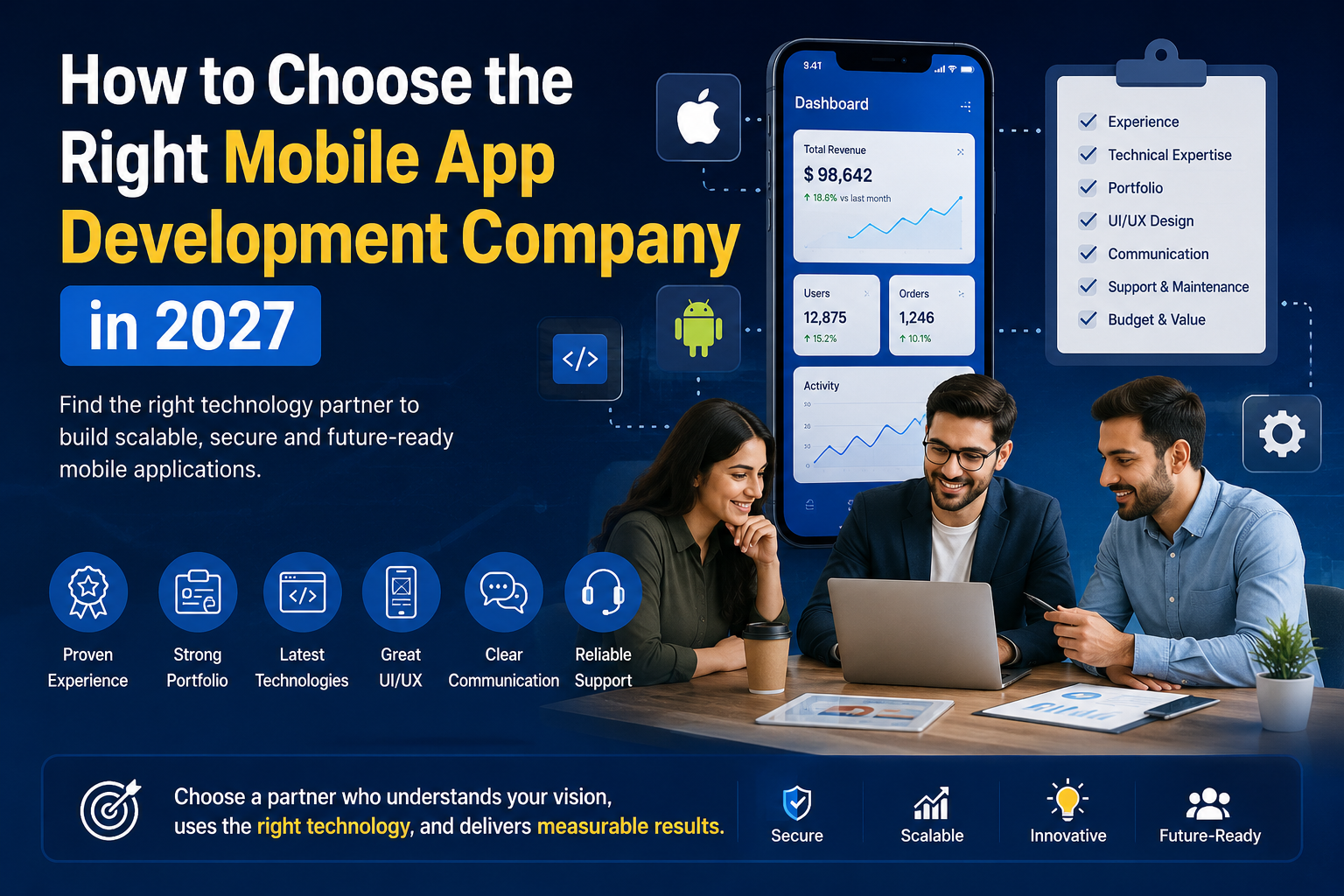
Your mobile app can become a successful mobile product or a costly misjudgment that will require rebuilding later, depending on your choice of mobile app development company.
The problem is that on the surface there are a lot of development companies that look alike. They can provide services like Android and iOS development, Flutter or React Native, UI/UX design, backend development, integration with Artificial Intelligence, and post-launch support. They can also have a great portfolio on their websites and an attractive price.
However, it’s really about the way they think about your product, how they manage the development process, how they deal with risk and what they do once the app is released.
When choosing a mobile app development company in 2027, businesses must consider more factors than just coding. The best development partners will be familiar with product strategy, user experience, architecture, security, privacy, AI, testing, scalability, and app-store requirements and long-term maintenance.
This article will walk you through what to watch out for before hiring a mobile app development company in 2027, how to compare proposals, questions to ask, red flags to look out for as well as scoring different agencies before making your final decision.
Quick Answer: How Do You Choose a Mobile App Development Company?
Selecting the right mobile app development company starts with setting the goals of your business, the target audience, the features you want in the app, the platform or platforms you’re going to build it on, the budget and the timeframe. Next, evaluate shortlisted companies for experience, proven portfolio, tech skills, UI/UX, development process, testing, security, communication, price clarity, source-code ownership, scalability, and post-launch support.
Do not choose a company simply because it offers the lowest quote.
Instead, ask:
- Has the company built applications similar to yours?
- Can you verify its portfolio through live apps or case studies?
- Does it understand your business problem rather than just your feature list?
- Can it explain why a particular technology is appropriate?
- Does it have a structured discovery and development process?
- How does it handle security and privacy?
- How does it test across real devices?
- Who owns the source code and intellectual property?
- What happens after launch?
- Can the team support AI or other emerging technologies when they genuinely add value?
The best mobile app development partner is not necessarily the largest or cheapest company. It is the one that provides the best fit between your product requirements, technical needs, budget, risk level and long-term goals.
Why Choosing the Right Mobile App Development Company Matters
A mobile application is more than a collection of screens and features.
It may become the primary way customers:
- Buy products
- Book services
- Make payments
- Communicate with your business
- Manage accounts
- Consume content
- Track orders
- Access information
- Interact with your brand
That means the development partner you choose can affect your application’s performance, security, usability, scalability and long-term cost.
A poorly planned application can create problems such as:
- Slow performance
- Frequent crashes
- Poor user experience
- Security vulnerabilities
- Difficult maintenance
- Expensive feature changes
- App-store rejection
- Scaling problems
- Poor integration with backend systems
Conversely, the right development company will be able to validate your idea, prioritize features, choose an appropriate tech stack, create a user experience that works for you, test the application and prepare it for future growth.
Newer Android quality advice also focuses on performance, stability, compatibility, accessibility, privacy and testing over the devices and form factors supported.
Thus, selecting an application development firm ought to be taken into the business and technology factor, not just procurement.
What to Define Before Hiring an App Development Company
Before contacting development companies, you should have a basic understanding of what you want to accomplish.
You do not need to prepare a complete technical specification. A good development partner should help you turn your idea into technical requirements.
However, these six areas should be clear.
1. Define Your Business Goal
Start with one question:
Why are you building this application?
Your objective might be to:
- Generate revenue
- Increase customer engagement
- Sell products
- Provide an online service
- Automate business operations
- Create a marketplace
- Launch a subscription product
- Build an MVP
- Improve customer support
- Extend an existing website or platform
Your business goal should influence your features and technology.
For example, an e-commerce app, healthcare application and internal employee application may all require mobile development, but their architecture, security and user experience requirements can be very different.
2. Identify Your Target Users
Define who will use your application.
Consider:
- Location
- Age group
- Device preferences
- Technical experience
- User problems
- Accessibility requirements
- Frequency of use
- Purchasing behavior
Your development partner should understand the users before recommending functionality.
3. Separate MVP Features From Future Features
One of the most common mistakes is trying to build everything in version one.
Create two lists:
Must-have features
These are required for the initial product.
Future features
These can be introduced after launch.
For example, an e-commerce MVP might require:
- Registration
- Product browsing
- Search
- Cart
- Checkout
- Payment
- Order tracking
- Notifications
Advanced recommendations, loyalty programs, AI shopping assistants and additional integrations could be introduced later.
A good development company should help you prioritize rather than simply accepting every requested feature.
4. Decide Which Platforms You Need
Determine whether your product needs:
- Android
- iOS
- Both Android and iOS
- Tablets
- Foldables
- Wearables
- Other connected devices
The answer can influence whether native or cross-platform development is appropriate.
5. Establish a Budget Range
Your development budget should account for more than coding.
Consider:
- Discovery
- UX/UI design
- Frontend development
- Backend development
- APIs
- Third-party services
- Testing
- Security
- Cloud infrastructure
- App-store deployment
- Maintenance
A realistic budget makes it easier to compare vendors.
6. Set a Realistic Timeline
Tell potential agencies when you would ideally like to launch.
However, avoid selecting a company simply because it promises the shortest timeline.
How to Shortlist Mobile App Development Companies
Do not immediately request proposals from 20 companies.
Create a shortlist of approximately 3–5 development partners.
For each company, review:
Step 1: Website
Check whether the company clearly explains its services, technologies and development process.
Step 2: Portfolio
Look for projects similar to yours.
Step 3: Live Applications
Whenever possible, download applications the company claims to have developed.
Step 4: Team
Find out who will actually work on your project.
Step 5: Reviews and Case Studies
Look for evidence of real client work rather than only testimonials.
Step 6: Discovery Process
Ask whether the company offers a structured discovery or product-planning phase.
Step 7: Proposal
Compare detailed proposals rather than headline prices.
Current competitors increasingly emphasize proof of relevant work, team transparency, discovery, IP ownership and post-launch support rather than simply listing technologies.
12 Things to Look for in a Mobile App Development Company
1. Relevant Mobile App Development Experience
Experience matters, but relevant experience matters more.
A company may have built 100 applications, but that does not automatically make it suitable for your project.
Look for experience with:
- Industries similar to yours
- Comparable user journeys and workflows
- Business models similar to your application
- Relevant third-party integrations and APIs
- Security and compliance requirements similar to your project
- Applications with comparable technical complexity
If you are building a marketplace, for example, ask about marketplace experience rather than simply asking how many apps the company has developed.
2. A Verifiable Portfolio
A portfolio should contain evidence, not just attractive screenshots.
Look for:
- Live applications
- App Store listings
- Google Play listings
- Case studies
- Screenshots
- User flows
- Technical challenges
- Business outcomes
If possible, download the applications.
Ask yourself:
Does the live product demonstrate the quality the company claims to deliver?
A screenshot alone cannot prove development capability.
3. Technical Expertise
A strong mobile app development company should have expertise appropriate to your project.
Depending on your requirements, this may include:
- Swift
- Kotlin
- Flutter
- React Native
- Native Android
- Native iOS
- APIs
- Backend development
- Cloud infrastructure
- Databases
- Authentication
- Payment integrations
- Push notifications
- Analytics
- CI/CD
- Automated testing
However, do not choose an agency simply because it lists a long technology stack.
Ask:
Why is this technology appropriate for my application?
A strong partner should explain the decision based on your product requirements.
4. Strong UI/UX Capabilities
Good application design is not simply about making screens look attractive.
A strong UI/UX process should consider:
- User goals
- Navigation
- Information architecture
- User flows
- Accessibility
- Visual hierarchy
- Onboarding
- Error handling
- Conversion
- Usability
Ask whether the agency provides:
- Wireframes
- Prototypes
- Design systems
- User-flow mapping
- Usability testing
The design should support your business objective rather than exist separately from development.
5. A Structured Development Process
Ask the company to explain the complete process from idea to launch.
A mature process may include:
- Discovery
- Requirements analysis
- Product planning
- UX/UI design
- Technical architecture
- Development
- Testing
- Client review
- Deployment
- Post-launch support
One important question is:
What happens before the first line of production code is written?
If the answer is simply “we start development,” ask more questions.
A proper discovery phase can uncover missing requirements, technical risks and unnecessary features before they become expensive changes.
6. A Serious Testing Strategy
Testing should not happen only at the end.
Ask whether the team performs:
- Functional testing
- UI testing
- API testing
- Integration testing
- Performance testing
- Security testing
- Compatibility testing
- Device testing
- Regression testing
- Accessibility testing
Ask specifically:
Which real devices and operating-system versions will be tested?
This matters because mobile applications operate across different devices, screen sizes, OS versions and network conditions.
7. Strong Security and Privacy Practices
Security should be considered during architecture and development.
Ask about:
- Authentication
- Authorization
- Encryption
- Secure API communication
- Secure storage
- Credential management
- Payment data
- Permissions
- Third-party SDKs
- Data retention
- Security testing
Also ask:
What happens if a security vulnerability is discovered after launch?
The agency should have a clear process for identifying, prioritizing and resolving security issues.
8. Clear Communication
Communication problems can damage a project even when the technical team is capable.
Ask:
- Who is the primary contact?
- Who manages the project?
- How often are updates provided?
- Which project-management tools are used?
If communication is poor before you sign the contract, it may become worse once development begins.
9. Transparent Pricing
A professional proposal should explain what is included.
Look for separate information about:
- Discovery
- Design
- Development
- Backend
- Testing
- Deployment
- Third-party services
- Cloud infrastructure
- Maintenance
- Support
Do not compare only the final number.
A low quote may simply exclude important work.
10. Source-Code and Intellectual Property Ownership
This is a critical contract issue.
Before development starts, clarify:
Source code: Who owns the code?
- UI/UX: Who owns the designs?
- Database: Who controls the data?
- APIs: Who owns custom APIs?
- Documentation: Will all documentation be provided?
- Hosting: controls hosting accounts?
- App stores: Who owns the developer accounts?
- AI integrations: Who owns custom AI work?
Also ask:
Can another development company take over the application if necessary?
A professional handover should be possible.
11. Scalability
Your application may begin with 500 users and eventually need to support 500,000.
Ask how the architecture can handle:
- More users
- More transactions
- Larger databases
- Increased API traffic
- More integrations
- Additional features
- Multiple regions
You do not need to over-engineer a small MVP.
But the initial architecture should not unnecessarily prevent future growth.
12. Post-Launch Support
Launching the application is not the end of the project.
You may need:
- Bug fixes
- OS compatibility updates
- Security updates
- Performance optimization
- New features
- Analytics
- Monitoring
- SDK updates
- Store updates
Ask exactly what is included after launch.
Also ask whether support is:
- Included for a limited period
- Charged monthly
- Charged hourly
- Covered by an SLA
- Available only during business hours
Native vs Cross-Platform App Development
Choosing between native and cross-platform development is an important technical decision.
There is no universally best option.
The correct choice depends on your product.
Native App Development
Native applications use platform-specific technologies such as:
- Swift for iOS
- Kotlin for Android
Native development can be a strong choice when:
- Performance is critical
- Deep device integration is required
- Platform-specific functionality is important
- Advanced graphics are required
- The product needs highly specialized OS capabilities
Flutter App Development
Flutter allows developers to create applications for multiple platforms from a shared codebase.
It may be suitable when you want:
- Faster cross-platform development
- Consistent UI
- Shared code
- Reduced duplication
- A unified development approach
However, Flutter should not be selected simply because it is popular.
React Native App Development
React Native can be useful for businesses that want cross-platform development and already have React or JavaScript expertise.
It can provide:
- Shared development
- Cross-platform delivery
- Faster development for suitable projects
- Access to native functionality when needed
Again, the application requirements should determine the technology.
How Should You Choose?
Ask your potential development partner:
Why do you recommend this technology for our application?
The answer should consider:
- Performance
- Budget
- Time to market
- Platform requirements
- Device capabilities
- Existing technology
- Maintenance
- Long-term roadmap
A good development company recommends technology based on your product—not simply the framework it prefers to sell.
How Important Is AI Expertise in 2027?
AI is becoming an increasingly important consideration when choosing a mobile app development company.
But businesses should be careful about selecting an agency simply because it advertises “AI development.”
The better question is:
What problem will AI solve for our users or business?
Potential mobile AI applications include:
- AI assistants
- Intelligent search
- Personalized recommendations
- Content generation
- Document analysis
- Voice interaction
- Image understanding
- Predictive functionality
- Automated workflows
- AI-powered customer support
- Agentic workflows
Generative AI in Mobile Applications
Generative AI can be used to:
- Generate content
- Summarize information
- Answer user questions
- Personalize recommendations
- Assist with workflows
- Analyze documents
However, an AI feature should have a clear purpose.
Adding a chatbot to an application simply because AI is trending does not necessarily improve the product.
AI Agents and Agentic Experiences
AI applications are now shifting from responding to queries to assisting people in performing tasks.
An AI assistant could, for instance:
- Know what a user wants. Be aware of a user’s request.
- Access permitted information
- Identify what to do
- Carry out an approved activity
- Confirm the result
Newer App Patterns such as intelligent and agentic experiences are becoming more commonplace in Android development and will be increasingly relevant to consider whether a development partner is familiar with these newer patterns.
On-Device AI
On-device AI allows certain AI processing to happen directly on a user’s device.
Depending on the use case, this can provide benefits such as:
- Improved privacy
- Offline functionality
- Reduced server dependency
- Faster responses for certain tasks
- Potentially lower inference costs
Android supports on-device AI capabilities, while Apple’s developer ecosystem also provides on-device foundation-model capabilities for suitable application experiences.
Therefore, if AI is central to your product, ask:
- Which AI models will be used?
- Which processing happens on-device?
- What data is sent to external services?
- How is user data protected?
- How are AI responses tested?
- What happens when AI produces an incorrect result?
- What are the ongoing inference costs?
That is a much stronger evaluation than simply asking whether an agency “offers AI development.”
How to Evaluate Mobile App Security and Privacy
Security should be part of the architecture from the beginning.
Authentication
Ask how users will securely sign in.
Potential methods include:
- Password authentication
- Social login
- Passkeys
- Multi-factor authentication
- Phone verification
Data Encryption
Sensitive information should be appropriately protected during transmission and storage.
API Security
Ask how APIs are:
- Authenticated
- Authorized
- Rate limited
- Monitored
- Protected from unauthorized access
Secure Storage
Sensitive credentials, tokens and user information should not be stored insecurely on the device.
Third-Party SDK Security
Third-party libraries can introduce security and privacy risks.
Your development team should know:
- Which SDKs are being used
- Why they are required
- What data they collect
- How they are updated
- What happens if a vulnerability is discovered
Android’s current quality guidance explicitly considers third-party SDKs part of the application’s overall technical responsibility.
Privacy
Ask:
- What information does the app collect?
- Why does it collect it?
- Where is the information stored?
- Who can access it?
- How long is it retained?
- Which third parties receive it?
Privacy should be considered during product planning rather than added just before app-store submission.
How to Evaluate an Agency’s Development Process
A reliable development company should be able to explain its process clearly.
Discovery
The team should understand:
- Business goals
- Target audience
- User problems
- Competitors
- Features
- Integrations
- Risks
Product Planning
Requirements should be prioritized into:
- MVP
- Phase 2
- Future improvements
UX/UI Design
The team should map user journeys before building the final interface.
Technical Architecture
The architecture should define:
- Frontend
- Backend
- Database
- APIs
- Authentication
- Cloud infrastructure
- Third-party services
Development
Features should be built in manageable iterations.
Testing
Testing should happen continuously rather than only before launch.
Deployment
The agency should prepare the application for the required stores and environments.
Post-Launch
Monitoring, maintenance and future improvements should be planned before launch.
How Mobile App Testing Should Work
A professional QA process should test the application under realistic conditions.
Functional Testing
Does every feature perform the required function?
UI Testing
Does the interface behave correctly across supported screen sizes?
API Testing
Does the application communicate correctly with backend systems?
Performance Testing
Does the application remain responsive?
Device Testing
Does it work across the devices your users actually use?
Network Testing
What happens when:
- The network becomes slow?
- The connection disappears?
- The user changes from Wi-Fi to mobile data?
Security Testing
Can unauthorized users access restricted information?
Regression Testing
Does a new update break an existing feature?
Accessibility Testing
Can users with different accessibility needs use the application effectively?
Android’s current quality guidance includes areas such as stability, performance, compatibility, accessibility and testing across supported form factors.
Ask for the agency’s QA process before signing a contract.
App Store and Google Play Launch Experience
An application is not finished when the code is complete.
Your development partner should understand the release process for:
- Apple App Store
- Google Play
This can include:
- Store metadata
- Screenshots
- App descriptions
- App icons
- Privacy information
- Testing tracks
- Release configuration
- Version management
- Compliance
- Store submission
Ask:
How many applications has your team successfully launched?
Then ask a more important question:
Who will manage the submission and resolve store-review issues if the application is rejected?
Apple’s current review guidance emphasizes testing, complete functionality, accurate information and appropriate privacy disclosures before submission.
How Much Does It Cost to Hire a Mobile App Development Company?
There is no universal mobile app development price.
The cost depends on:
- Number of platforms
- Features
- UI/UX complexity
- Backend requirements
- API integrations
- Payment systems
- Real-time functionality
- AI functionality
- Security requirements
- Admin dashboard
- Testing
- Infrastructure
- Maintenance
A simple MVP can have very different requirements from an enterprise application.
Common Pricing Models
Fixed Price
A defined scope is agreed upon at a defined price.
This works best when requirements are relatively stable.
Time and Materials
You pay based on the time and resources used.
This can work well for evolving products.
Dedicated Development Team
A dedicated team works on the product over an extended period.
This can be useful for continuously evolving applications.
Milestone-Based Development
Payments are tied to agreed project milestones.
The important point is to compare scope, not just price.
A cheaper proposal may exclude:
- QA
- UX research
- Deployment
- Documentation
- Maintenance
- Security
- Backend development
Always normalize the proposals before comparing them.
Should You Run a Discovery or Pilot Before Full Development?
For complex or high-value applications, consider starting with a discovery phase or limited technical pilot.
A discovery phase can help validate:
- Product requirements
- User flows
- Technical architecture
- Technology selection
- Third-party integrations
- Security requirements
- Development estimates
For technically risky projects, a small proof-of-concept can also test a critical feature before committing to full development.
For example, if your application depends on:
- Real-time video
- Complex AI
- Bluetooth
- Advanced maps
- IoT
- High-volume transactions
- Complex payment systems
a technical prototype can expose risks early.
This approach also helps you evaluate the development team based on actual work rather than sales presentations.
Agency vs Freelancer vs In-House Team
There are several ways to build a mobile application.
| Option | Best For | Main Advantage | Main Limitation |
| Freelancer | Small/simple apps | Lower overhead | Limited team depth |
| Agency | Most business apps | Multiple specialists | Higher cost than a single freelancer |
| In-house | Long-term products | Maximum internal control | Hiring and management overhead |
| Dedicated team | Growing products | Ongoing development capacity | Requires long-term commitment |
Freelancer
A freelancer may be suitable for:
- Simple MVPs
- Prototypes
- Small applications
- Limited feature development
Mobile App Development Agency
An agency can provide multiple disciplines such as:
- Product strategy
- UX/UI
- Developers
- Backend engineers
- QA
- Project management
- DevOps
- Deployment
This can be valuable for more complex applications.
In-House Team
An internal team can make sense when mobile development is a core, long-term business function.
Dedicated Team
A dedicated development team can be useful when you need ongoing development without immediately building a large internal department.
The right option depends on your:
- Budget
- Product complexity
- Timeline
- Internal resources
- Long-term strategy
How to Choose a Mobile App Development Company in India
If you are considering an Indian development company, evaluate it using the same quality standards you would apply to any international partner.
However, also consider:
Communication and Time Zones
Make sure there is sufficient overlap between your working hours and the development team’s schedule.
International Client Experience
If you are targeting customers in the US, UK, Australia or other markets, ask whether the company has experience working with similar clients.
Contract and Ownership Terms
Clearly document:
- Source-code ownership
- Intellectual property
- Confidentiality
- Payment milestones
- Deliverables
- Termination
- Handover
Quality Assurance
Do not assume that a lower development cost means lower quality—or that a higher price guarantees quality.
Evaluate actual work, team capability and process.
Post-Launch Support
Confirm how support works after the application launches and whether support is available during your business hours.
The current 2026 search landscape also includes dedicated guides targeting businesses choosing mobile app development companies in India, so this is a useful secondary search-intent variation to address naturally without turning the entire article into an India-specific page.
10 Red Flags to Watch For
1. An Unrealistically Low Quote
If one proposal is dramatically cheaper, find out what has been excluded.
2. Guaranteed Timelines Before Discovery
A company cannot accurately estimate a complex application without understanding the scope.
3. No Verifiable Portfolio
If the agency cannot show relevant work, ask why.
4. Only Screenshots, No Live Apps
A portfolio should ideally include evidence of actual shipped products.
5. No Clear Technology Recommendation
The agency should explain why its recommended architecture fits your project.
6. No Testing Strategy
If testing is treated as an afterthought, quality risks increase.
7. No Security Discussion
A development partner should be comfortable discussing security and privacy.
8. Unclear Source-Code Ownership
Do not leave ownership terms unclear.
9. No Post-Launch Plan
Every application needs some form of ongoing maintenance.
10. Too Many Technology Buzzwords
AI, blockchain, cloud, IoT and automation do not automatically make an application better.
Technology should solve a real user or business problem.
15 Questions to Ask Before Hiring a Mobile App Development Company
Before signing a contract, ask every shortlisted company:
- Have you built an application similar to ours?
- Can we see live applications or relevant case studies?
- Who will actually work on our project?
- Will the work be handled internally or outsourced?
- Which technology stack do you recommend and why?
- What happens during the discovery phase?
- Who owns the source code and intellectual property?
- Which third-party SDKs and services will be used?
- How will the architecture scale as users increase?
- Who handles App Store and Google Play submission?
- What support is included after launch?
- What happens if we decide to change development partners?
Do not just collect the answers.
Compare the quality and specificity of the answers.
A vague answer can be as informative as a bad answer.
Mobile App Development Company Evaluation Scorecard
If you are comparing several development companies, use a weighted scorecard.
| Evaluation Factor | Weight |
| Relevant Experience | 15% |
| Technical Expertise | 15% |
| Portfolio Quality | 10% |
| UI/UX Capabilities | 10% |
| Development Process | 10% |
| Security & Privacy | 10% |
| Communication | 10% |
| Pricing Transparency | 10% |
| Post-Launch Support | 5% |
| AI & Modern Technology Expertise | 5% |
| Total | 100% |
Score each company from 1–5.
Then calculate:
Score × Weight = Weighted Score
This makes your decision more objective.
For example, a company with an excellent portfolio but poor communication should not automatically win.
Likewise, a company with the lowest price should not automatically win.
Mobile App Development Company Checklist for 2027
Before hiring an app development partner, check the following:
- Relevant mobile app development experience
- Verifiable portfolio
- Live applications
- Relevant industry experience
- Strong UI/UX process
- Native development expertise
- Cross-platform expertise
- Flutter or React Native expertise where appropriate
- Backend development capabilities
- API integration experience
- Security practices
- Privacy awareness
- Testing strategy
- Real-device testing
- Accessibility testing
- App Store experience
- Google Play experience
- AI development capabilities where relevant
- Understanding of on-device AI where relevant
- Scalable architecture
- Clear communication
- Transparent pricing
- Source-code ownership
- Intellectual property terms
- Documentation
- Post-launch maintenance
- Support SLA
- Clear change-request process
- Handover process
You do not need a company that checks every technology box.
You need a company that checks the right boxes for your application.
Why Businesses Choose ThirdEssential
When it comes to mobile app development, the key is to select a partner who appreciates both your technology needs and your business goals.
Our mobile application development process at ThirdEssential is based on creating a customized digital product that is tailored to the needs of a specific business instead of applying a one-size-fits-all technology or development model to all projects.
We can help businesses with:
- Custom mobile application development
- Android app development
- iOS app development
- Cross-platform app development
- UI/UX design
- API and backend integration
- Application testing
- App deployment
- Ongoing maintenance and support
When evaluating ThirdEssential alongside other development companies, we recommend using the same criteria outlined in this guide:
- Relevant experience
- Portfolio quality
- Technical expertise
- Development process
- Security
- Communication
- Pricing transparency
- Ownership
- Scalability
- Post-launch support
That allows you to make a decision based on evidence and project fit rather than simply choosing the company with the lowest quote.
If you are planning a new application or improving an existing mobile product, you can explore our mobile app development services In Indore and discuss your requirements with the ThirdEssential team.
Frequently Asked Questions
What should I look for in a mobile app development company?
Look for relevant experience, a verifiable portfolio, technical expertise, UI/UX capabilities, a structured development process, strong testing, security practices, transparent pricing, clear source-code ownership and post-launch support.
How do I choose the right mobile app development company?
Start by defining your business goals, target users, features, platforms, budget and timeline. Then shortlist three to five companies and compare their portfolio, technical expertise, process, security, pricing, communication, ownership terms and support.
How do I evaluate a mobile app development company?
Evaluate the company based on evidence rather than promises. Review relevant live applications, case studies, technical recommendations, team structure, development process, testing strategy, security practices, pricing and post-launch support.
What questions should I ask a mobile app development company?
Ask about relevant experience, live projects, team members, technology recommendations, discovery, UX/UI, testing, security, source-code ownership, intellectual property, third-party services, scalability, app-store submission and post-launch support.
How much does it cost to hire a mobile app development company?
The cost depends on application complexity, number of platforms, features, UI/UX requirements, backend development, integrations, security, testing, AI functionality and ongoing maintenance. There is no single price that applies to every mobile application.
How long does it take to develop a mobile app?
The timeline depends on the application’s scope and complexity. Discovery, design, backend development, integrations, testing and app-store submission can all affect the schedule. A reliable company should provide an estimate after understanding the requirements.
Should I choose native or cross-platform mobile app development?
It depends on your product. Native development can be appropriate when performance and deep platform integration are priorities. Cross-platform development can be useful when you want to share development across Android and iOS. Your development partner should explain the recommendation based on your actual requirements.
How important is AI expertise when choosing a mobile app development company in 2027?
It’s a matter of knowing whether you’re just looking to have someone write code, or whether you’re searching for a mobile app development partner that can assist you in creating a sustainable digital product.
Before you begin creating a new mobile app, make sure you have your business goals and core features figured out. Next, apply the criteria outlined in this guide to select the development company that is right for your product, users and business goals.
Final Thoughts
It is not just about finding developers who can create an app; it is about selecting the mobile app development company in 2027 that can help you develop your app.
It’s about locating a technology partner who will be able to support you in making those correct choices before, during and after development.
Before signing a contract, evaluate:
- Relevant experience
- Portfolio quality
- Technical expertise
- UI/UX capabilities
- Discovery and planning
- Native and cross-platform options
- AI capabilities
- Security and privacy
- Testing
- App-store experience
- Pricing
- Source-code ownership
- Intellectual property
- Scalability
- Communication
- Post-launch support
Most importantly, make comparisons between evidence, not promises.
Consider real-life applications. Ask detailed questions. Make a comparison of proposals based on the same criteria. Know what you’re purchasing. Establish ownership of the product. Also, ensure that the developer has a viable plan to support the application once it goes live.
It should not just be a matter of a “yes” or “no” to any feature request.
They should be able to explain:
What should we build?
Why should we build it?
Which technology should we use?
What happens after launch?
It’s a matter of knowing whether you’re just looking to have someone write code, or whether you’re searching for a mobile app development partner that can assist you in creating a sustainable digital product.
Before you begin creating a new mobile app, make sure you have your business goals and core features figured out. Next, apply the criteria outlined in this guide to select the development company that is right for your product, users and business goals.