
Last updated on July 16th, 2026 at 06:05 pm
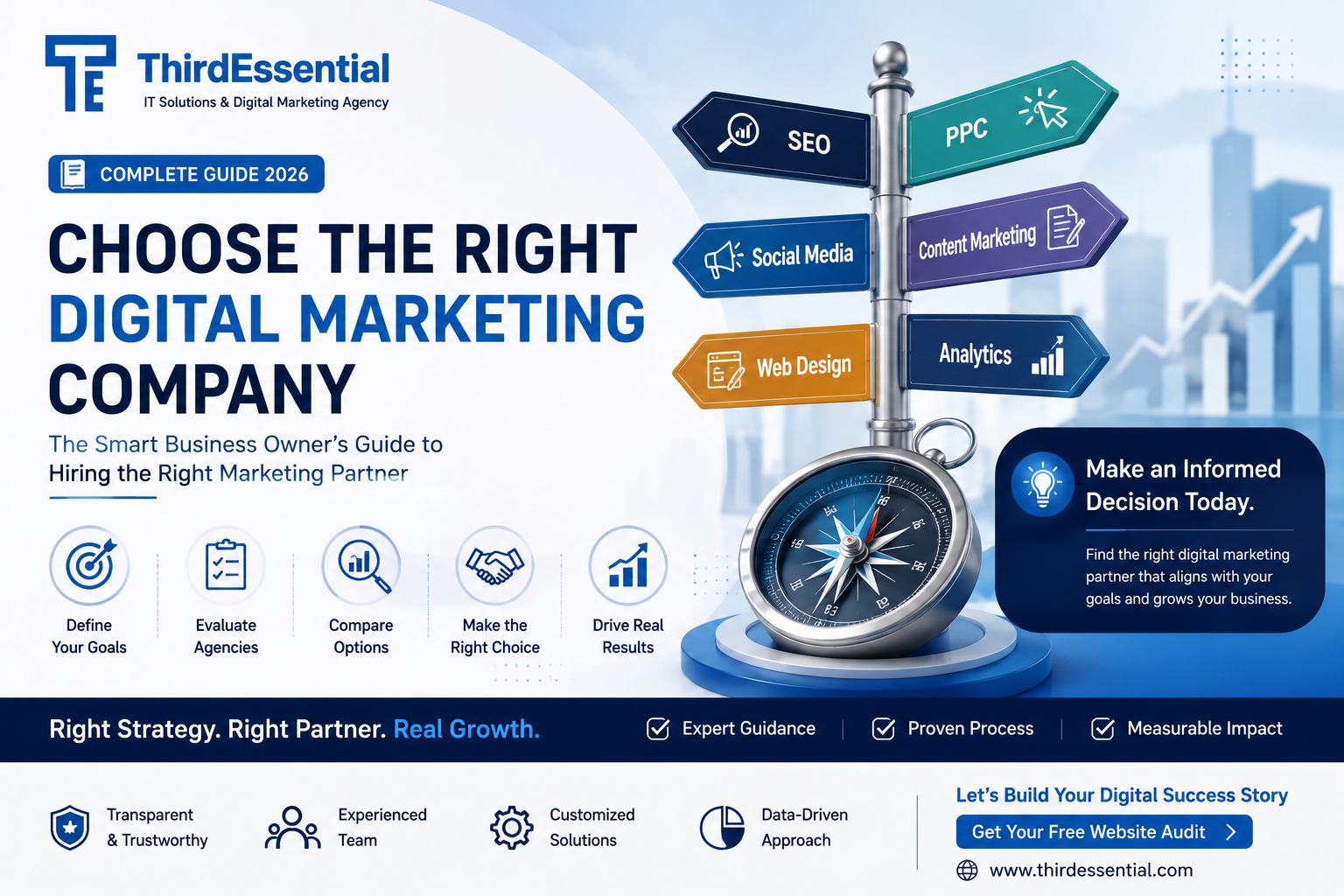
Hiring a digital marketing company can be one of the most important business decisions you make.
The right partner can help you generate qualified leads, improve online visibility, lower customer acquisition costs, and build a sustainable growth strategy. The wrong one can consume months of budget with little to show beyond impressive-looking reports.
The challenge isn’t the lack of agencies. It’s the abundance of options. From boutique local firms and specialist SEO agencies to full-service marketing companies, every provider claims to deliver measurable results.
Instead of asking, “Which agency is the best?” ask a better question:
“Which agency is the best fit for my business goals, budget, and stage of growth?”
That shift in thinking changes how you evaluate every proposal.
This guide explains the practical factors that matter, the questions worth asking, the warning signs to watch for, and a structured framework for making a confident decision.
Why Choosing the Right Agency Matters
A marketing agency isn’t simply a service provider. Over time, it becomes an extension of your team.
The agency may influence:
- Your website
- Brand messaging
- Lead generation
- Advertising budget
- Search visibility
- Conversion rates
- Customer acquisition
- Marketing technology stack
Changing agencies every few months often creates disruption. Campaign history is lost, reporting changes, creative direction shifts, and valuable learning is reset.
Choosing carefully at the beginning is usually less expensive than replacing an agency later.
The right digital marketing company aligns its strategy with your business goals, communicates transparently, measures meaningful KPIs, and demonstrates proven expertise in the marketing channels that matter most for your industry.
Step 1: Define Your Business Goals Before Contacting Any Agency
One of the most common mistakes businesses make is contacting agencies before defining what success looks like.
If your goals are vague, proposals will be vague too.
Start by identifying the outcome you want.
| Business Goal | Recommended Services |
|
Generate more local leads |
Local SEO, Google Ads, GBP Optimization |
| Increase online sales | SEO, PPC, CRO, Shopping Ads |
| Improve brand awareness | Content Marketing, Social Media Marketing |
| Launch a new product | Paid Advertising, Landing Pages, Email Marketing |
| Improve website performance |
Technical SEO, Web Development, UX |
Clear objectives also make it easier to compare agencies based on outcomes rather than promises.
What Services Should a Good Digital Marketing Agency Offer?
Not every business needs every marketing channel. A good agency recommends only the services that support your objectives instead of selling a standard package.
Common services include:
Search Engine Optimization (SEO)
Improves organic visibility through technical optimization, content strategy, keyword research, and authority building.
Pay-Per-Click Advertising (PPC)
Helps generate immediate traffic using platforms such as Google Ads and Microsoft Advertising while optimizing campaigns for cost efficiency and conversion quality.
Social Media Marketing
Supports audience engagement, paid social campaigns, and brand awareness across platforms where your customers are active.
Website Design and Development
Marketing campaigns perform better when the website provides a fast, user-friendly experience with clear conversion paths.
Content Marketing
Creates educational resources, landing pages, blogs, and other assets that attract visitors and support SEO, lead nurturing, and brand authority.
Should You Hire a Full-Service Agency or a Specialist?
There is no universal answer. The right choice depends on your goals, internal resources, and growth stage.
A full-service agency can simplify coordination by managing multiple channels under one strategy. A specialist agency may be a stronger fit when a single channel—such as SEO or PPC—is the primary growth driver.
The key is to evaluate whether the agency’s expertise matches your immediate priorities rather than assuming one model is always better.
Step 2: Evaluate the Agency Using a Structured Framework
Most businesses compare agencies based on price, portfolio, or how convincing the sales presentation is. While these factors matter, they rarely predict whether the partnership will succeed.
Instead, evaluate every agency using the same criteria. This makes comparisons objective and reduces the risk of choosing a partner based on promises rather than capability.
The 12-Step Digital Marketing Agency Evaluation Framework
|
Evaluation Criteria |
Why It Matters |
What to Look For |
| Business Understanding | The agency should understand your goals before recommending tactics. | Discovery questions, industry knowledge, growth strategy. |
| Relevant Experience | Experience in your industry can shorten the learning curve, but it shouldn’t be the only deciding factor. | Similar business models, comparable challenges, measurable outcomes. |
| Service Expertise | Strong execution in the channels you need. | SEO, PPC, content, web development, social media, CRO, analytics. |
| Strategic Planning | Marketing should support business objectives, not just traffic growth. | Documented roadmap with priorities and timelines. |
| Reporting & Analytics | Transparent reporting builds trust and enables informed decisions. | GA4 dashboards, KPI tracking, actionable insights. |
| Communication | Consistent communication prevents misunderstandings and delays. | Dedicated account manager, regular review meetings. |
| Technical Capabilities | Marketing relies on a solid technical foundation. | Technical SEO, tracking implementation, website performance, CRM integration. |
| Pricing Transparency | Clear pricing reduces unexpected costs later. | Scope of work, inclusions, exclusions, contract terms. |
| Scalability | Your agency should be able to support future growth. | Ability to add services, increase campaign complexity, expand markets. |
| Process & Documentation | Mature agencies follow repeatable processes. | Onboarding, approvals, project management, quality assurance. |
| Client References | References provide context beyond testimonials. | Willingness to connect you with existing or former clients. |
| Cultural Fit | A productive relationship depends on shared expectations and collaboration. | Responsiveness, working style, values, problem-solving approach. |
Quick Evaluation Tip
A polished presentation is easy to create.
A clear explanation of how the agency plans to achieve your goals is far more valuable.
Ask for specifics rather than broad statements like “We’ll improve your SEO.”
For example:
- Which pages would you optimize first?
- How will keyword opportunities be identified?
- How will success be measured?
- What happens if the results plateau?
The quality of these answers often reveals the agency’s depth of expertise.
Step 3: Match the Agency to Your Business Stage
One of the biggest mistakes businesses make is assuming that the “best” agency is the right agency.
In reality, the ideal partner depends on where your business is today.
Start-up (0–2 Years)
Typical priorities:
- Build an online presence
- Launch a website
- Generate initial leads
- Validate marketing channels
Recommended services:
- Website Design
- Local SEO
- Google Business Profile Optimization
- Google Ads
- Basic Content Marketing
Avoid paying for enterprise-level marketing packages before establishing product-market fit.
Growing Small Business
Typical priorities:
- Consistent lead generation
- Higher search visibility
- Better conversion rates
- Brand awareness
Recommended services:
- SEO
- PPC
- Social Media Marketing
- Email Marketing
- Landing Page Optimization
- Conversion Rate Optimization (CRO)
Scaling Business
Focus shifts toward efficiency rather than simply increasing traffic.
Key priorities include:
- Marketing attribution
- Customer acquisition cost (CAC)
- Return on ad spend (ROAS)
- Marketing automation
- CRM integration
- Multi-channel reporting
At this stage, agencies should demonstrate strategic planning alongside execution.
Enterprise Organization
Enterprise businesses often require:
- Cross-functional collaboration
- Compliance awareness
- Advanced analytics
- International SEO
- Dedicated project management
- Governance processes
The selection criteria become more rigorous because multiple stakeholders are involved.
Agency vs Freelancer: Which Is the Better Choice?
This question comes up frequently, especially for start-ups and small businesses.
The answer depends on your budget, project complexity, and long-term goals.
| Factor | Freelancer | Digital Marketing Agency |
| Cost | Usually lower | Higher due to broader expertise |
| Skill Coverage | Often specializes in one area | Access to multiple specialists |
| Availability | Depends on individual workload | Dedicated team with backup resources |
| Scalability | Limited | Easier to scale campaigns |
| Project Management | Usually self-managed | Structured workflows and account management |
| Reporting | Varies significantly | Typically standardized and recurring |
| Long-Term Growth | Suitable for focused projects | Better for integrated marketing strategies |
When a Freelancer Makes Sense
A freelancer may be the right fit if you need:
- A one-time website update
- Blog writing
- Graphic design
- A small SEO audit
- Limited PPC campaign management
- Budget-friendly support
When an Agency Makes More Sense
Choose an agency if you need:
- Multiple marketing channels working together
- Long-term growth strategy
- Team collaboration
- Ongoing optimization
- Access to specialists across SEO, PPC, content, design, and development
- Consistent reporting and strategic guidance
Neither option is inherently better. The decision should reflect the complexity of your business needs.
Step 4: Understand Digital Marketing Agency Pricing
Pricing varies widely because agencies differ in experience, service scope, technology, team size, and deliverables.
Instead of searching for the cheapest option, focus on understanding what is included.
Common Pricing Models
Monthly Retainer
Best for:
- SEO
- Content Marketing
- Ongoing PPC management
- Social Media Management
Includes continuous optimization and reporting.
Project-Based Pricing
Suitable for:
- Website development
- SEO audits
- Brand identity
- Landing pages
- Marketing strategy
Projects have a defined scope and timeline.
Hourly Consulting
Useful for:
- Training
- Marketing audits
- Strategy workshops
- Technical troubleshooting
Performance-Based Pricing
Some agencies charge based on agreed performance metrics.
Before choosing this model, clarify:
- How success is measured
- Attribution methods
- Reporting frequency
- Data ownership
- External factors that may affect results
Performance-based pricing can be effective, but it requires clearly defined expectations.
What Influences Agency Pricing?
Several factors determine cost:
- Number of services included
- Business size
- Industry competitiveness
- Geographic targeting
- Advertising budget
- Content production requirements
- Website complexity
- Reporting frequency
- Level of strategic involvement
A proposal with a higher price may offer better long-term value if it includes stronger strategy, experienced specialists, and measurable business outcomes.
Pricing Transparency Checklist
Before signing, ensure you understand:
- Scope of work
- Deliverables
- Campaign setup fees
- Advertising spend (separate from agency fees)
- Contract length
- Exit terms
- Reporting schedule
- Ownership of accounts and creative assets
- Additional charges for extra work
Unexpected costs often arise when these details are unclear.
Step 5: Focus on Meaningful KPIs, Not Vanity Metrics
One of the easiest ways to be misled is by impressive-looking reports filled with metrics that have little impact on business growth.
Metrics such as impressions, likes, or website visits can provide useful context, but they should not be the primary measure of success.
| Business Objective | Meaningful KPI |
| Generate Leads | Qualified leads, cost per lead (CPL), lead-to-customer conversion rate |
| Increase Online Sales | Revenue, conversion rate, average order value (AOV), return on ad spend (ROAS) |
| Improve Brand Visibility | Organic traffic growth, keyword rankings, branded search volume |
| Customer Retention | Repeat purchases, customer lifetime value (CLV), retention rate |
| Local Business Growth | Google Business Profile interactions, phone calls, direction requests, local rankings |
Instead, align KPIs with your business objectives. A reliable agency should explain not only what changed but also why it changed and what actions will be taken next.
Reporting: What a Good Agency Should Provide
Monthly reports should do more than present charts and percentages.
A useful report typically includes:
- Progress toward agreed KPIs
- Campaign performance by channel
- SEO improvements and keyword trends
- Paid advertising performance
- Conversion data
- Website insights
- Completed work
- Planned priorities for the next month
- Challenges and recommended actions
The report should help you make business decisions—not leave you interpreting raw data.
Expert Insight
The best agencies don’t promise first-page rankings or overnight results. Instead, they define measurable business objectives, explain the strategy behind their recommendations, and provide transparent reporting that connects marketing activity to real business outcomes.
Step 6: Ask the Right Questions Before Hiring an Agency
Most agency sales calls focus on what they offer. Your goal is to understand how they think, how they work, and how they’ll measure success.
Use these questions during discovery calls to compare agencies consistently.
Strategy & Business Understanding
- How will you learn about our business and customers?
- What marketing channels do you recommend first, and why?
- How will you prioritize activities during the first 90 days?
- What does success look like after 3, 6, and 12 months?
Experience & Expertise
- Have you worked with businesses similar to ours?
- Can you explain the results of a relevant project without sharing confidential information?
- Which team members will work on our account?
Reporting & Communication
- Which KPIs will you report on each month?
- How often will we have review meetings?
- Will we have a dedicated account manager?
- What tools do you use for reporting and project management?
Technical Capabilities
- How do you approach technical SEO?
- How do you track conversions across channels?
- Do you have experience with GA4, Google Tag Manager, CRM integrations, and conversion tracking?
- How do you ensure accurate attribution?
Commercial & Contract
- What is included in the monthly fee?
- Are there any additional charges?
- What is the minimum contract period?
- What happens if we decide to end the agreement?
- Who owns the website, ad accounts, analytics, and creative assets?
Before hiring a digital marketing agency, ask about their strategy, reporting process, KPIs, communication style, technical expertise, pricing, contract terms, and ownership of digital assets. These answers provide a clearer picture of long-term compatibility than marketing claims alone.
Step 7: Review the Contract Carefully
A proposal can look excellent while the contract contains terms that limit flexibility.
Before signing, review these points.
Scope of Work
The contract should clearly define:
- Deliverables
- Responsibilities
- Timelines
- Exclusions
- Approval process
Avoid vague statements such as:
“SEO optimization as required.”
Instead, expect specific deliverables.
Ownership of Digital Assets
Confirm ownership of:
- Website
- Domain
- Google Ads account
- Google Analytics property
- Google Search Console
- Google Business Profile
- Meta Business Manager
- Creative assets
- Content
- Landing pages
Your business should retain access to these assets, regardless of the agency relationship.
Exit Process
Understand:
- Notice period
- Handover process
- Final reporting
- Account transfer
- Data export
A smooth transition protects your business if you change providers later.
Step 8: Watch for Red Flags
Not every warning sign appears before signing a contract.
Some become obvious during onboarding or campaign execution.
Before Hiring
Be cautious if an agency:
- Guarantees #1 Google rankings
- Promises overnight results
- Avoids discussing KPIs
- Cannot explain its strategy
- Has unclear pricing
- Uses generic proposals for every client
- Refuses to answer technical questions
- Doesn’t ask about your business goals
- Focuses only on traffic instead of business outcomes
- Pressures you into signing immediately
After Hiring
Reassess the relationship if you notice:
- Reports contain only vanity metrics
- Meetings become inconsistent
- Recommendations stop after the initial setup
- Campaign changes are rarely explained
- Communication becomes slow
- Deadlines are repeatedly missed
- No strategic planning is presented
- The same report is reused every month with minimal analysis
Step 9: Evaluate the Agency’s AI Readiness
Artificial intelligence has changed how many agencies work—but tools alone don’t guarantee better results.
Instead of asking whether an agency uses AI, ask how it uses AI.
Strong Indicators
- AI supports research and data analysis, while humans review strategy and quality.
- Content is edited for accuracy, originality, and brand voice.
- AI helps automate repetitive tasks rather than replacing strategic thinking.
- Reporting combines automation with meaningful interpretation.
- The agency understands GA4, Consent Mode, server-side tracking, and modern analytics.
Warning Signs
- Mass-produced AI content with little editing.
- No quality assurance process.
- Heavy reliance on automation without explaining decisions.
- Generic strategies generated without understanding your business.
A capable agency should use AI to improve efficiency while maintaining human oversight for planning, creativity, and decision-making.
Step 10: Compare Local vs National Agencies
Businesses often wonder whether to work with a local agency or a larger national provider.
The right choice depends on your goals.
| Factor | Local Agency | National Agency |
| Local Market Knowledge | Strong | Varies |
| Face-to-Face Meetings | Easier | Less common |
| Personal Attention | Often more direct | Depends on account size |
| Service Breadth | May specialize | Typically broader |
| Team Size | Smaller | Larger |
| Scalability | Moderate | High |
For businesses targeting customers in Indore or nearby regions, a local agency may offer stronger understanding of regional search behavior, local competition, and community trends. Companies planning nationwide or international campaigns may benefit from a partner with broader operational capacity.
Step 11: A 30–60–90 Day Onboarding Timeline
Knowing what should happen after you sign helps set realistic expectations.
| Timeframe | What a Professional Agency Typically Does |
| First 30 Days | Business discovery, account setup, audits, competitor research, baseline reporting, strategy development. |
| Days 31–60 | Technical fixes, campaign launches, content planning, initial optimization, tracking validation. |
| Days 61–90 | Performance analysis, strategy refinement, scaling successful campaigns, roadmap for the next quarter. |
Marketing results vary by channel. For example, paid advertising may generate data within weeks, while SEO often requires several months before meaningful improvements become visible.
Step 12: Use an Agency Comparison Scorecard
When comparing multiple proposals, assign scores instead of relying on memory or first impressions.
| Criteria | Weight | Agency A | Agency B | Agency C |
| Business Understanding | 20% | |||
| Relevant Experience | 15% | |||
| Strategy Quality | 15% | |||
| Reporting & KPIs | 10% | |||
| Technical Expertise | 10% | |||
| Communication | 10% | |||
| Pricing Transparency | 10% | |||
| References & Portfolio | 5% | |||
| Scalability | 5% | |||
| Cultural Fit | 5% |
A structured scorecard reduces bias and helps stakeholders make decisions based on consistent criteria.
Final Checklist Before You Hire
Use this checklist before signing with any digital marketing agency:
- Business goals are clearly defined.
- Services align with your objectives.
- Pricing and scope are transparent.
- KPIs are agreed upon.
- The reporting schedule is documented.
- Contract terms are understood.
- You retain ownership of digital assets.
- The communication process is clear.
- References or case studies have been reviewed.
- The agency demonstrates strategic thinking, not just execution.
Ready to Choose a Marketing Partner?
Choosing a digital marketing company is less about finding the agency with the biggest claims and more about finding a team that understands your business, communicates transparently, and can execute a strategy aligned with your goals.
If you’re evaluating partners, take the time to compare proposals using the framework in this guide rather than focusing solely on price or promises.
At ThirdEssential, we believe informed clients make better long-term partners. Whether you’re exploring Digital Marketing Services, SEO Services, PPC Services, Social Media Marketing Services, Web Development Services, or looking for a Free Website Audit, the goal should always be the same: build a marketing strategy that supports sustainable business growth with measurable outcomes.
FAQ Section
1. How do I choose the right digital marketing company?
Start by defining your business goals, then compare agencies based on experience, strategy, reporting, technical expertise, communication, pricing transparency, and client references. Use a structured evaluation framework rather than selecting the lowest-cost provider.
2. What should I look for in a digital marketing agency?
Look for clear strategic thinking, measurable KPIs, transparent reporting, relevant experience, technical expertise, realistic expectations, and a collaborative communication style. The agency should explain how its recommendations support your business objectives.
3. How much does a digital marketing agency cost in India?
Costs vary depending on services, campaign complexity, and agency expertise. Monthly retainers can range from ₹15,000 for small local campaigns to ₹2,00,000+ for comprehensive multi-channel strategies. Always review the scope of work before comparing prices.
4. Is it better to hire a freelancer or a digital marketing agency?
Freelancers are often suitable for focused projects or limited budgets. Agencies are generally a better choice for businesses needing multiple marketing services, strategic planning, ongoing optimization, and access to specialists.
5. How long does it take to see results?
It depends on the marketing channel. Paid advertising can generate data within weeks, while SEO commonly requires several months before significant improvements become visible. Timelines vary based on competition, website quality, and campaign scope.
6. What questions should I ask before hiring an agency?
Ask about strategy, KPIs, reporting frequency, communication, technical expertise, pricing, contract terms, ownership of digital assets, and expected timelines. Their answers should demonstrate planning rather than generic promises.
7. Can a digital marketing agency guarantee first-page rankings?
No reputable agency can guarantee specific Google rankings. Search algorithms consider many factors outside an agency’s control. Be cautious of providers making absolute ranking guarantees.
8. What KPIs should I track?
The most useful KPIs depend on your objectives. Common examples include qualified leads, conversion rate, return on ad spend (ROAS), customer acquisition cost (CAC), organic traffic, keyword visibility, and revenue attributed to marketing activities.