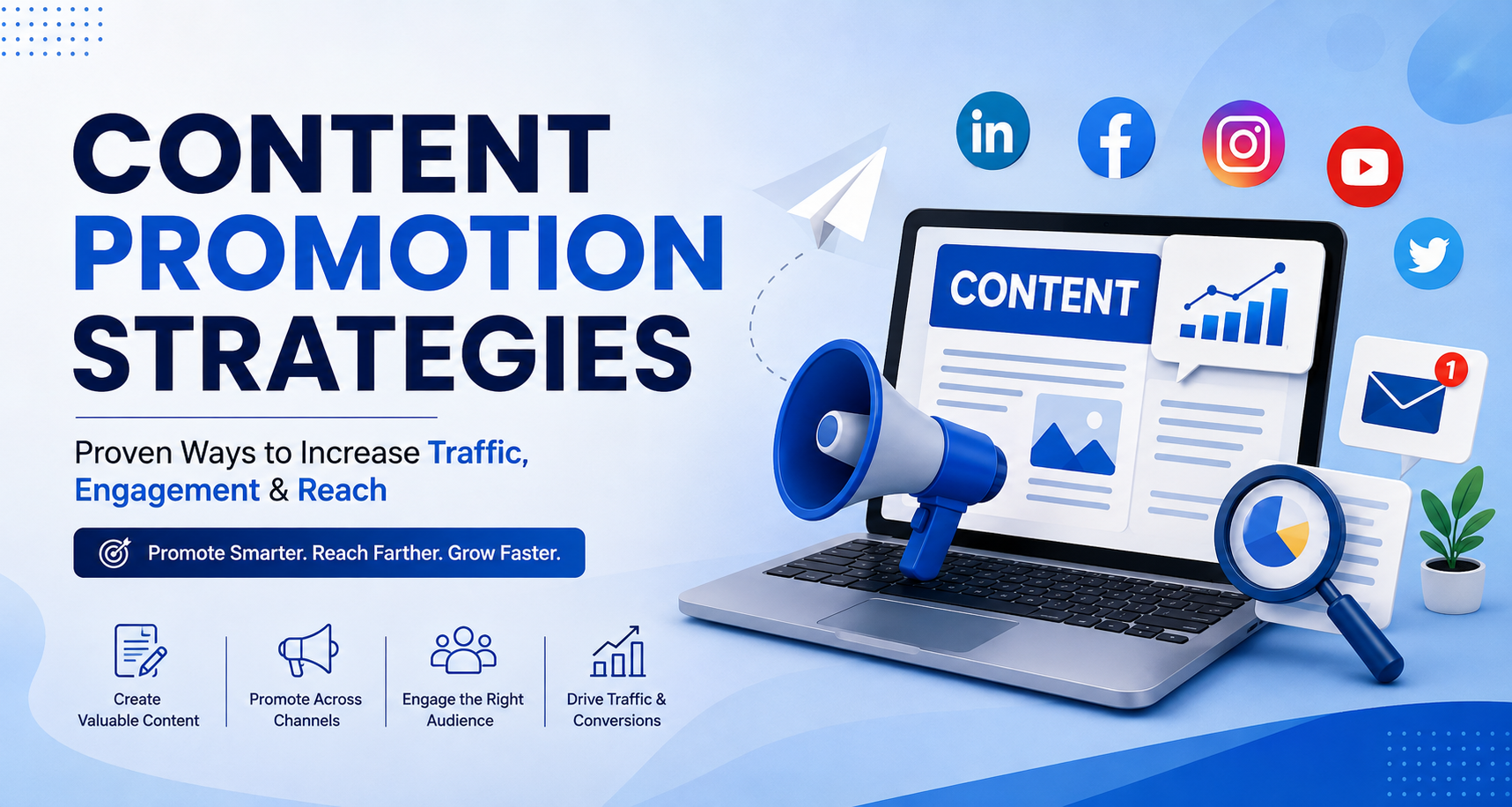
Content Promotion Strategies: 15 Proven Ways to Increase Traffic & Reach

Content Promotion Strategies: 15 Proven Ways to Increase Traffic & Reach

Creating valuable content takes time. But publishing a blog post, guide, video, or case study is only the beginning. Even excellent content can struggle to generate traffic if the right people never discover it.

That is where content promotion comes in.

Content promotion is the process of distributing your published content across channels such as search engines, social media, email, online communities, partnerships, outreach, and paid advertising. The goal is not simply to get more views. Effective promotion should help you attract the right audience, generate engagement, earn backlinks, build brand awareness, and ultimately support business growth.

A strong content promotion strategy combines organic and paid channels instead of depending on a single source of traffic.

In this guide, we’ll cover 15 practical content promotion strategies, explain how to build a repeatable promotion workflow, and show you which metrics to track to determine whether your efforts are actually working.

What Is Content Promotion?

Content promotion is the strategic distribution of content after it has been created and published.

For example, publishing a detailed blog post does not mean your promotional work is finished. That article can also become:

  • LinkedIn posts
  • Instagram content
  • Short-form videos
  • An email newsletter
  • A downloadable checklist
  • A presentation
  • An infographic
  • A discussion topic for relevant communities
  • Outreach material for industry websites
  • Supporting content for paid advertising

Think of your original article as the core asset and your promotion channels as the distribution network around it.

The objective is simple: put useful content in front of people who are most likely to find it relevant and valuable.
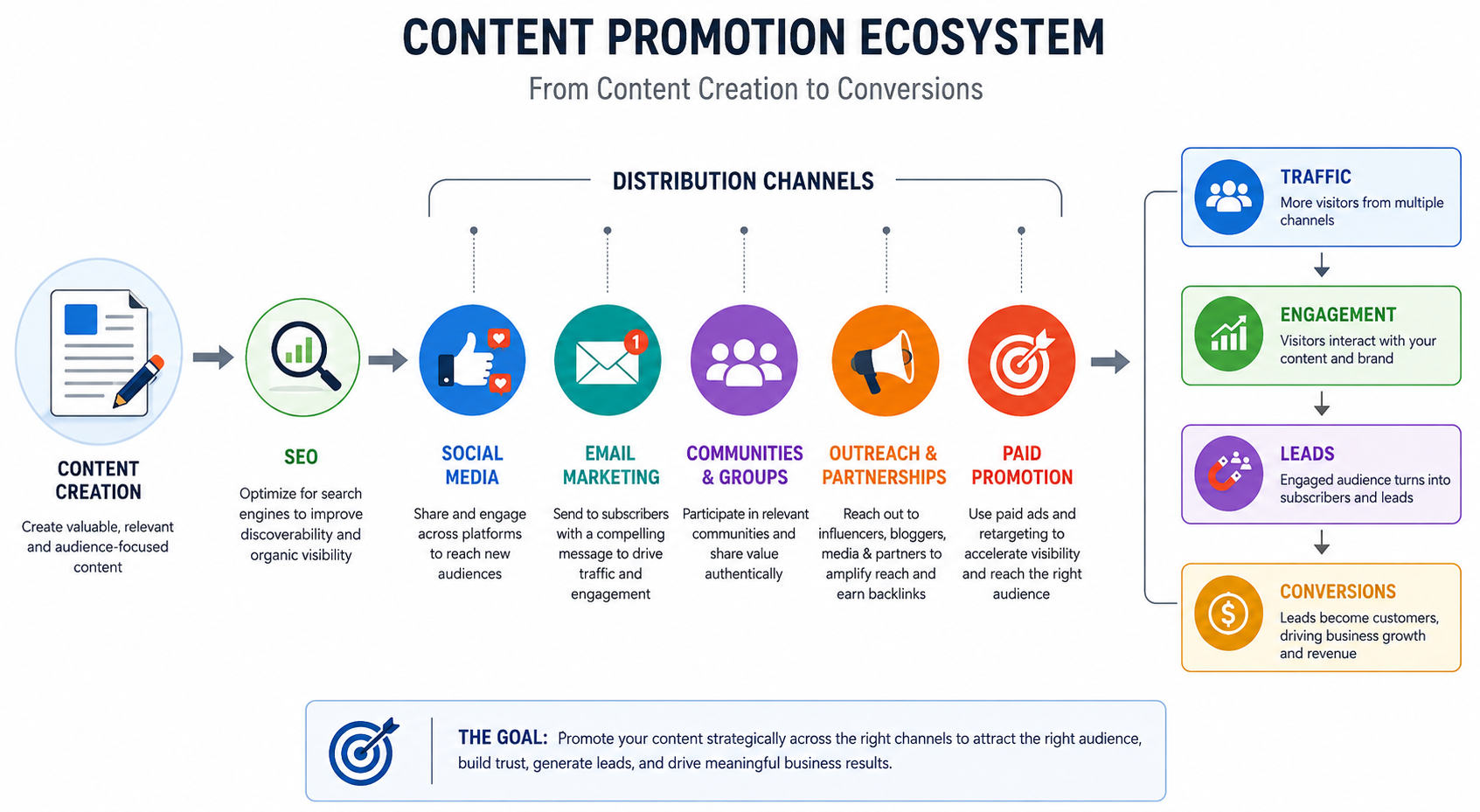
Content promotion ecosystem showing SEO, social media, email, outreach and paid advertising channels leading to traffic, leads and conversions

Why Content Promotion Matters

Search engines can bring long-term organic traffic, but ranking takes time and competition can be high. Social algorithms are also constantly changing, while email lists and professional communities provide opportunities to reach audiences more directly.

A strong promotion strategy can help you:

  • Increase website traffic
  • Improve content visibility
  • Generate qualified leads
  • Build backlinks
  • Strengthen brand authority
  • Increase social engagement
  • Reach new audiences
  • Extend the lifespan of existing content
  • Support SEO performance
  • Generate conversions from existing content assets

The important point is that content creation and content promotion should work together.

A useful piece of content with no distribution may remain invisible. A well-promoted piece of content has more opportunities to attract readers, shares, mentions, links, and conversions.

15 Content Promotion Strategies

1. Share Content on Social Media

Social media is one of the easiest places to start promoting newly published content.

However, avoid copying the same blog link and caption across every platform. Each channel has different user behavior and content formats.

For example:

  • Turn the article’s key points into a LinkedIn post.
  • Create a carousel summarizing the main lessons.
  • Convert an important section into a short video.
  • Use an interesting statistic or insight as a standalone social post.
  • Ask a question related to the article to encourage discussion.

The goal should not always be to push people directly to the website. First create something useful on the platform, then give users a reason to explore the full article.

2. Repurpose One Article Into Multiple Content Formats

One of the most efficient promotion strategies is content repurposing.

Instead of creating ten completely new pieces of content, take one strong article and turn it into multiple assets.
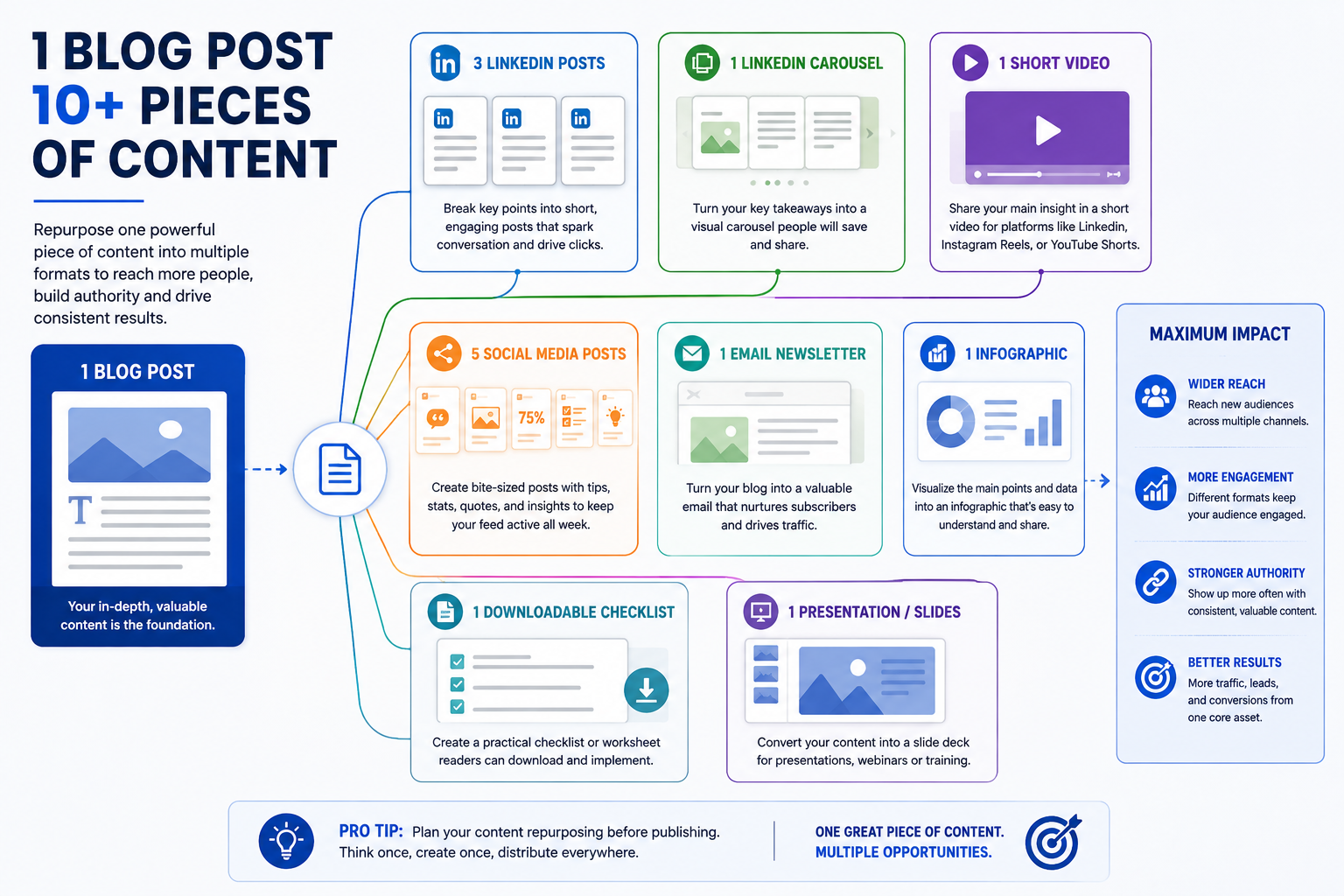
Repurpose One Article Into Multiple Content Formats

For example:

1 blog post → 1 LinkedIn carousel → 3 LinkedIn posts → 1 short video → 5 social posts → 1 email → 1 infographic

This increases your content’s reach while reducing the amount of time required to create new material.

The key is to adapt the content instead of simply copying and pasting it.

3. Build an Email Distribution Strategy

Your email subscribers are already familiar with your brand, making email one of the most valuable channels for content promotion.

When publishing a new article, don’t simply send:

“New blog post: Read now.”

Instead, give subscribers a useful reason to click.

For example:

Most businesses spend hours creating content but very little time promoting it. Here are five distribution tactics that can help you get more value from every article you publish.

Then link to the full guide.

You can also segment your email list based on interests, industry, previous engagement, or customer stage so that your content is more relevant to each audience.

4. Promote Content Through LinkedIn

For B2B companies, LinkedIn can be particularly useful for content distribution.

Rather than publishing only the article URL, extract one strong insight and build a native LinkedIn post around it.

A simple structure is:

Problem → Insight → Practical recommendation → Example → CTA

You can then publish additional posts based on different sections of the same article.

This gives one piece of content multiple opportunities to reach your audience.

5. Use Relevant Online Communities

Communities can generate highly targeted traffic when used correctly.

Look for communities where your target audience is already discussing the problem your content addresses.

The important rule is do not spam links.

Participate in the conversation first. Answer questions, provide useful information, and share your article only when it genuinely adds value.

Relevant professional communities, industry groups, discussion platforms, and niche forums can be useful distribution channels when approached naturally.

6. Partner With Industry Influencers and Experts

Influencer marketing doesn’t always mean working with celebrities or large creators.

For B2B and specialist industries, a respected industry expert with a smaller but highly relevant audience may be more valuable.

You can:

  • Interview experts for an article.
  • Include expert quotes.
  • Create a collaborative guide.
  • Invite professionals to contribute insights.
  • Create an expert roundup.
  • Share the finished article with contributors.

When people are genuinely involved in creating a piece of content, they are more likely to engage with or share it.

7. Build Backlinks Through Outreach

Content promotion and link building can work together.

After publishing a valuable resource, identify websites that already discuss the same subject.

Then create a personalized outreach campaign explaining why your resource could add value to their existing content.

Focus on relevance rather than sending hundreds of generic emails.

A strong backlink prospect usually has:

  • Relevant subject matter
  • A genuine audience
  • Useful existing content
  • Editorial standards
  • A reason to reference your resource

The objective isn’t simply to collect links. It is to earn relevant editorial mentions that can contribute to authority, referral traffic, and discoverability.

8. Use Guest Posting

Guest posting can extend your reach beyond your own website.

Instead of writing generic articles for unrelated websites, identify publications that already reach your target audience.

Choose topics that naturally connect to your expertise and provide genuine value to the host publication.

You can then reference your own resources where they are contextually useful.

Quality matters more than quantity. A small number of relevant publications can be more valuable than dozens of low-quality placements.

9. Leverage Digital PR

If your content contains original research, useful data, expert insights, industry trends, or unique findings, consider promoting it through digital PR.

For example, a company could publish:

“2026 Digital Marketing Performance Report”

The data can then become the basis for:

  • Press outreach
  • Industry commentary
  • Expert quotes
  • News coverage
  • Publisher mentions
  • Social content
  • Sales material

Original information gives journalists, publishers, and industry professionals a stronger reason to reference your content.

10. Promote High-Value Content With Paid Advertising

Organic promotion isn’t the only option.

Paid advertising can accelerate the distribution of valuable content, particularly when the content supports a larger marketing objective.

Potential channels include:

However, don’t promote every blog post simply because it exists.

Paid promotion is generally better suited to content that:

  • Targets a valuable audience
  • Supports a commercial topic
  • Generates leads
  • Builds remarketing audiences
  • Demonstrates expertise
  • Supports a larger campaign

Start with a clear objective and track the result rather than optimizing only for clicks.

11. Use Retargeting to Re-Engage Visitors

Someone who reads one article may not be ready to become a customer immediately.

Retargeting allows you to reconnect with visitors who have already interacted with your website.

For example:

Blog visitor → Retargeting ad → Service page → Lead form

This approach can be particularly useful when informational content sits at the top of your marketing funnel.

The important thing is to maintain relevance. A visitor who read an SEO guide should receive an offer related to SEO rather than an unrelated service.

12. Collaborate With Complementary Brands

Look for businesses that serve a similar audience without directly competing with you.

For example, a web development company and a CRM consultant could collaborate on:

“The Complete Guide to Building a Lead-Generating Website and CRM Funnel.”

Both businesses can contribute expertise and promote the finished resource to their respective audiences.

This creates a mutually beneficial distribution opportunity while introducing each brand to a new but relevant audience.

13. Update and Republish Existing Content

Content promotion doesn’t always mean creating something new.

Sometimes your existing content already has the foundation for stronger performance.

Review older articles and look for:

  • Outdated statistics
  • Old screenshots
  • Broken links
  • Missing sections
  • New industry developments
  • Better examples
  • New search intent
  • Opportunities for internal links

After improving the article, update its publication information where appropriate and promote it again through your existing channels.

A useful article can have multiple promotional cycles throughout its lifespan.

14. Strengthen Internal Linking

Internal links are often overlooked as a content promotion method.

When you publish a new article, identify older relevant pages that can link to it.

For example, an article about content promotion could be connected to pages covering:

This helps readers discover related information and creates a stronger relationship between pages across your website.

Internal linking should be natural and useful. Avoid adding links simply to increase the number of links on a page.

15. Optimize Content for Search and AI-Driven Discovery

Content promotion shouldn’t stop at social media and paid advertising.

Your content should also be structured so that search engines and modern search experiences can understand it clearly.

Start with the fundamentals:

  • Match the search intent.
  • Use a clear heading structure.
  • Answer important questions directly.
  • Include relevant entities and terminology naturally.
  • Add original insights and examples.
  • Keep important information easy to find.
  • Strengthen internal linking.
  • Maintain accurate and useful information.
  • Demonstrate first-hand expertise where possible.

The goal isn’t to write content for algorithms. It is to create content that is genuinely useful, well-structured, trustworthy, and easy to understand.

How to Create a Content Promotion Workflow

A repeatable workflow prevents content promotion from becoming an afterthought.

Here’s a simple seven-day framework:

Day 0 — Publish

Publish the article after checking:

  • SEO title
  • Meta description
  • URL
  • Internal links
  • Images
  • CTAs
  • Mobile experience
  • Tracking

Day 1 — Social + Email

Share the article through your main social channels and send it to the appropriate email segment.

Day 2 — Create Supporting Content

Turn the article into:

  • A carousel
  • Short posts
  • A video
  • A visual summary

Day 3 — Outreach

Identify relevant publishers, experts, websites, and communities that may benefit from the content.

Day 4 — Community Distribution

Participate in relevant discussions and contribute useful insights from the article where appropriate.

Day 5 — Paid Promotion

If the article supports a commercial objective, test paid distribution against a clearly defined audience.

Day 7 — Review Performance

Check traffic, engagement, referrals, backlinks, conversions, and search visibility.

Then decide whether to continue, improve, repurpose, or redistribute the content.

Content Promotion Metrics to Track

Getting traffic is useful, but traffic alone doesn’t tell you whether your strategy is working.

Track metrics based on your objective.

Metric What It Tells You
Organic traffic Whether search is generating visibility
Referral traffic Which external channels send visitors
Social engagement Whether your content resonates
Click-through rate Whether promotion generates interest
Backlinks Whether other websites find the content valuable
Leads Whether content contributes to business opportunities
Conversion rate Whether visitors take desired actions
Assisted conversions Whether content supports later conversions

For example, a blog post with 2,000 visitors and no leads may be less commercially valuable than an article with 500 highly targeted visitors that generates 20 qualified enquiries.

Always connect content metrics to the business objective.
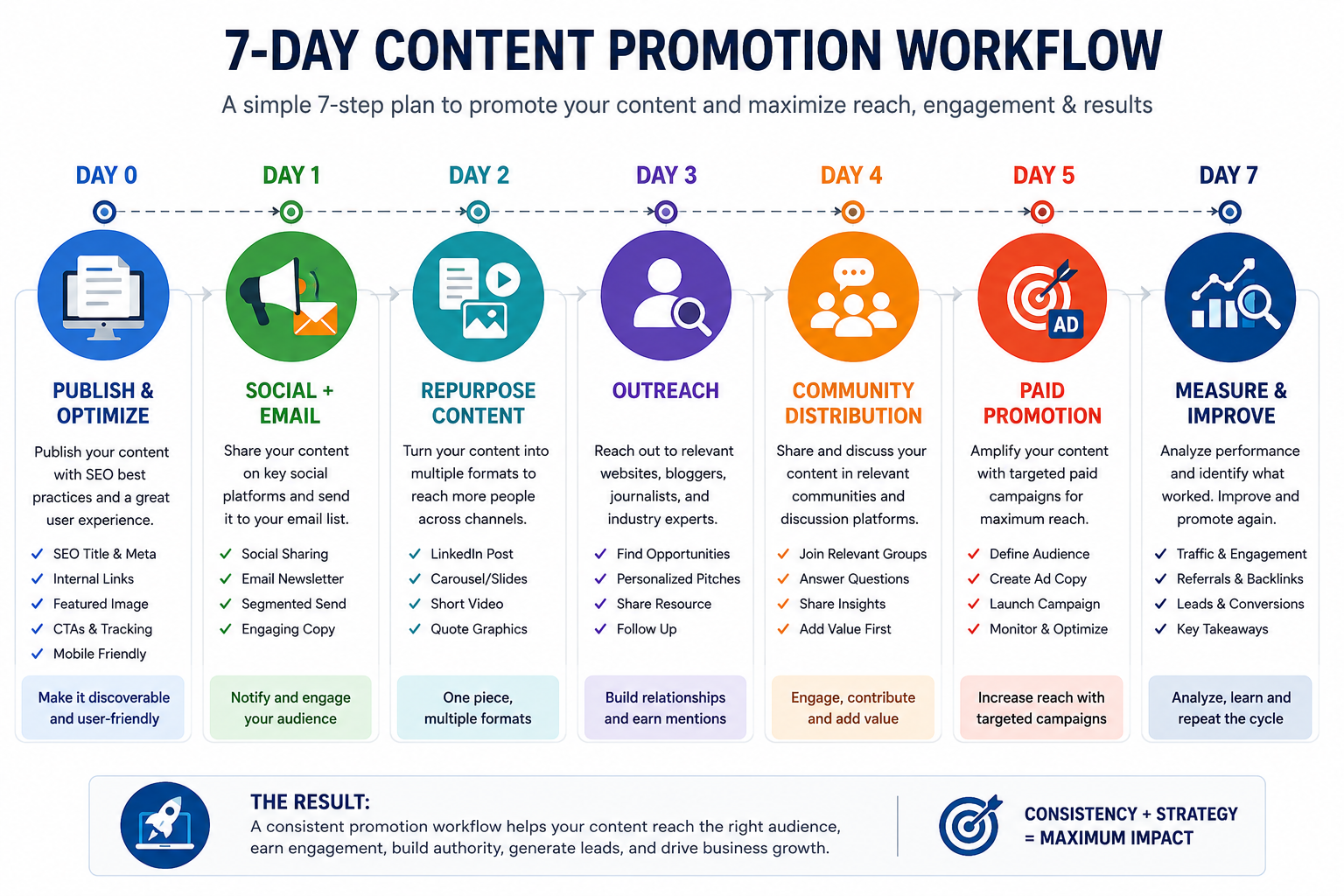
Seven-day content promotion workflow showing publishing, social media, email, repurposing, outreach, paid promotion and performance analysis

Common Content Promotion Mistakes

Even a strong article can underperform if its promotion strategy is weak.

Avoid these common mistakes:

Publishing Once and Forgetting About It

One social post isn’t a promotion strategy. Valuable content can be redistributed in different formats over time.

Using the Same Message Everywhere

Different platforms require different formats, hooks, and communication styles.

Buying Low-Quality Backlinks

Focus on relevance and editorial value rather than backlink volume.

Promoting Every Piece With Paid Ads

Not every article deserves an advertising budget. Prioritize content that supports measurable objectives.

Measuring Only Pageviews

Traffic is useful, but leads, conversions, engagement, and qualified referral traffic can provide more meaningful insights.

Creating Content Without a Distribution Plan

Before publishing, decide how the content will be promoted. Distribution should be part of the content strategy from the beginning.

A Simple Content Promotion Ecosystem

The most effective approach combines multiple channels:

Content Asset

↓

SEO + Internal Linking

↓

Social Media + Email

↓

Communities + Partnerships

↓

Outreach + Digital PR

↓

Paid Promotion + Retargeting

↓

Traffic + Engagement

↓

Leads + Conversions

This approach turns content promotion from a collection of random marketing activities into a repeatable system.

Frequently Asked Questions

What is content promotion?

Content promotion is the process of distributing published content through channels such as search engines, social media, email, communities, partnerships, outreach, and paid advertising to increase its visibility, traffic, engagement, and business impact.

What are the best content promotion strategies?

Some of the most effective strategies include SEO, social media distribution, email marketing, content repurposing, backlink outreach, guest posting, digital PR, partnerships, paid advertising, retargeting, and community engagement.

How do I promote a blog post?

Start by sharing it with relevant audiences through social media and email. Then repurpose the article into additional formats, build relevant outreach opportunities, strengthen internal links, participate in relevant communities, and consider paid promotion when the content supports a valuable business objective.

Can I promote content without paid advertising?

Yes. SEO, social media, email marketing, internal linking, community participation, partnerships, guest posting, digital PR, and organic outreach can all generate content visibility without requiring an advertising budget.

How long should I promote a piece of content?

There is no fixed promotional period. High-quality evergreen content can be promoted repeatedly over months or even years. Review performance regularly and refresh the content when information, search intent, or industry conditions change.

What is the difference between content marketing and content promotion?

Content marketing is the broader strategy of using valuable content to attract, educate, engage, and convert an audience. Content promotion is the distribution component that helps that content reach the intended audience.

Final Takeaway

Creating great content is only half the job.

The real opportunity comes from building a system that consistently puts that content in front of the right people.

Instead of publishing an article and waiting for traffic, combine SEO, social media, email, content repurposing, communities, partnerships, outreach, digital PR, paid advertising, and retargeting based on the audience and objective.

Most importantly, measure what happens after distribution.

The goal isn’t to generate the largest possible number of views. It is to attract the right audience, create meaningful engagement, earn authority, generate qualified traffic, and turn useful content into measurable business results.

If your business is creating content but struggling to turn that content into traffic and leads, a structured content promotion strategy can help connect your content efforts with your broader SEO, digital marketing, and growth goals.

Ready to get more value from your content? ThirdEssential can help businesses combine content marketing, SEO, paid advertising, and digital marketing into a strategy designed around measurable growth.
CTA: Get a Free Digital Marketing Consultation

10 Effective SEO Techniques to Boost Your Website’s Ranking

Why Some Websites Rank While Others Stay Invisible

Imagine two businesses in the same city offering nearly identical services.

Both invest in professional websites. Both publish blogs. Both spend money on marketing.

A year later, one appears on the first page of Google for valuable searches. The other barely attracts organic visitors.

The difference usually isn’t luck.

It’s the quality of the SEO strategy behind the website.

Search engine optimization has changed significantly over the past few years. Google’s ranking systems now evaluate far more than keywords. They look at page experience, content quality, website performance, search intent, topical authority, technical health, and dozens of other signals working together.

That means ranking well isn’t about finding shortcuts. It’s about building a website that genuinely deserves visibility.

Whether you’re a local business, an eCommerce store, or a growing SaaS company, the same principle applies: if your website helps users better than competing pages, search engines have stronger reasons to recommend it.

This guide breaks down ten practical SEO techniques that continue to deliver results in 2026. More importantly, you’ll learn why they matter, when to prioritize them, and where businesses often waste time focusing on the wrong things.

1. Build a Strong Technical Foundation Before Chasing Rankings

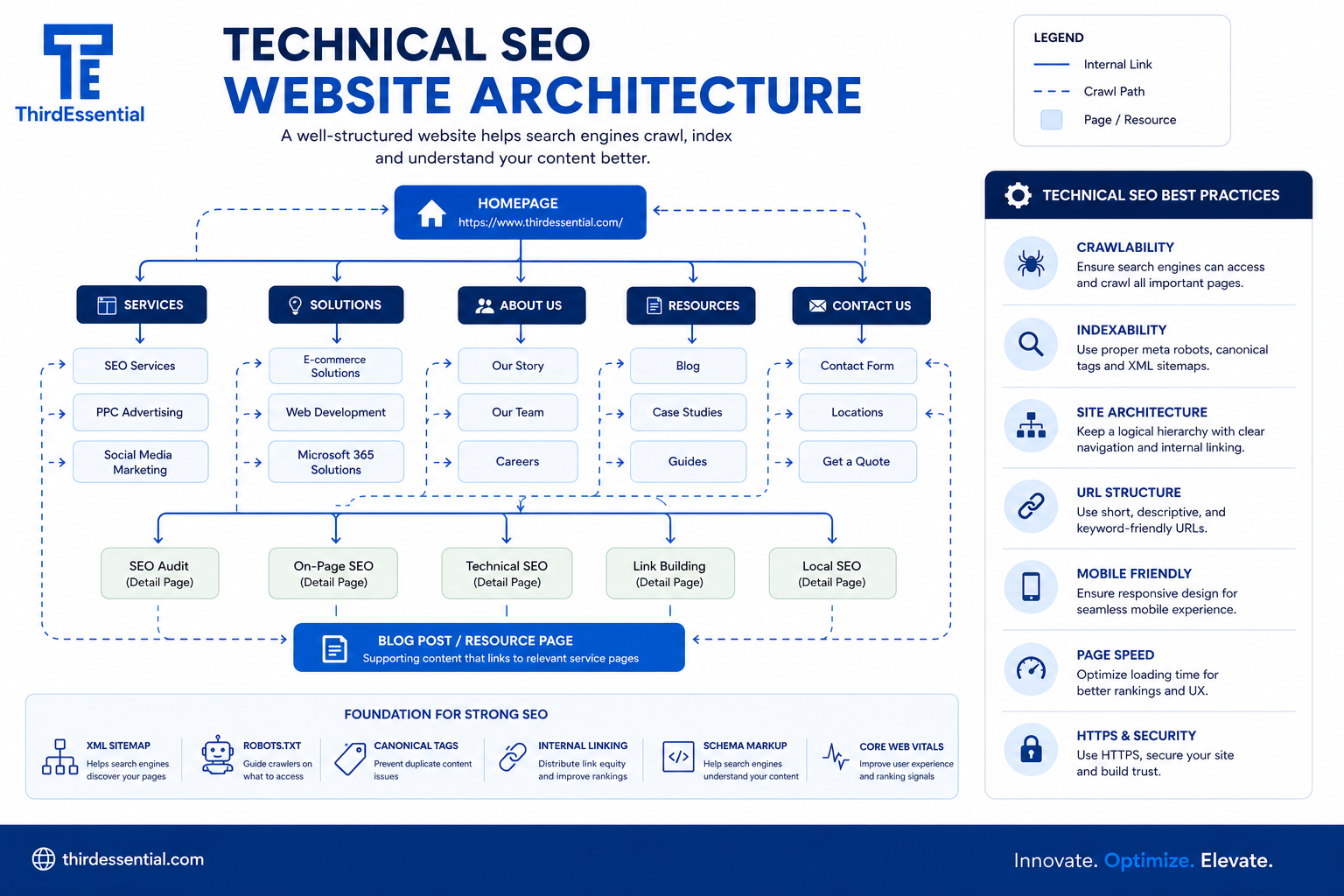
Technical SEO website architecture diagram

Many businesses start SEO by researching keywords.

Ironically, that’s often not the biggest problem.

If Google struggles to crawl your website, your pages load slowly, or your navigation confuses both visitors and search engines, even well-written content may never reach its ranking potential.

Technical SEO isn’t glamorous, but it’s one of the highest-return investments you can make.

Google has repeatedly emphasized that websites should be built for users first while remaining easy for search engines to understand. A clean technical structure supports both goals.

Focus on Website Architecture

Think of your website like a library.

If books are randomly placed without categories, finding anything becomes frustrating.

Search engines face a similar challenge.

A clear website architecture helps Google discover pages faster while helping visitors navigate naturally.

A healthy structure usually includes:

  • Logical navigation
  • Descriptive URLs
  • XML sitemap
  • Breadcrumbs
  • Organized service pages
  • Clean internal hierarchy

Businesses investing in professional web development services in Indore often benefit from SEO-friendly architecture from the beginning rather than trying to repair structural issues later.

Improve Crawlability

Not every page deserves Google’s attention.

Search engines have limited crawl resources.

Duplicate pages, unnecessary archives, broken links, parameter URLs, and poorly managed redirects waste crawl budget.

Regular technical audits should identify:

  • Broken links
  • Redirect chains
  • Duplicate content
  • Missing canonicals
  • Crawl errors
  • Indexing issues

Google Search Console is usually the first place to investigate these problems.

HTTPS Isn’t Optional

HTTPS has been a confirmed ranking signal for years.

More importantly, users expect secure websites.

If browsers display security warnings, trust disappears almost instantly.

Whether you’re running an online store or a simple business website, secure connections are now a basic expectation rather than an added feature.

Common Mistake

Many businesses redesign their website without considering URL structure.

Months later, they discover hundreds of rankings disappeared because redirects weren’t implemented correctly.

SEO should be involved before development begins—not after launch.

Summary

Build clean website architecture

Improve crawlability

Secure every page with HTTPS

Monitor indexing through Search Console

Fix technical issues before publishing more content

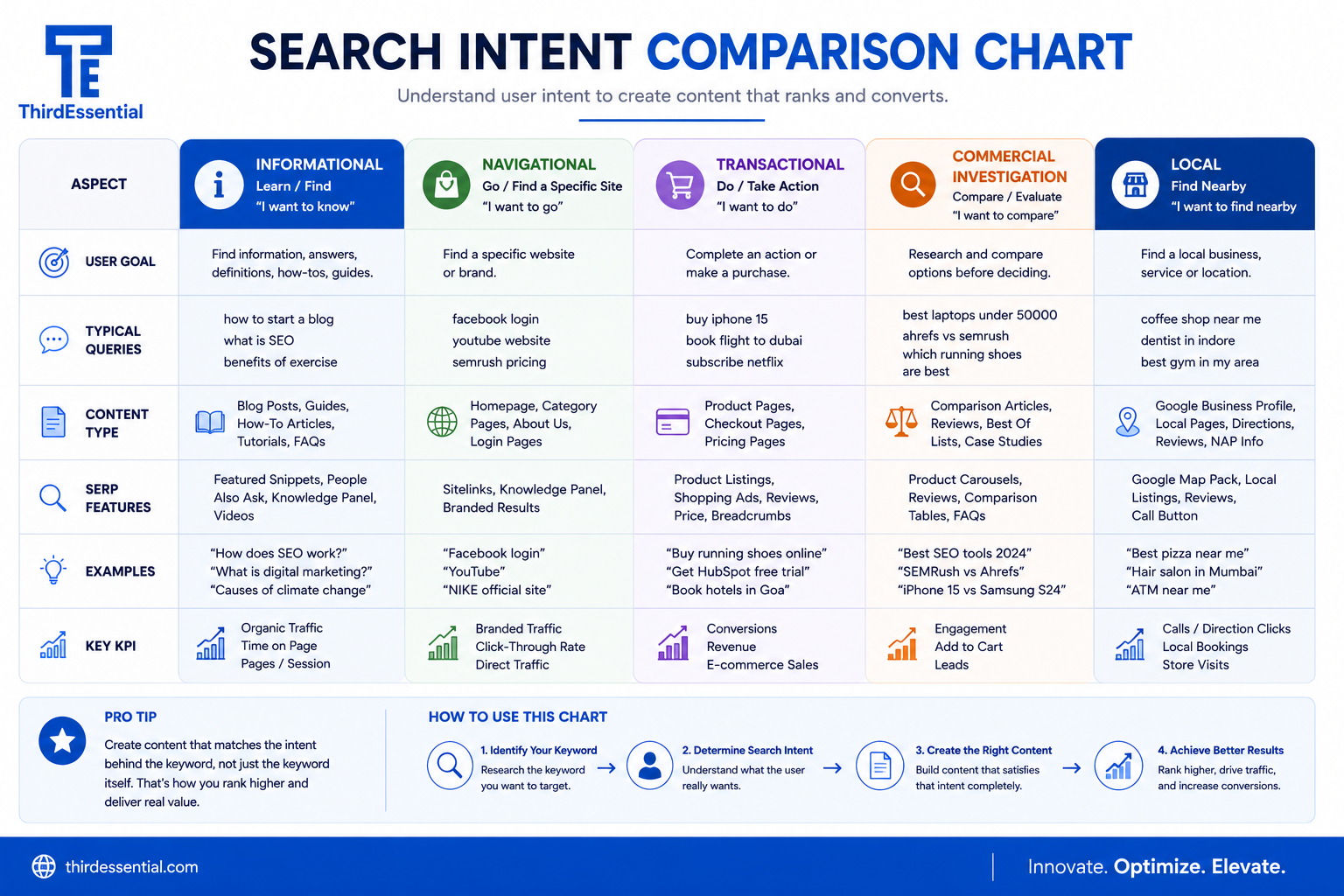
2. Create Content Around Search Intent, Not Just Keywords

Search intent comparison chart

Keyword research has changed.

Years ago, finding high-volume keywords was enough to build a content strategy.

That approach doesn’t work nearly as well anymore.

Google has become much better at understanding what users actually want.

Two people can search similar phrases while expecting completely different answers.

Consider these searches:

  • best CRM software
  • CRM software pricing
  • CRM implementation consultant

They look related.

Their intent isn’t.

One person is researching.

Another is comparing.

The third may be ready to hire someone.

Successful SEO begins by identifying the purpose behind every search.

The Four Main Types of Search Intent

Intent

Example

Best Content

Informational What is SEO? Guides, blogs
Commercial Best SEO agency Comparisons
Transactional Hire SEO expert Service pages
Navigational ThirdEssential SEO Brand pages

Trying to satisfy multiple intents on one page often results in satisfying none of them well.

Why Intent Matters More Than Keyword Density

Google’s systems increasingly evaluate whether a page solves the searcher’s problem.

That’s why pages with fewer keyword repetitions sometimes outrank pages that are heavily optimized.

The winning page simply answers the question better.

Practical Tip

Before writing any article, search your target keyword and study the first page.

Ask yourself:

  • What format dominates?
  • Are results mostly guides?
  • Lists?
  • Videos?
  • Product pages?
  • Local businesses?

Google is already showing you what users expect.

Match that expectation before trying to outperform it.

Information Gain Matters More Than Ever

Publishing another article that repeats existing advice rarely earns strong rankings.

Instead, ask:

“What can I explain that the current top results don’t?”

That could include:

  • implementation challenges
  • decision frameworks
  • cost comparisons
  • prioritization advice
  • common mistakes
  • practical examples

This concept—often called information gain—helps create content that’s genuinely worth ranking.

Summary

Target user intent first

Choose one primary intent per page

Study existing search results

Add original insights

Focus on solving problems rather than repeating keywords

3. Improve Page Experience Before Looking for More Traffic

A common assumption is that poor rankings are caused by weak content.

Sometimes that’s true.

Other times, the content is perfectly useful—but the experience of consuming it isn’t.

People leave because the page loads slowly, jumps while loading, hides important information behind pop-ups, or simply feels difficult to use.

Google has spent years encouraging website owners to improve these aspects through its Page Experience signals and Core Web Vitals. While great content remains the stronger ranking factor, a frustrating user experience can still reduce engagement and conversions.

Core Web Vitals: What They Measure

Core Web Vitals focus on three aspects of page performance:

Metric Measures

Why It Matters

Largest Contentful Paint (LCP) Loading speed Users shouldn’t wait for the main content to appear.
Interaction to Next Paint (INP) Responsiveness Pages should react quickly when visitors click or type.
Cumulative Layout Shift (CLS) Visual stability Buttons and text shouldn’t move unexpectedly while loading.

Improving these metrics isn’t just about pleasing Google. Faster, more stable websites generally keep visitors engaged for longer.

4. Build Topical Authority Instead of Publishing Random Blogs

There’s a misconception that publishing more blog posts automatically leads to better rankings.

It doesn’t.

A website with 300 average articles often loses to one with 40 exceptionally useful resources covering a subject in depth.

Google wants confidence that your website understands a topic—not that it mentions it occasionally.

That’s where topical authority comes in.

What Is Topical Authority?

Topical authority is built when your website covers a subject comprehensively instead of relying on isolated articles.

For example, if your business offers SEO services, don’t stop at writing a single guide on SEO techniques.

Create supporting content around:

  • Technical SEO
  • Local SEO
  • On-page SEO
  • Off-page SEO
  • Core Web Vitals
  • Google Search Console
  • Keyword Research
  • Website Audits
  • Content Marketing
  • Schema Markup
  • Internal Linking
  • AI Search Optimization

Together, these pages reinforce each other and signal expertise.

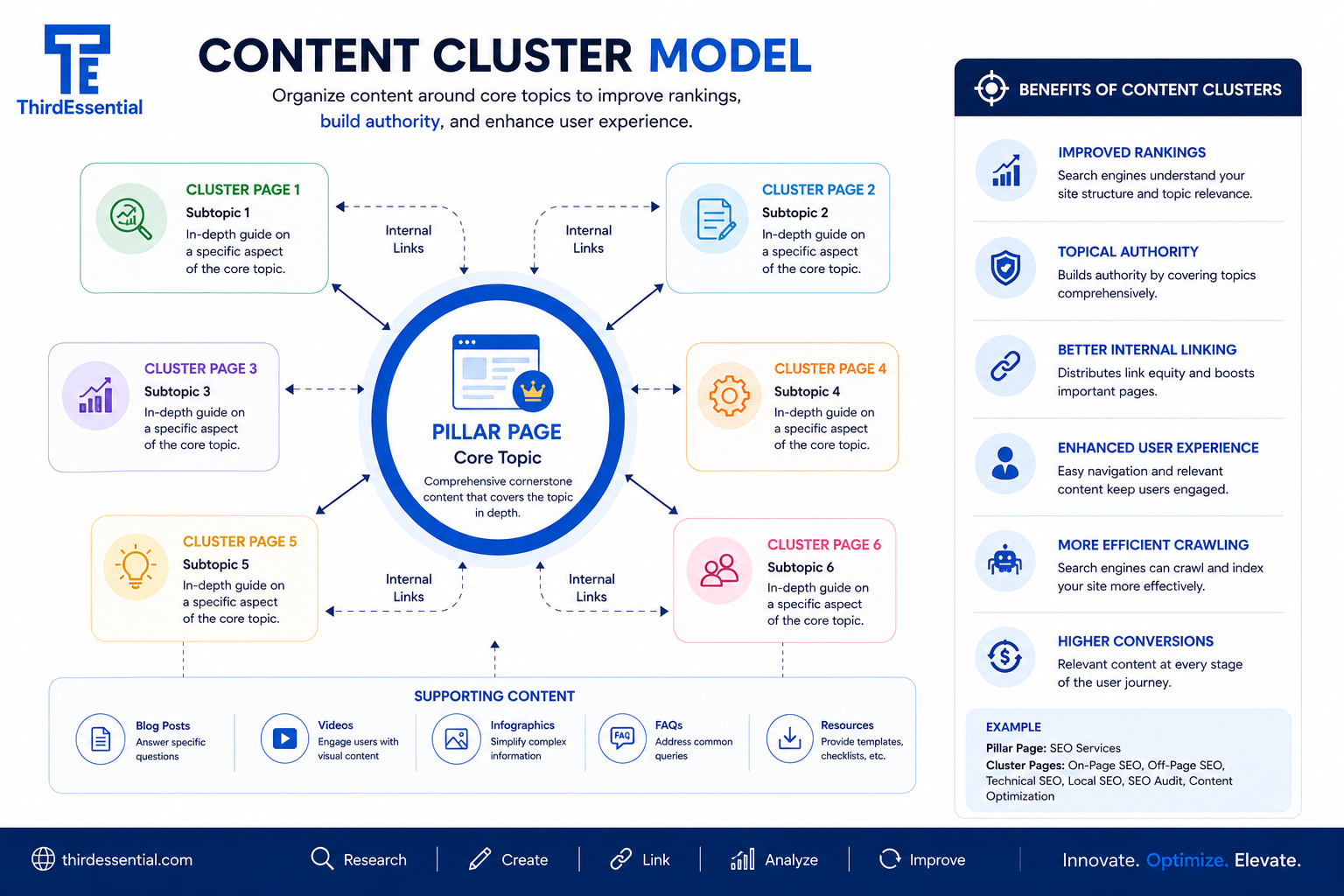
Build Content Clusters

Content cluster model

Rather than publishing disconnected articles, organize content into clusters.

Pillar Page Supporting Content
Complete SEO Guide Keyword Research
Complete SEO Guide Technical SEO Checklist
Complete SEO Guide Local SEO Guide
Complete SEO Guide Core Web Vitals Explained
Complete SEO Guide Internal Linking Strategy

Each supporting article links back to the pillar page and to other relevant resources.

This structure helps search engines understand the relationship between your content while making it easier for readers to explore a topic in depth.

Common Mistake

Many businesses publish content based only on what’s trending.

Trending topics can bring short-term traffic, but if they don’t relate to your services or expertise, they rarely contribute to long-term authority.

Prioritize evergreen content first. Add trend-based articles only when they’re genuinely relevant to your audience.

Quick Checklist

Build pillar pages

Create supporting articles

Keep topics closely related

Update older content regularly

5. Make Internal Linking Work Harder

Internal links are often added as an afterthought.

They deserve much more attention.

A thoughtful internal linking strategy helps search engines discover content, understand page relationships, and distribute authority across your website.

For readers, internal links answer the next logical question.

Imagine someone reading about SEO. Their next question might be:

“How do I improve my website’s technical performance?”

That’s a natural place to reference web development services in Indore if the discussion shifts toward building faster, search-friendly websites from the ground up.

Likewise, while discussing user engagement and retention, mentioning custom mobile app development can make sense when explaining how businesses create consistent experiences beyond the browser.

The key is relevance.

Never insert internal links simply because you want another page indexed.

Internal Linking Best Practices

  • Link naturally within paragraphs.
  • Use descriptive anchor text.
  • Prioritize pages with business value.
  • Avoid linking the same anchor repeatedly on one page.
  • Fix orphan pages that receive no internal links.
  • Review links after publishing new content.

Common Mistake

Some websites place dozens of internal links in every article.

More isn’t better.

Too many links dilute relevance and make content harder to read.

If every paragraph contains three links, readers stop noticing them altogether.

Summary

Link where readers genuinely benefit

Connect related topics

Review internal links regularly

Avoid keyword stuffing through anchor text

6. Add Structured Data to Help Search Engines Understand Your Content

Structured data doesn’t guarantee higher rankings.

That’s an important distinction.

What it does is help search engines interpret your content more accurately, which may improve how your pages appear in search results.

Schema markup provides additional context.

Instead of simply seeing a page, Google can recognize whether it’s:

  • An article
  • A service
  • An FAQ
  • A product
  • A local business
  • An event
  • A review

This extra context can increase eligibility for rich results.

Types of Schema Worth Implementing

Schema Type Best Used For

Article

Blog posts
FAQ

Frequently asked questions

Organization

Company information

Local Business

Local SEO

Breadcrumb

Navigation

Product

E-commerce

Don’t Overdo It

Schema should accurately reflect what’s on the page.

Adding FAQ schema without visible FAQs or using review schema for self-written testimonials violates Google’s guidelines and may prevent rich results.

Use structured data honestly.

7. Focus on User Experience, Not Just Rankings

Imagine two websites offering identical services.

One loads quickly.

Navigation is obvious.

The contact form works.

Buttons are easy to find.

The other…

Takes eight seconds to load.

Pop-ups appear immediately.

Menus are confusing.

Which business feels more trustworthy?

That’s why user experience indirectly supports SEO.

People stay longer, interact more, and are more likely to convert.

Working with an experienced UI/UX design agency can help businesses identify friction points that analytics alone don’t reveal, such as confusing navigation paths or unnecessary steps during enquiries.

Accessibility Matters Too

Accessibility isn’t only about compliance.

It’s about ensuring everyone can use your website.

Simple improvements include:

  • Descriptive alt text
  • Proper heading hierarchy
  • Keyboard navigation
  • Readable colour contrast
  • Meaningful link text

Accessible websites often become better websites for everyone.

Quick Checklist

Improve readability

Simplify navigation

Reduce unnecessary clicks

Optimize forms

Improve accessibility

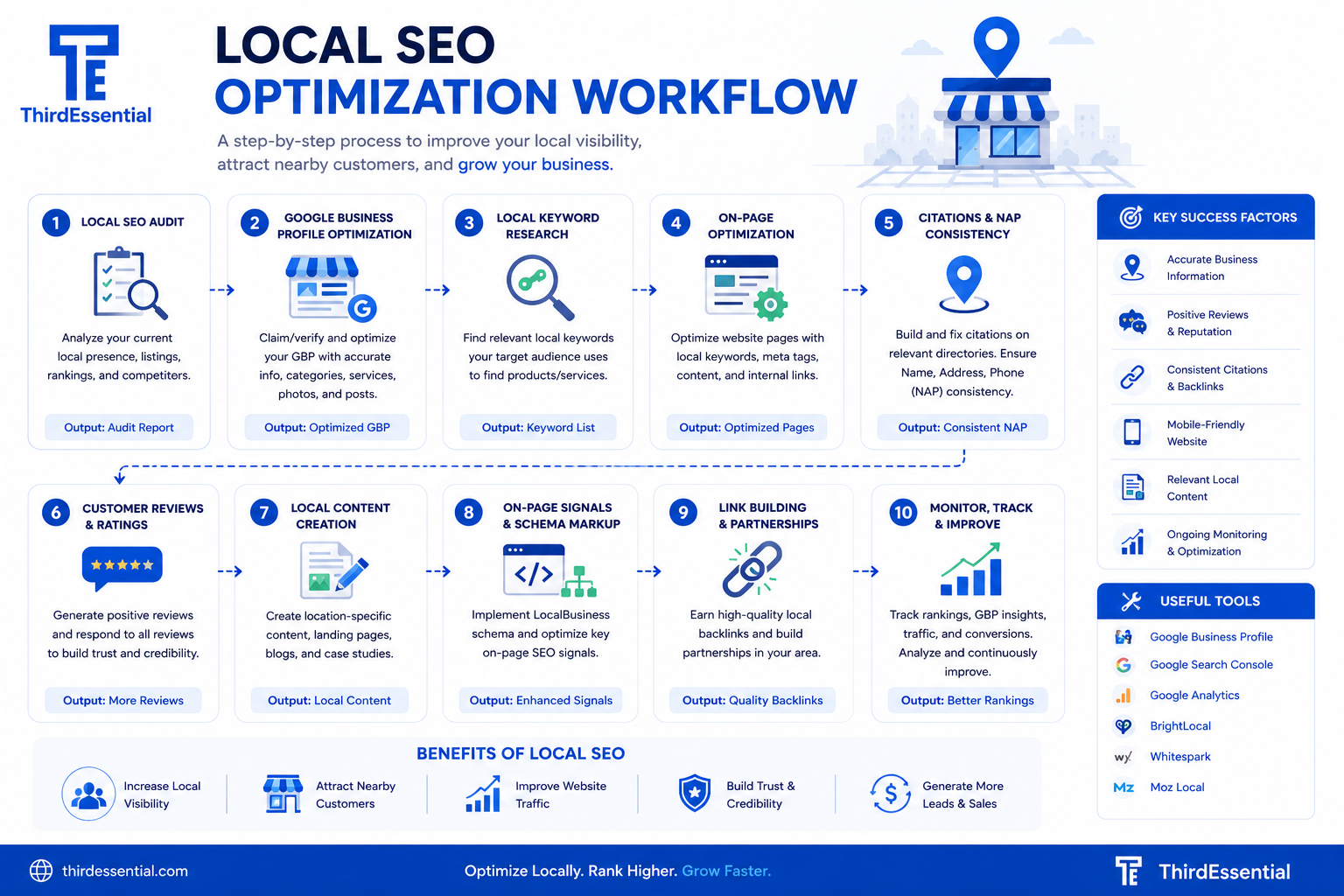
8. Strengthen Local SEO If You Serve a Specific Area

A business serving customers in one city doesn’t need visitors from every country.

It needs visibility where potential customers actually are.

That’s the purpose of Local SEO.

Key Areas to Focus On

Optimize Google Business Profile

An accurate and regularly updated Google Business Profile increases your chances of appearing in local search results and Google Maps.

Keep information consistent across every platform.

Include:

  • Business hours
  • Categories
  • Contact details
  • Photos
  • Services
  • Customer reviews

Create Location-Relevant Content

Rather than stuffing city names into every paragraph, produce genuinely useful local content.

Businesses offering digital marketing services in Indore, for example, can publish guides about local consumer behaviour, regional market trends, or digital advertising opportunities specific to Central India.

That’s significantly more valuable than repeating “Indore” twenty times.

Local SEO Checklist

Optimize Google Business Profile

Collect authentic reviews

Build local citations

Maintain NAP consistency

Publish local content

Local SEO optimization workflow

9. Keep Your Website Healthy After Launch

Launching a website isn’t the end of the project.

It’s the beginning.

Over time:

Plugins become outdated.

Security vulnerabilities appear.

Links break.

Pages slow down.

Content becomes inaccurate.

Ignoring these issues gradually affects user trust and search performance.

Businesses using website maintenance services typically stay ahead of these problems through regular updates, backups, uptime monitoring, and performance checks.

Preventive maintenance is almost always less expensive than recovering from a hacked or broken website.

Monthly Website Maintenance Checklist

Task

Frequency

Update plugins

Monthly

Update WordPress core

Monthly

Check backups

Weekly

Fix broken links

Monthly

Review Search Console errors

Monthly

Monitor Core Web Vitals

Monthly

Scan for malware

Weekly

10. Measure Results and Keep Improving

SEO isn’t something you complete once.

Search behaviour changes.

Competitors publish new content.

Google updates its systems.

Businesses launch new products.

The websites that continue improving usually outperform those left untouched.

Measure What Actually Matters

Instead of obsessing over rankings alone, monitor:

  • Organic traffic
  • Qualified leads
  • Conversion rate
  • Click-through rate
  • Indexed pages
  • Core Web Vitals
  • Revenue from organic search

Higher rankings mean little if they don’t contribute to business growth.

Build Helpful Digital Tools

Not every valuable SEO asset is a blog post.

Interactive calculators, checklists, browser utilities, and productivity tools naturally attract backlinks and repeat visitors because they solve real problems.

For businesses targeting niche audiences, browser extension development can support long-term brand visibility by creating practical tools users return to regularly. While this won’t replace a strong content strategy, it can complement one by earning mentions and links that purely informational content often doesn’t.

Prioritization Framework

If you’re starting from scratch, tackle SEO in this order:

Priority

Focus Area

Impact

1

Technical SEO & Indexing Very High

2

Website Speed & Core Web Vitals High

3

Search Intent & Content Quality Very High

4

Internal Linking High

5

Structured Data Medium

6

Local SEO High (for local businesses)

7

Content Clusters High

8

Ongoing Maintenance High

9

Authority Building Long-term

10

Continuous Measurement Essential

Key Takeaways

Before moving to the FAQs, here’s a practical summary of the strategies discussed:

  • Build a technically sound website before scaling content.
  • Match every page to a clear search intent.
  • Improve Core Web Vitals and overall page experience.
  • Create content clusters to establish topical authority.
  • Use internal links to guide users and distribute authority naturally.
  • Implement structured data where it’s appropriate.
  • Optimize for local search if your customers are geographically focused.
  • Maintain your website regularly to prevent technical issues.
  • Measure SEO success using business outcomes—not rankings alone.
  • Treat SEO as an ongoing process rather than a one-time project.

Frequently Asked Questions

1. Is SEO still worth investing in if I’m already running Google Ads?

Yes. SEO and Google Ads serve different purposes. Paid ads can generate traffic immediately, but they stop producing results when the budget runs out. SEO takes longer to build momentum, yet it can continue attracting qualified visitors over time. Businesses often see the strongest results when both channels support each other rather than compete.

2. How often should I update my website’s content?

There’s no universal schedule, but reviewing important pages every six to twelve months is a good practice. Update statistics, replace outdated examples, improve internal links, and expand sections where competitors provide more value. If your industry changes quickly, quarterly reviews may be more appropriate.

3. Can a new website rank on Google quickly?

A new website can begin appearing in search results within days or weeks after indexing, but earning competitive rankings usually takes longer. The timeline depends on factors such as competition, website quality, topical authority, backlinks, and how consistently useful content is published.

4. What’s the difference between Technical SEO and On-Page SEO?

Technical SEO focuses on how search engines crawl, index, and understand your website. It includes areas such as website architecture, page speed, structured data, HTTPS, canonical tags, and mobile usability.

On-page SEO focuses on the content itself—headings, keywords, search intent, internal links, metadata, and content quality.

Both are essential. Strong content can’t compensate for serious technical issues, and perfect technical SEO won’t help if the content doesn’t answer users’ questions.

5. Do backlinks still matter?

Yes, but quality matters far more than quantity.

Links from trusted, relevant websites continue to be a strong authority signal. Buying low-quality backlinks or participating in link schemes can do more harm than good. The most sustainable approach is creating genuinely useful resources that other websites naturally reference.

6. What is the biggest SEO mistake businesses make?

Many businesses focus on publishing more content without fixing underlying technical or strategic issues.

Common examples include:

  • Slow-loading websites
  • Poor mobile experience
  • Weak internal linking
  • Publishing articles without understanding search intent
  • Ignoring Google Search Console
  • Never updating older content

Improving these fundamentals often produces better results than simply increasing publishing frequency.

7. How important are Core Web Vitals?

Core Web Vitals are one part of Google’s broader Page Experience considerations. While they aren’t the only ranking factor, they directly affect how visitors experience your website. Faster, more responsive pages generally improve engagement, reduce abandonment, and support stronger conversion rates.

8. What should I measure to know if my SEO strategy is working?

Avoid judging success by rankings alone.

Instead, monitor:

  • Organic traffic growth
  • Qualified enquiries
  • Conversion rate
  • Click-through rate (CTR)
  • Indexed pages
  • Search visibility
  • Time on page
  • Revenue generated through organic search

The ultimate goal isn’t simply to rank higher—it’s to generate meaningful business outcomes.

Final Thoughts

SEO has become more sophisticated, but the core principle hasn’t changed.

Websites that provide clear answers, deliver a good user experience, and demonstrate genuine expertise consistently outperform those built around shortcuts or outdated tactics.

If you’re planning your SEO roadmap, don’t try to improve everything at once.

Start with the technical foundation.

Make sure your website is easy to crawl, fast to load, and simple to use. Build content around real customer questions. Strengthen internal links, improve topical coverage, and measure progress using meaningful business metrics instead of chasing rankings alone.

Over time, these improvements reinforce one another. Better website performance leads to better user engagement. Better engagement supports stronger search visibility. Stronger visibility creates more opportunities to generate qualified leads and build lasting brand authority.

SEO isn’t a one-time project.

It’s an ongoing process of making your website more useful than it was yesterday.

How ThirdEssential Can Help

Whether you’re launching a new website, improving an existing one, or looking to strengthen your organic search performance, having the right technical and strategic foundation makes a measurable difference.

At ThirdEssential, we combine web development, user experience, technical SEO, content strategy, and digital marketing to help businesses build websites that don’t just attract visitors—they support long-term growth.

If you’re evaluating your current website, start with an SEO audit. Identifying the biggest opportunities first often delivers far better returns than making random improvements.

Exploring the Top 11 Benefits of Becoming a Web Developer

Are you looking for a career that offers creativity, flexibility, and a high demand for skilled professionals? Web development might be the perfect choice for you. Not only is web development a challenging and rewarding field, but it also offers a variety of benefits that make it a great career option for those looking to break into the tech industry.

Here are 11 top benefits of becoming a web developer:

1) High Demand for Skilled Professionals

As technology continues to advance, the demand for web developers is constantly increasing. This means that job security is high and the potential for career growth is promising.

2) Great Earning Potential

Web developers typically earn a higher salary than other professions in the tech industry. This is due to the specialized skills and expertise required to build and maintain complex websites and applications.

3) Opportunities for Remote Work

Web development is a career that allows for remote work, meaning that you can work from anywhere in the world. This flexibility is especially attractive for those who want to travel or work from home.

4) Creative Outlet

Web development is a field that encourages creativity, allowing you to use your skills to create visually appealing and interactive websites and applications.

5) Continuous Learning Opportunities

Technology is always changing, which means that web developers are constantly learning and adapting to new tools and techniques. This ensures that the job is always challenging and engaging.

6) Collaboration with Other Professionals

Web development is a team-based field, meaning that you will have the opportunity to work closely with other professionals, such as designers, project managers, and content creators.

7) Work on a Variety of Projects

As a web developer, you will work on a variety of projects for different clients, industries, and audiences. This variety ensures that the job remains interesting and engaging.

8) Flexibility in Work Schedule

Web developers typically have a flexible work schedule, meaning that you can work during hours that suit your lifestyle and personal preferences.

9) Ability to Work on Personal Projects

Web development is a career that allows for personal projects, which can help you build your portfolio and showcase your skills to potential employers.

10) Positive Impact on Society

Web developers have the ability to create websites and applications that can positively impact society, such as educational platforms, healthcare applications, and environmental initiatives.

11) Transferable Skills

The skills and knowledge gained as a web developer are transferable to other tech-related fields, such as mobile app development, software engineering, and user experience design.

Why Choose ThirdEssential IT Solution for Your Next Web Development Company

If you’re looking for a reliable and professional web development company In Indore, ThirdEssential IT Solution is a top choice. Here are some reasons why you should consider choosing ThirdEssential for your next web development project:

1) Expertise and Experience

ThirdEssential has a team of highly skilled web developers with years of experience in the industry. They have worked on a variety of projects for clients in different industries, and are well-versed in the latest web development technologies and tools.

2) Customized Solutions

ThirdEssential understands that every business has unique needs and requirements when it comes to their website. That’s why they offer customized solutions tailored to meet the specific needs of their clients.

3) Quality Assurance

At ThirdEssential, quality is a top priority. They ensure that every project they work on is thoroughly tested and reviewed to guarantee that it meets the highest standards of quality and performance.

4) Timely Delivery

ThirdEssential understands that time is of the essence in the business world. That’s why they work diligently to ensure that all projects are completed on time and within budget.

5) Excellent Customer Service

ThirdEssential takes pride in their excellent customer service. They are always available to answer any questions or concerns that their clients may have, and they strive to provide prompt and effective solutions.

6) Competitive Pricing

ThirdEssential offers competitive pricing for their web development services, without compromising on quality or service. They provide transparent and upfront pricing, so clients know exactly what to expect.

7) Ongoing Support and Maintenance

ThirdEssential provides ongoing support and maintenance services to ensure that their clients’ websites continue to function at their best. They offer regular updates and maintenance to keep the website secure and up-to-date.

In conclusion, becoming a web developer offers a range of benefits, including job security, great earning potential, flexibility, creativity, and continuous learning opportunities. If you are interested in pursuing a career in web development, start by taking online courses, attending coding bootcamps, or seeking out internships. With dedication and hard work, you can enjoy a fulfilling and rewarding career in web development.

ThirdEssential IT Solution is a great choice for your next web development project. With their expertise, customized solutions, quality assurance, timely delivery, excellent customer service, competitive pricing, and ongoing support and maintenance, you can trust that your website will be in good hands. Contact ThirdEssential today to discuss your web development needs and get started on your project.

The Power of Social Media Marketing: A Guide to Success

Social media marketing has become an indispensable part of any business strategy in the digital age. In recent years, it has gained immense popularity as a tool for connecting with customers, building brand awareness, and driving sales. In this blog post, we will explore the power of social media marketing and provide a guide to success for businesses looking to get the most out of their social media efforts.

First and foremost, SMM is all about creating and sharing content on social media platforms such as Facebook, Instagram, Twitter, LinkedIn, and more. With the right content, businesses can attract and engage their target audience, build brand loyalty, and drive conversions. Social media allows businesses to communicate with their customers in a more personal and direct way than traditional marketing methods. It also enables businesses to listen to their customers’ feedback and respond to their needs in real-time.

One of the main benefits of SMM is that it is cost-effective. Compared to other forms of advertising, social media marketing can be much cheaper and has a higher ROI (return on investment). By creating and sharing valuable content, businesses can build a loyal following on social media and increase their chances of generating leads and sales.

To be successful in SMM, businesses need to have a clear strategy in place. This strategy should include defining their target audience, setting goals and objectives, creating a content calendar, and tracking their performance. By understanding their target audience and what they want to achieve, businesses can create content that resonates with their audience and helps them achieve their goals.

Another important aspect of social media marketing is consistency. Businesses need to post regularly and consistently on their social media channels to maintain their followers’ interest and engagement. This means creating a content calendar and scheduling posts in advance to ensure a regular flow of content.

In addition to creating and sharing content, businesses should also engage with their followers on social media. This means responding to comments, messages, and mentions in a timely manner and building relationships with their customers. By showing that they care about their customers and are listening to their feedback, businesses can build trust and loyalty with their audience.

Finally, businesses should track their social media performance using analytics tools to measure their success and adjust their strategy accordingly. By analyzing their data, businesses can identify what works and what doesn’t and make informed decisions about their social media strategy.

SMM has become a powerful tool for businesses looking to connect with their customers, build brand awareness, and drive sales. By creating and sharing valuable content, engaging with their audience, and tracking their performance, businesses can achieve success on social media and achieve their business goals.

Why Choose Us for Your Next Social Media Marketing Campaign?

ThirdEssential IT Solution is a full-service digital marketing agency that specializes in social media marketing. With years of experience in the industry, We have developed a proven track record of creating and implementing successful social media campaigns for businesses of all sizes.

Here are some reasons why you should choose us for your next social media marketing campaign:

Expertise: ThirdEssential IT Solution has a team of social media experts who stay up-to-date with the latest trends and best practices in social media marketing. We have the knowledge and expertise to create and implement a customized social media strategy that meets your business needs and goals.

Customization: ThirdEssential IT Solution understands that every business is unique, and therefore, requires a customized social media strategy. We take the time to understand your business, target audience, and goals before creating a tailored social media campaign that will help you achieve your objectives.

Creative Content: Social media success requires more than just posting content. The content must be creative, engaging, and valuable to your target audience. ThirdEssential IT Solutions team of content creators develops compelling content that resonates with your audience, keeping them engaged and coming back for more.

Increased Brand Awareness: ThirdEssential IT Solutions social media campaigns are designed to increase your brand’s visibility and reach. We use a combination of organic and paid social media strategies to ensure maximum exposure and engagement.

Analytics and Reporting: ThirdEssential IT Solution tracks your social media performance using advanced analytics tools. This allows them to measure your success, identify areas for improvement, and make data-driven decisions for future campaigns.

Conclusion

Social media marketing can be a game-changer for your business if done correctly. Partnering with ThirdEssential IT Solution for your next social media marketing campaign ensures that you have a team of experts on your side who will help you achieve your business goals. From customized strategies to creative content and advanced analytics, ThirdEssential IT Solution provides a comprehensive social media marketing solution for your business.

The Power of Content Marketing: How to Create Compelling Content

Content marketing is an essential aspect of modern digital marketing. In a world where traditional advertising methods are losing their effectiveness, it is proving to be a more valuable and effective tool for attracting and retaining customers. Creating compelling content is at the heart of a successful content marketing campaign, and in this article, we’ll explore how you can create content that engages your audience and drives your business forward.

Understand Your Audience

Before you begin creating content, you need to understand who you’re creating it for. This involves identifying your target audience, understanding their needs, and determining what type of content they’re likely to engage with. You can gather this information through market research, surveys, and social media analysis.

Once you’ve identified your audience, you can create content that speaks directly to them. This could be anything from blog posts to videos, social media posts, or infographics. The key is to create content that resonates with your audience and addresses their pain points.

Tell a Story

Humans are wired for storytelling, and stories are a powerful way to engage your audience. Your content should tell a story that connects with your audience emotionally. This could be a story about how your product or service has helped a customer, or it could be a personal story about your business journey.

When telling a story, it’s important to be authentic and genuine. People can spot insincerity a mile away, so make sure your story is true and reflects your brand values.

Make it Visual

Visual content is more engaging than text-based content, so it’s essential to include visuals in your content marketing strategy. This could be anything from images to videos, infographics, or interactive content.

Visuals help to break up text and make your content more digestible. They also help to convey complex ideas in a simple and engaging way. When creating visual content, make sure it’s high quality and consistent with your brand image.

Provide Value

One of the most important aspects of content marketing is providing value to your audience. Your content should educate, inform, or entertain your audience. It should provide them with something they can’t get anywhere else.

When creating content, ask yourself what value it provides to your audience. Is it solving a problem, answering a question, or providing inspiration? Whatever it is, make sure it’s valuable and relevant to your audience.

Optimize for Search Engines

Creating compelling content is only half the battle. You also need to make sure your content is discoverable by search engines. This involves optimizing your content for SEO.

SEO involves optimizing your content for keywords that your target audience is searching for. This helps your content to appear higher up in search engine results pages (SERPs) and drives more organic traffic to your site.

To optimize your content for SEO, make sure you’re using relevant keywords in your content, headlines, and meta descriptions. You should also ensure your content is well-structured, mobile-friendly, and loads quickly.

Conclusion

Content marketing is an essential tool for businesses looking to attract and retain customers. By creating compelling content that engages your audience and provides value, you can build brand awareness, establish trust, and drive sales. Remember to understand your audience, tell a story, make it visual, provide value, and optimize for search engines. By following these tips, you’ll be well on your way to creating a successful content marketing strategy.

Welcome to ThirdEssential IT Solution Company in Indore! We are a full-service digital marketing agency dedicated to helping businesses grow through effective content marketing strategies.

At ThirdEssential, we believe that content is the backbone of modern marketing. With the right content, you can attract, engage, and retain customers, build brand awareness, and drive sales. That’s why we work closely with our clients to develop customized content marketing strategies that align with their business goals and target audience.

Our team of experienced content creators, strategists, and analysts work together to create compelling content that resonates with your audience. From blog posts to social media campaigns, videos, infographics, and more, we use a variety of content formats to tell your brand story and connect with your audience.

We understand that every business is unique, and that’s why we take a personalized approach to content marketing. We start by getting to know your business, target audience, and industry. From there, we develop a content strategy that’s tailored to your specific needs, goals, and budget.

At ThirdEssential, we believe in transparency and accountability. We provide regular reports and analytics to measure the success of our content marketing campaigns and adjust our strategies accordingly. Our goal is to help you achieve your business objectives, whether that’s increasing website traffic, generating leads, or boosting sales.

In addition to content marketing, we also offer a range of digital marketing services, including SEO, PPC advertising, email marketing, and more. Our integrated approach to marketing ensures that your brand message is consistent across all channels, and that you’re getting the best possible return on investment.

We’re passionate about helping businesses succeed through effective content marketing, and we’re confident that we can help you too. Contact us today to learn more about how we can help you achieve your marketing goals!

Maximizing WordPress Performance: Tips and Tricks for Speed Optimization

WordPress is one of the most popular content management systems (CMS) in the world, powering over 40% of all websites on the internet. However, as your site grows, you may start to notice a decrease in performance, which can result in slower loading times, poor user experience, and even loss of traffic. In this blog, we’ll explore some tips and tricks for maximizing WordPress performance and optimizing your site’s speed.

Optimize Images

Images are an essential part of any website, but they can also be a significant source of slow loading times. Large images can take a long time to load, so it’s essential to optimize them before uploading them to your site. You can use an image optimization tool like Smush or WP Compress to compress images without losing quality, reducing their file size and speeding up your site’s loading times.

Use a Content Delivery Network (CDN)

A content delivery network (CDN) is a network of servers that are located in different parts of the world. When someone visits your site, the CDN will serve content from the server closest to them, reducing the distance that the data has to travel and speeding up your site’s loading times. You can use a CDN service like Cloudflare or Amazon CloudFront to improve your site’s performance.

Choose a Fast Web Host

Your web host is one of the most critical factors in determining your site’s speed. If you’re using a slow web host, your site will be slow, no matter how much optimization you do. Choose a web host that’s known for its speed and reliability, such as WP Engine or SiteGround.

Minimize HTTP Requests

Every time someone visits your site, their browser sends a request to the server for each file that needs to be loaded, including images, CSS, and JavaScript files. The more HTTP requests your site has to make, the slower it will be. You can reduce the number of HTTP requests by combining files and minimizing the use of external scripts.

Use Caching

Caching is the process of storing frequently accessed data, such as HTML, CSS, and JavaScript files, in a cache so that it can be retrieved quickly. By using caching, you can significantly reduce the loading times of your site. You can use a caching plugin like WP Rocket or W3 Total Cache to enable caching on your site.

Optimize Your Database

WordPress stores all of its data, including posts, pages, comments, and settings, in a database. Over time, the database can become cluttered with unnecessary data, which can slow down your site. You can optimize your database by deleting spam comments, post revisions, and other unnecessary data using a plugin like WP-Optimize.

Minimize Plugins

Plugins are a great way to add functionality to your site, but they can also slow it down. Each plugin you add to your site adds more code and functionality, which can increase loading times. To maximize your site’s performance, only use the plugins that you absolutely need, and try to use lightweight plugins whenever possible.

Use a Lightweight Theme

Your site’s theme is another critical factor in determining its speed. Themes that are bloated with unnecessary features and functionality can slow down your site. Choose a lightweight theme that’s optimized for speed, such as Astra or GeneratePress.

Optimize Your CSS and JavaScript

CSS and JavaScript files can be a significant source of slow loading times, especially if they’re not optimized. You can optimize your CSS and JavaScript files by minifying them, which removes unnecessary code and comments, and combining them into a single file. You can use a plugin like Auto optimize to do this automatically.

Conclusion

Maximizing WordPress performance is critical for providing a fast and reliable user experience, improving SEO rankings, and retaining visitors on your site. By following the tips and tricks outlined in this blog, you can optimize your site’s speed and significantly reduce loading times. Remember to regularly monitor your site’s performance and make adjustments as needed to ensure that it continues to perform optimally. With a little bit of effort and attention, you can create a lightning-fast WordPress site that stands out from the crowd.

At ThirdEssential IT Solution Company, we specialize in providing innovative and reliable technology solutions to help businesses of all sizes achieve their goals. Our team of experienced professionals is dedicated to providing exceptional customer service, and we strive to develop long-term partnerships with our clients.

We believe that technology should be an enabler for businesses, not a barrier, and we work closely with our clients to understand their unique needs and challenges. Our approach is collaborative, transparent, and results-driven, and we are committed to delivering the highest quality solutions that meet the needs of our clients and their customers. Contact us today to learn more about how we can help you take your business to the next level.

Responsive Web Design: Creating Websites for all Devices

In today’s world, where the use of smartphones and tablets has become ubiquitous, responsive web design has become a necessity. With so many people accessing the internet from a wide range of devices, it’s essential for websites to be optimized for all screen sizes. It allows websites to adjust to the size of the device they’re being viewed on, ensuring that the user experience is consistent across all devices. In this blog, we’ll explore what it is, its benefits, and how it works.

What is Responsive Web Design?

Responsive web design is an approach to web development that allows websites to adapt to different screen sizes and resolutions. The goal is to provide a consistent user experience across all devices, whether it’s a desktop computer, a tablet, or a smartphone. With responsive web design, a website’s layout, content, and images are optimized for each device, ensuring that the site looks great and functions well, no matter what device it’s being viewed on.

Benefits of Responsive Web Design

The benefits of its are numerous. Perhaps the most significant benefit is that it allows websites to reach a wider audience. With so many people using smartphones and tablets to access the internet, it ensures that websites can be viewed on any device, making them more accessible to a wider range of users.

Responsive web design also provides a better user experience. When a website is optimized for the device it’s being viewed on, users can easily navigate the site, read content, and interact with the site’s features. This means that users are more likely to stay on the site longer, engage with the content, and ultimately convert into customers or clients.

Responsive web design also has SEO benefits. Google has stated that responsive web design is their recommended approach for building mobile-friendly websites. Websites that are optimized for all devices are more likely to rank higher in search engine results, which can lead to increased traffic and more leads.

How Does Responsive Web Design Work?

Responsive web design works by using a combination of flexible layouts, flexible images, and media queries. Let’s take a closer look at each of these components.

Flexible Layouts

One of the key components of responsive web design is the use of flexible layouts. Instead of using fixed-width layouts, which are designed for a specific screen size, it uses fluid grids that can adjust to any screen size. This means that as the screen size changes, the layout of the website changes as well, ensuring that the content is always easy to read and navigate.

Flexible Images

Another key component of it is the use of flexible images. Images that are optimized for one screen size may not look great on another screen size, so it’s important to use images that can adjust to different screen sizes. This can be achieved by using CSS to set the maximum width of the image, which allows the image to scale down as the screen size gets smaller.

Media Queries

Finally, responsive web design uses media queries to detect the size of the device being used and apply the appropriate styles to the website. Media queries allow developers to specify different CSS rules for different screen sizes, ensuring that the website looks great and functions well on all devices.

Conclusion

Responsive web design is a crucial component of modern web development. With so many people using smartphones and tablets to access the internet, it’s essential for websites to be optimized for all screen sizes. It allows websites to adapt to different devices, providing a consistent user experience across all devices. This approach also provides a range of benefits, including improved SEO, increased traffic, and better user engagement. If you’re developing a website, it’s essential to ensure that it’s optimized for all devices using it techniques.

ThirdEssential IT Solutions is a leading software development company based in Indore, India. Established in 2016, the company has grown to become a trusted partner for businesses looking for reliable and innovative technology solutions. With a team of highly skilled developers, designers, and project managers, ThirdEssential IT Solutions has been able to deliver high-quality software products and services to clients across various industries.

At ThirdEssential IT Solutions Company in Indore, we believe that technology can transform businesses, and we are dedicated to helping our clients leverage technology to achieve their business goals. We offer a wide range of services, including software development, web development, mobile app development, digital marketing, and IT consulting. Our team of experts works closely with clients to understand their unique business needs and develop custom solutions that align with their goals.

Advantages of Android App Development: Build App for Your Business

In today’s digital age, it is essential for businesses to have a mobile presence. With the majority of people using smartphones and tablets, mobile apps have become a popular way for businesses to engage with their customers. Android, as an operating system, is one of the most widely used platforms for mobile devices. In this blog, we will discuss the advantages of Android app development and how it can help build an app for your business.

1) Large User Base

One of the biggest advantages of developing an Android app is the large user base. Android is the most widely used mobile operating system, with a market share of over 70%. This means that by developing an Android app, you can reach a large number of potential customers.

2) Easy Customization

Android app development offers easy customization of apps. Android apps can be easily customized to meet the unique needs of your business. With Android, you have the freedom to design the app to your specific requirements, including features, functionality, and design. This can help ensure that your app stands out and provides a unique user experience.

3) Easy Integration

Android app development allows for easy integration with other applications. Android apps can be integrated with social media, messaging apps, and other third-party services. This makes it easier for users to share content, connect with friends, and stay engaged with your business.

4) Cost-Effective

Android app development is cost-effective compared to other platforms. Android is an open-source platform, which means that developers can use it for free. This reduces the cost of app development and allows businesses to develop high-quality apps at a lower cost.

5) Easy to Publish

Android apps can be easily published on the Google Play Store. The Google Play Store is the largest app store in the world, with over 2.8 million apps. Publishing an app on the Google Play Store is easy and straightforward, allowing businesses to reach a large audience quickly.

6) Better User Engagement

Android apps provide better user engagement compared to other platforms. Android offers a more interactive and intuitive user interface, which makes it easier for users to navigate and use the app. This can help improve user engagement and retention.

7) Better ROI

Android app development can provide a better return on investment (ROI) compared to other platforms. Android apps can be developed at a lower cost, and with a large user base, businesses can reach more potential customers. This can help increase revenue and provide a better ROI for businesses.

8) Open-Source Platform

Android is an open-source platform, which means that developers can access the source code and make modifications to it. This allows developers to create customized solutions and add new features to the platform. This can help businesses create unique and innovative apps that meet their specific needs.

9) Easy to Learn

Android app development is easy to learn, even for beginners. Android uses Java as its primary programming language, which is a widely used language with a large community of developers. This means that there is a vast amount of resources available online, including tutorials, documentation, and forums.

10) Large Developer Community

Android has a large developer community, with millions of developers worldwide. This means that businesses can easily find developers to create custom apps for their specific needs. The large developer community also means that there is a vast amount of resources available, including libraries, tools, and frameworks.

Conclusion

Android app development offers many advantages for businesses looking to build a mobile app. With a large user base, easy customization, easy integration, and cost-effectiveness, Android is an excellent platform for businesses of all sizes. Android app development provides better user engagement, better ROI, and access to a large developer community, making it an ideal choice for businesses looking to create a mobile app.

ThirdEssential is a leading Mobile app development company in Indore. We specializes in creating custom mobile apps for businesses. We have a team of experienced developers who use the latest technologies to build high-quality Android apps. We have extensive experience in creating Android apps that are optimized for performance and user experience.

Innovative Mobile App Solutions: Trusted Development Partner

Mobile applications are the backbone of the digital age we live in. They have transformed how we conduct our daily lives and businesses. Mobile apps have become an essential tool for communication, entertainment, and work. The app market is massive, and the demand for innovative and user-friendly mobile apps continues to grow. As a result, the need for mobile app development companies has increased dramatically.

Innovative mobile app solutions are what separates a good mobile app development company from a great one. A trusted development partner that offers innovative solutions can create an app that meets your business’s unique needs and drives success. In this blog post, we will explore what innovative mobile app solutions are, the benefits of working with a trusted development partner, and how they can help you achieve success.

What are Innovative Mobile App Solutions?

Innovative mobile app solutions refer to creative and unique solutions that mobile app development companies use to create apps that stand out. These solutions use the latest technology, design, and development techniques to create an app that is both functional and aesthetically pleasing.

Innovative mobile app solutions can help your business create a unique app that meets your customers’ needs and provides a seamless user experience. These solutions can range from incorporating the latest artificial intelligence technology to using 3D animations and augmented reality.

Benefits of Working with a Trusted Development Partner

There are many benefits to working with a trusted development partner that offers innovative mobile app solutions. Here are some of the top benefits:

Customized Solutions

A trusted development partner can provide customized solutions that meet your business’s unique needs. They can work with you to understand your business objectives, target audience, and what you want to achieve with your mobile app. Based on this information, they can create a customized solution that meets your specific needs.

Expertise

A trusted development partner has a team of experts who are knowledgeable about the latest technology, development techniques, and design trends. They can provide valuable insights and recommendations on how to make your app stand out and deliver the best user experience.

Quality Assurance

A trusted development partner ensures that your mobile app meets the highest quality standards. They have a rigorous testing process to ensure that the app is functional, secure, and user-friendly. This helps to minimize the risk of bugs and glitches that can harm your business’s reputation.

Timely Delivery

A trusted development partner understands the importance of timely delivery. They have a well-defined development process that ensures that your app is delivered on time and within budget. This can help you meet your business objectives and gain a competitive advantage.

Ongoing Support

A trusted development partner provides ongoing support and maintenance to ensure that your app is up to date and functioning properly. This helps to minimize the risk of downtime and ensures that your app continues to deliver the best user experience.

How a Trusted Development Partner Can Help You Achieve Success

A trusted development partner can help you achieve success in many ways. Here are some of the ways they can help:

Build a Competitive Advantage

A trusted development partner can help you build a competitive advantage by creating a mobile app that stands out from your competitors. They can incorporate innovative solutions that provide a unique user experience and help you gain a competitive edge.

Increase Customer Engagement

A trusted development partner can help you increase customer engagement by creating a mobile app that meets your customers’ needs and provides a seamless user experience. This can help you build a loyal customer base and increase customer satisfaction.

Generate Revenue

A trusted development partner can help you generate revenue by creating a mobile app that supports your business model. This can be through in-app purchases, subscriptions, or advertising revenue. By providing a mobile app that supports your business model, you can generate additional revenue streams and increase your bottom line.

Improve Operational Efficiency

A trusted development partner can help you improve operational efficiency by creating a mobile app that streamlines your business processes. For example, they can create an app that automates your sales process, reducing manual labor and increasing efficiency. This can help you save time and resources while improving productivity.

Enhance Brand Image

A trusted development partner can help you enhance your brand image by creating a mobile app that reflects your brand values and personality. They can incorporate your brand identity into the app design and create a user experience that aligns with your brand image. This can help you build brand awareness and improve brand loyalty.

Conclusion

Innovative mobile app solutions are crucial for businesses looking to create a mobile app that stands out and delivers a seamless user experience. Working with a trusted development partner can help you achieve success by providing customized solutions, expertise, quality assurance, timely delivery, and ongoing support. A trusted development partner can help you build a competitive advantage, increase customer engagement, generate revenue, improve operational efficiency, and enhance your brand image. With the right development partner, you can create a mobile app that meets your business objectives and drives success.

There are many IT solution companies in Indore that offer a wide range of services. However, the best IT solution company in Indore is one that has a proven track record of delivering high-quality solutions, a team of experienced professionals, and a customer-centric approach. Our company should offer customized solutions that meet the unique needs of each business and provide ongoing support to ensure the solutions are up to date and functioning properly. We  should also be able to provide cost-effective solutions that offer value for money. With the right IT solution company in Indore, businesses can leverage the latest technology and improve their operations, enhance customer engagement, and drive success.

The Importance of Digital Marketing to a Business’s Success

In today’s digital age, businesses need to stay ahead of the curve when it comes to marketing. The traditional methods of advertising and marketing are no longer sufficient, as consumers increasingly rely on the internet and social media to make purchasing decisions. This is where digital marketing comes in. Digital marketing is the use of digital channels and technologies to promote a product or service to potential customers. In this blog post, we will discuss the importance of digital marketing to a business’s success.

Increased Visibility

One of the main benefits of digital marketing is increased visibility. Traditional marketing methods such as print ads or TV commercials have limited reach and can be costly. It is allow businesses to reach a wider audience at a lower cost. By using techniques such as search engine optimization (SEO), businesses can improve their website’s ranking on search engine results pages (SERPs), making it more likely for potential customers to find them when searching for relevant keywords.

Targeted Advertising

Another advantage of digital marketing is the ability to target specific audiences. With traditional advertising methods, businesses have little control over who sees their ads. With digital marketing, however, businesses can target their ads to specific demographics, interests, and behaviors. This ensures that the ads are seen by people who are more likely to be interested in the product or service being offered, resulting in a higher conversion rate.

Cost-Effective

Digital marketing is also cost-effective compared to traditional advertising methods. With digital marketing, businesses can reach a larger audience at a lower cost. For example, social media advertising is relatively inexpensive and can reach a large audience. Email marketing is also cost-effective, allowing businesses to send targeted messages to their customers without the need for printing and postage costs.

Measurable Results

Digital marketing provides businesses with measurable results, allowing them to track the success of their campaigns. By using tools such as Google Analytics, businesses can track website traffic, conversions, and other important metrics. This allows businesses to adjust their strategies as needed to improve their results.

Flexibility

Digital marketing is also flexible, allowing businesses to quickly adapt to changes in the market. With traditional advertising methods, businesses have to plan and create campaigns well in advance. With digital marketing, businesses can create and launch campaigns quickly, allowing them to take advantage of new opportunities as they arise.

Brand Building

Digital marketing is an effective way to build a brand. By creating a strong online presence and engaging with customers on social media, businesses can establish themselves as leaders in their industry. This can help to increase brand recognition and loyalty, resulting in more repeat business.

Engagement

Digital marketing also allows for increased engagement with customers. Social media platforms such as Facebook and Twitter provide businesses with a way to interact with customers in real-time. This can help to build relationships with customers, resulting in increased loyalty and repeat business.

Increased Sales

Finally, digital marketing can lead to increased sales. By reaching a larger audience and targeting specific demographics, businesses can increase their chances of converting potential customers into paying customers. By providing valuable content and engaging with customers, businesses can establish themselves as trusted authorities in their industry, resulting in increased sales and revenue.

Conclusion

Digital marketing is crucial to a business’s success in today’s digital world. With its ability to increase visibility, target specific audiences, and provide measurable results, it is a cost-effective and flexible way to promote a product or service. By building a strong online presence and engaging with customers on social media, businesses can establish themselves as leaders in their industry, resulting in increased brand recognition and loyalty. So, if you’re looking to take your business to the next level, it is the way to go.

The IT solution in Indore is rapidly growing and expanding, with many companies offering a wide range of services to businesses and organizations. These companies are at the forefront of technological advancements, providing innovative solutions to complex problems. Our services range from software development and website design to digital marketing and data analytics. The competitive nature of the industry has led to the development of high-quality services that meet the demands of clients in various sectors.

As a hub of IT services in Central India, Indore is home to many talented professionals who have expertise in different areas of IT. Our professionals have contributed to the growth of the industry and have helped businesses and organizations in the region to stay competitive in today’s digital world.

Overall, the IT industry in Indore has immense potential for growth and development, and it is expected to continue to flourish in the coming years. The companies in the region are poised to make significant contributions to the global IT industry, and ThirdEssential can expect to see many more innovative and groundbreaking solutions coming out of Indore in the future.